
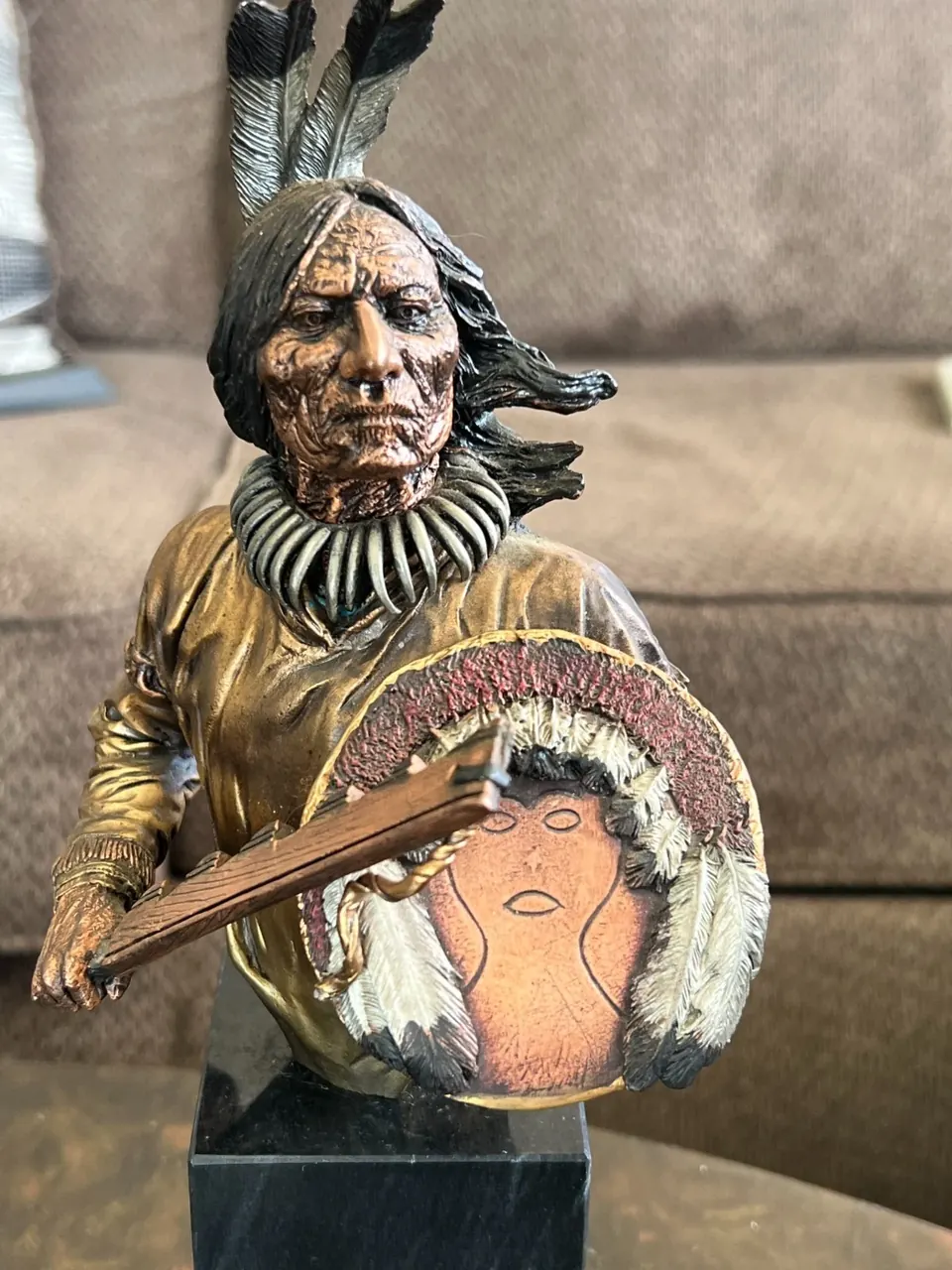
The shield is looking at you. Two oval eyes and a mouth sit in a figure that runs the height of it, with feathers fanned around the edge. The man holding it is stern, but the shield is the part I’d point to on a shelf. It turns out a photographer pointed his camera at it about ninety years before this copy of the sculpture was registered.
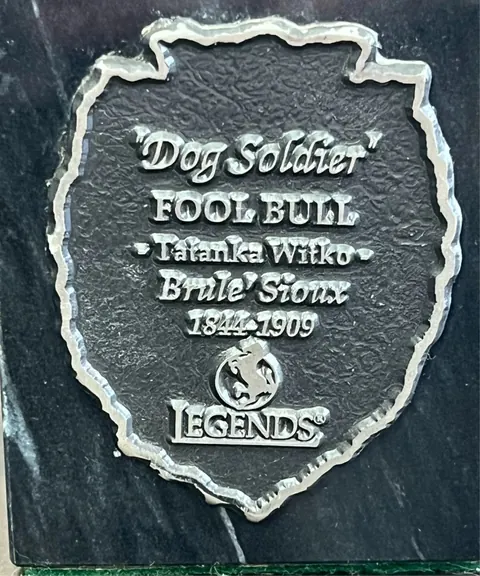
The name on the base
The plaque on the front of the stone base is shaped like a shield too. It gives the title as “Dog Soldier,” then a man’s name: Fool Bull, Tatanka Witko, Brulé Sioux, 1844–1909. Under that is the Legends horse and the company name. The plaque tells you who the sculpture shows. It doesn’t say who made it.
Fool Bull in 1900
The Library of Congress has a portrait of Fool Bull, made around 1900 and copyrighted by J. A. Anderson. The writing along the bottom of the print identifies the sitter as a medicine man and gives the negative number as 922. The History Nebraska archive holds Anderson’s glass negatives of the same sitting. It says the photograph was taken on the Rosebud Reservation, where Fool Bull lived in the Agency District, and describes him with two feathers in his hair, a shield with feathers in his left hand and a carved wooden stick in his right. Library of Congress portrait and History Nebraska record. The Amon Carter Museum of American Art also holds a print from negative 922.
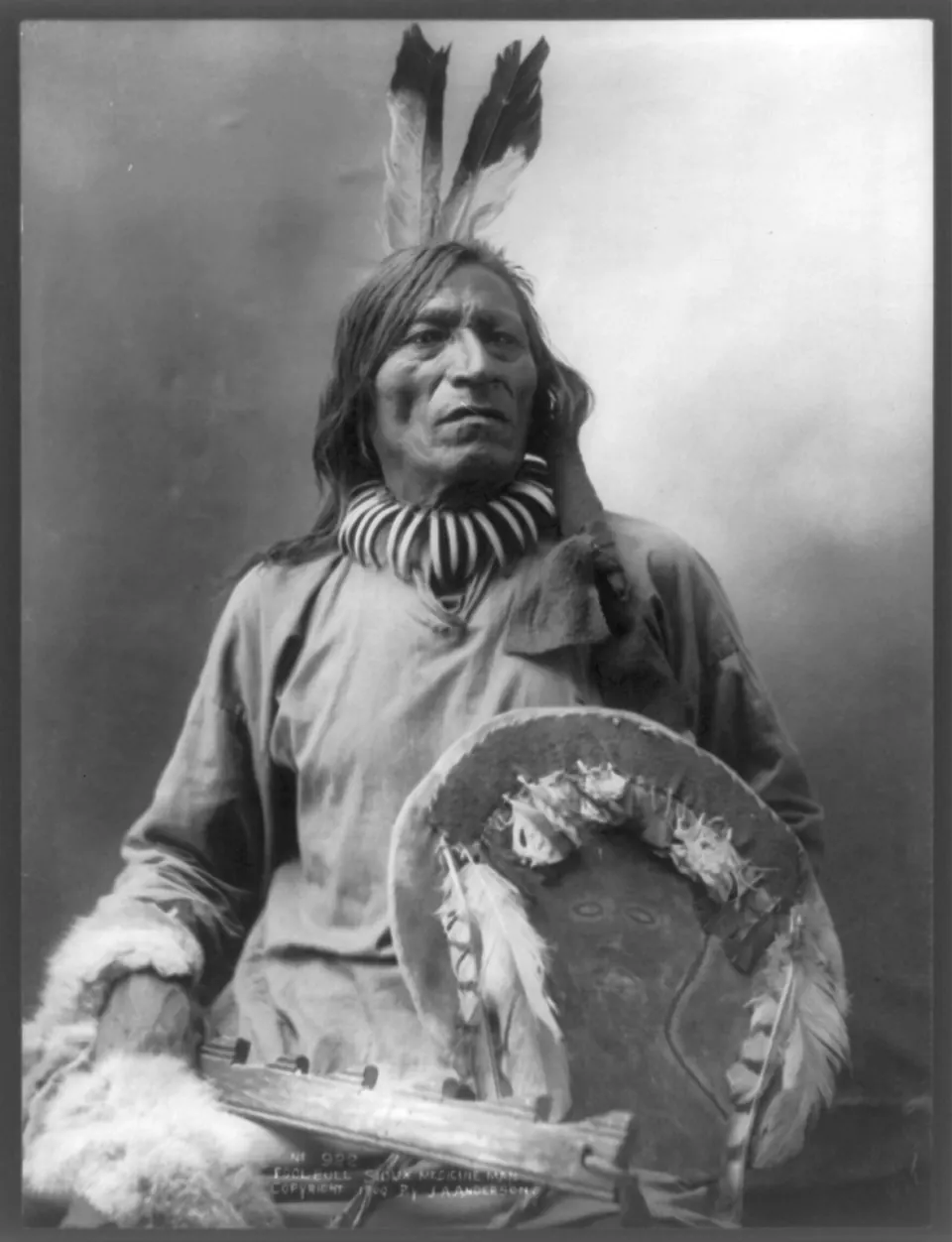
Put the two side by side and the pose looks familiar right down to the things Fool Bull was holding. The feathers lean the same way. The necklace sits at the same height. The stick has the same notches along its edge, and it crosses the shield at almost the same angle.
Zoom in on the shield
This is where the comparison gets interesting. In the photograph the figure on the shield is faint, and its outline is clearest down one side. The sculpture draws both sides, so the figure stands up straight in the middle of the shield. The loose plumes along the top of the real shield have become a neat ring of feathers. The border on the sculpture is painted a deep red. The photograph is black and white, so it can’t tell you what color the real one was. Whoever finished the sculpture had to decide.
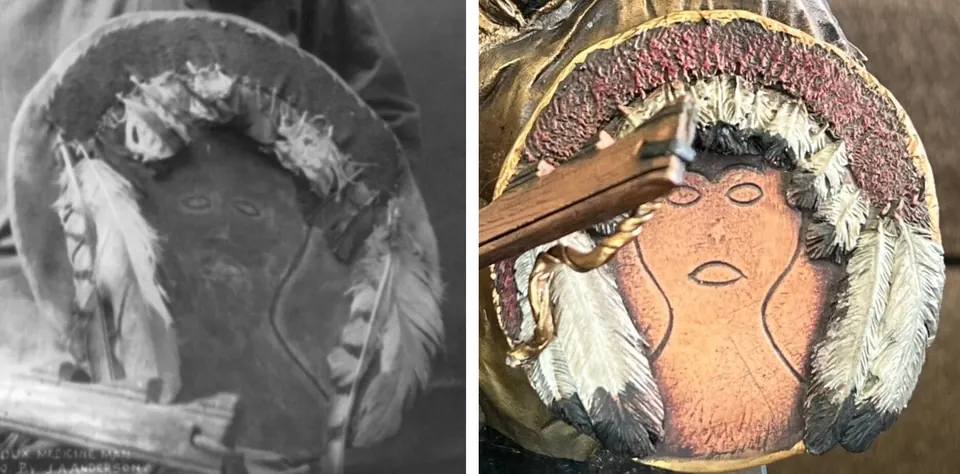
I thought the shield would explain the title. The smaller object turned out to be the clue. The South Dakota State Historical Society describes Fool Bull holding his painted buffalo-hide shield and a horse quirt associated with the Dog Soldier Society. A quirt is a short riding whip. Look for it crossing the shield in both images. South Dakota State Historical Society guide, page 34 (PDF)
What the certificate adds
The Legends certificate of ownership records the title, the number 19 of an edition of 950, and the date 10/19/92. It says a copy appears in the company’s registration records. It names the owner at registration, whose name I’ve blurred here, and the registrar who signed it. A gallery that carries the edition credits Willy Whitten, and a 2024 auction catalogue credits him for copy 89 of 950. I’d look for his name on the casting of this copy before filling in that line on its label. Gallery record for Dog Soldier and Lion and Unicorn auction catalogue, lot 52 (PDF)
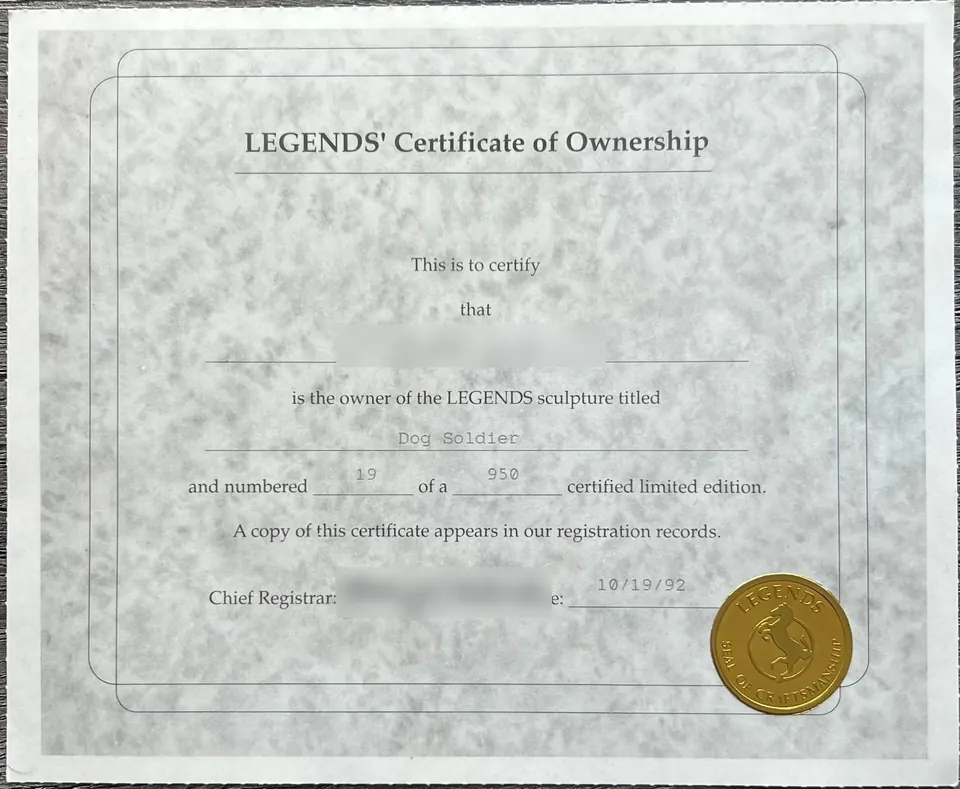
In What’s It Worth?, I’d scan the front of the sculpture with the plaque in the same set of photos, then add the certificate. In Dive Deeper I’d ask, Who sculpted this Legends piece, and what should I look for on the casting to find out? Then I’d go back to Anderson’s photograph and look at the shield again. Fool Bull is holding it so it faces the camera. Another old photograph worth zooming in on