
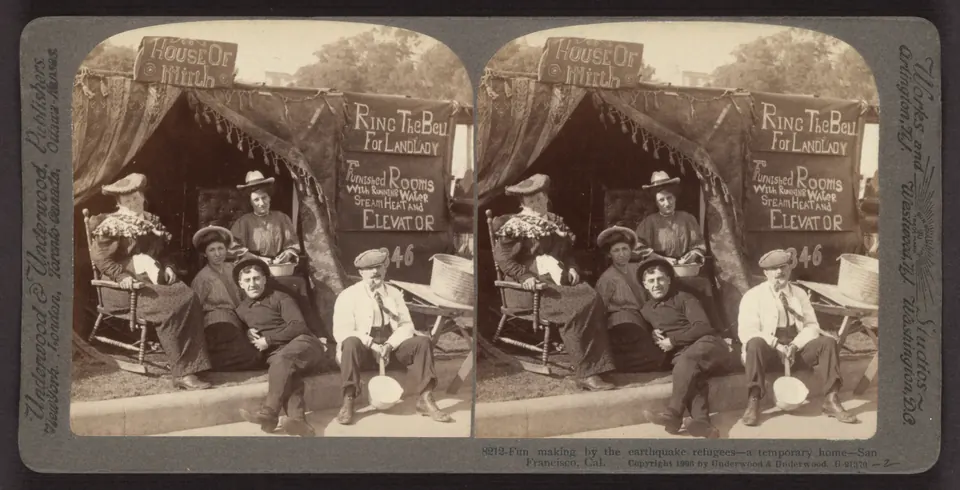
The sign says Elevator. It is painted in tall white letters on a dark cloth, under the words Furnished Rooms With Running Water, Steam Heat and, and it is hanging on the side of a tent. Above it, a second sign says Ring the Bell for Landlady. On top of the whole thing, propped up like a hotel's name over a front door, is a third: House of Mirth.
This is San Francisco in 1906, after the earthquake of April 18 and the fire that followed it. Five people are sitting out front. One woman has a rocking chair. One man has a saucepan. The caption printed on the card calls it Fun making by the earthquake refugees, and then, a little further along, a temporary home.
I went in for the elevator. I stayed because the photograph kept handing me more things to look at.
The Jokes on the Tent
Start with what the tent is made of. It is not canvas. The walls are draperies, the heavy patterned kind that hung in parlor doorways, and the fringe of tassels along the top edge is still on them. Behind the women there is a tufted upholstered chair. Somebody carried a parlor out of a ruined city and put it back together on the grass.
Then read the signs as a landlord’s advertisement, because that is what they are pretending to be. Furnished rooms: technically true. Running water: the man on the right has a saucepan and there is a washtub on the bench beside him, so the water ran as far as somebody carried it. Steam heat and an elevator: no. I looked for a bell for the landlady in both of the photographs in this story and could not find one.
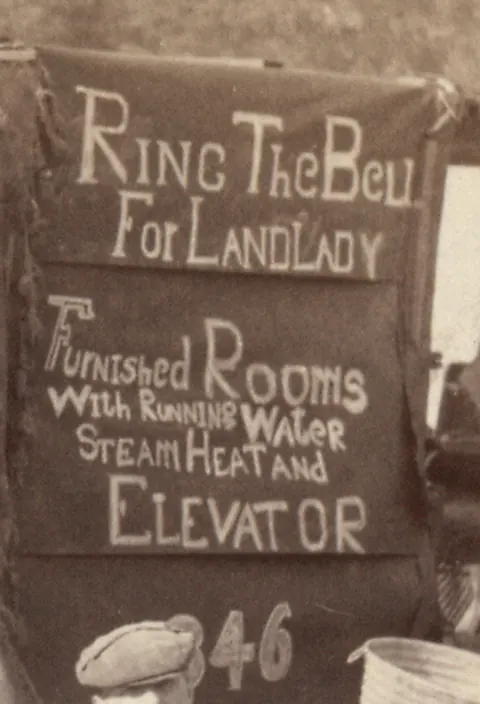
There is a number painted under the signs, too: 346. It could be a tent number, an old street number, or one more joke. I don’t know, and nothing I found says.
Two Pictures That Aren’t Quite the Same
The card carries two photographs side by side, and at first they look identical. They are not. A stereograph was made with a camera that had two lenses a short distance apart, roughly where your two eyes are. Put the card in a stereo viewer and each eye gets its own picture, and your brain does the rest: the people come forward and the tent falls back behind them.
You can catch the trick without a viewer. Look at the man in the cap on the right, and at the 346 painted on the tent behind his head.
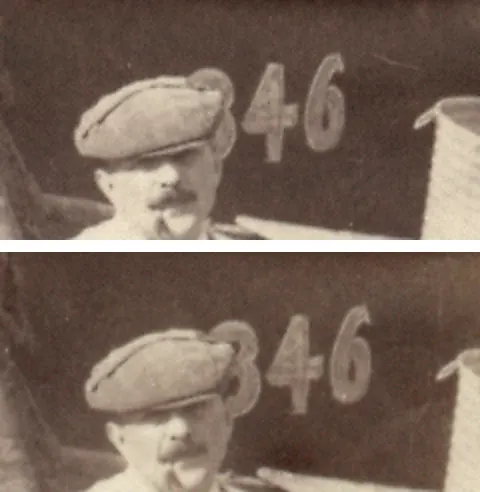
In the left-hand view his cap covers most of the 3. In the right-hand view more of the 3 peeks out beside it. He is in front of the tent wall, so the two lenses saw past him at slightly different angles. That small slide is the whole effect. Multiply it across every edge in the picture and a flat card turns into a front yard.
The Wider View
The Library of Congress has a second card of this scene. Its record carries the same copyright number as the first, H77336, and the same five people are in the same places: the hands, the hats and the saucepan all match. But this print is trimmed much more loosely, and it shows what the arched windows of the published card cut away.
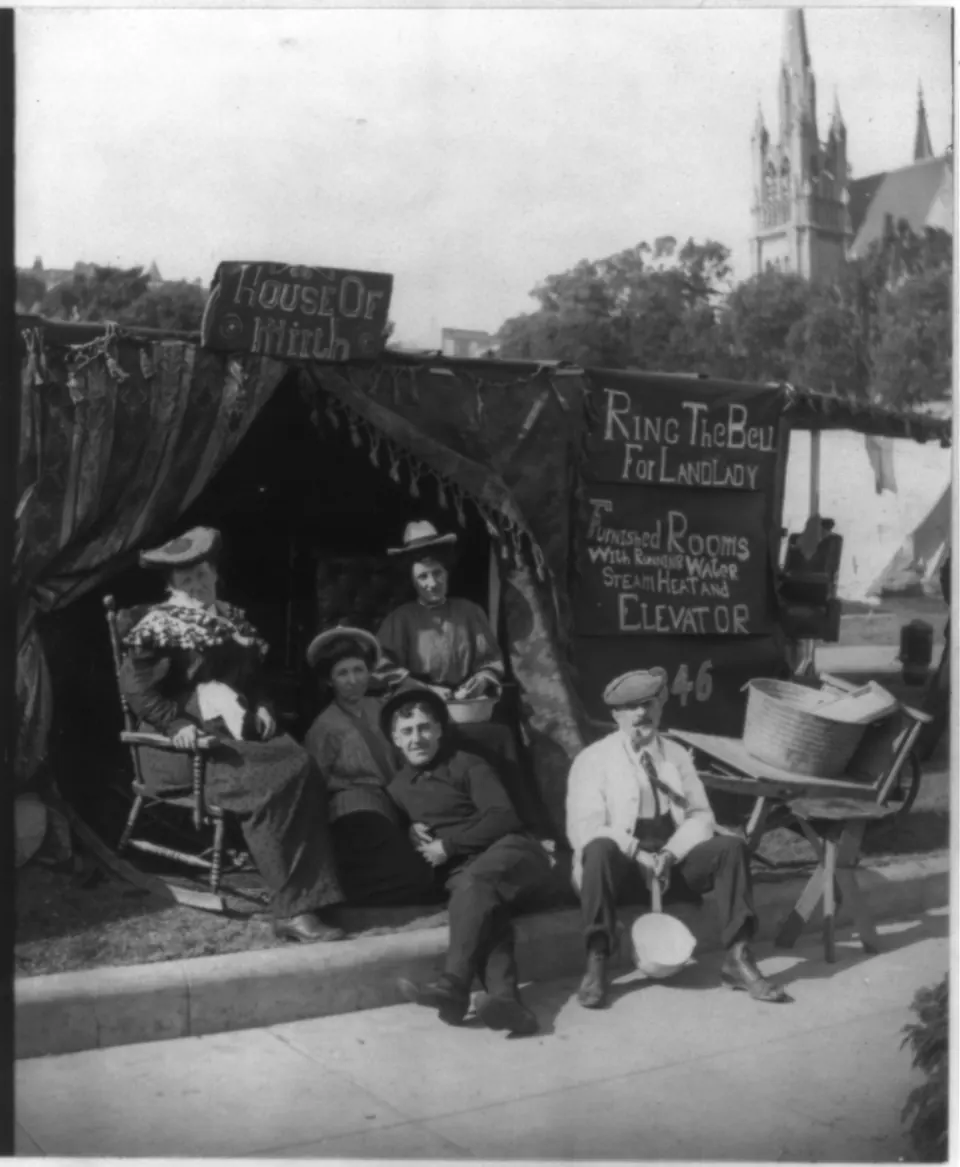
Above the trees on the right there is a church: a tall Gothic tower with pinnacles at its corners and a steep spire, and a smaller spire beyond it. Its shape matches St. Paulus Lutheran Church, which stood at 999 Eddy Street on the edge of Jefferson Square. That fits everything else I found. A Signal Corps photograph at the National Archives shows a refugee camp in “Jefferson Park” near Eddy and Gough Streets. And the Bancroft Library at Berkeley has a Miles Bros. photograph catalogued as House of Mirth restaurant (?) and Two Orphans barber shop. Refugee camp no. 16, Jefferson Square.
I like that question mark. The cataloguers weren’t sure the House of Mirth was a restaurant, and neither am I. With the bowl, the pans and the washtub, it was at least a kitchen.
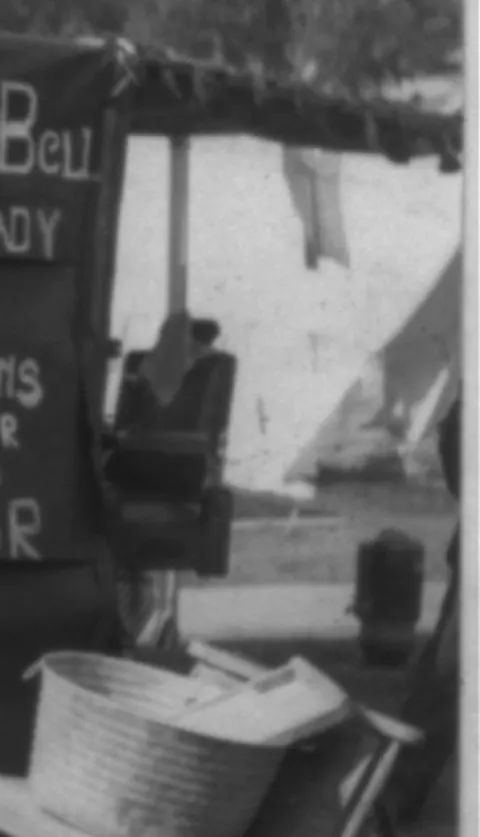
Now look at the right edge of the wider print. Next to the tent stands a high-backed padded chair with a headrest. It looks a lot like a barber’s chair, and the Bancroft caption puts a barber shop called Two Orphans right next door. Behind it is a plain white tent with none of the decorations. The National Park Service says the Army ran 21 of the city’s 26 official camps and laid the tents out in numbered streets. The House of Mirth is what one of those streets looked like after the people living in it had decorated.
The tent didn’t have to last. The city went on to build more than five thousand small wooden cottages for people still without homes, and tenants paid $2 a month toward a $50 price. The last camp closed in June 1908. St. Paulus lasted a good deal longer. It was still standing when this picture was taken, and it stood until a fire destroyed it in 1995.
Why “House of Mirth”?
Nobody in 1906 needed this explained. Edith Wharton’s novel The House of Mirth had been running in Scribner’s Magazine in 1905, and Scribner’s printed posters asking whether you were reading it. The book came out on October 14, 1905, and there were more than 140,000 copies in print by the end of that year.
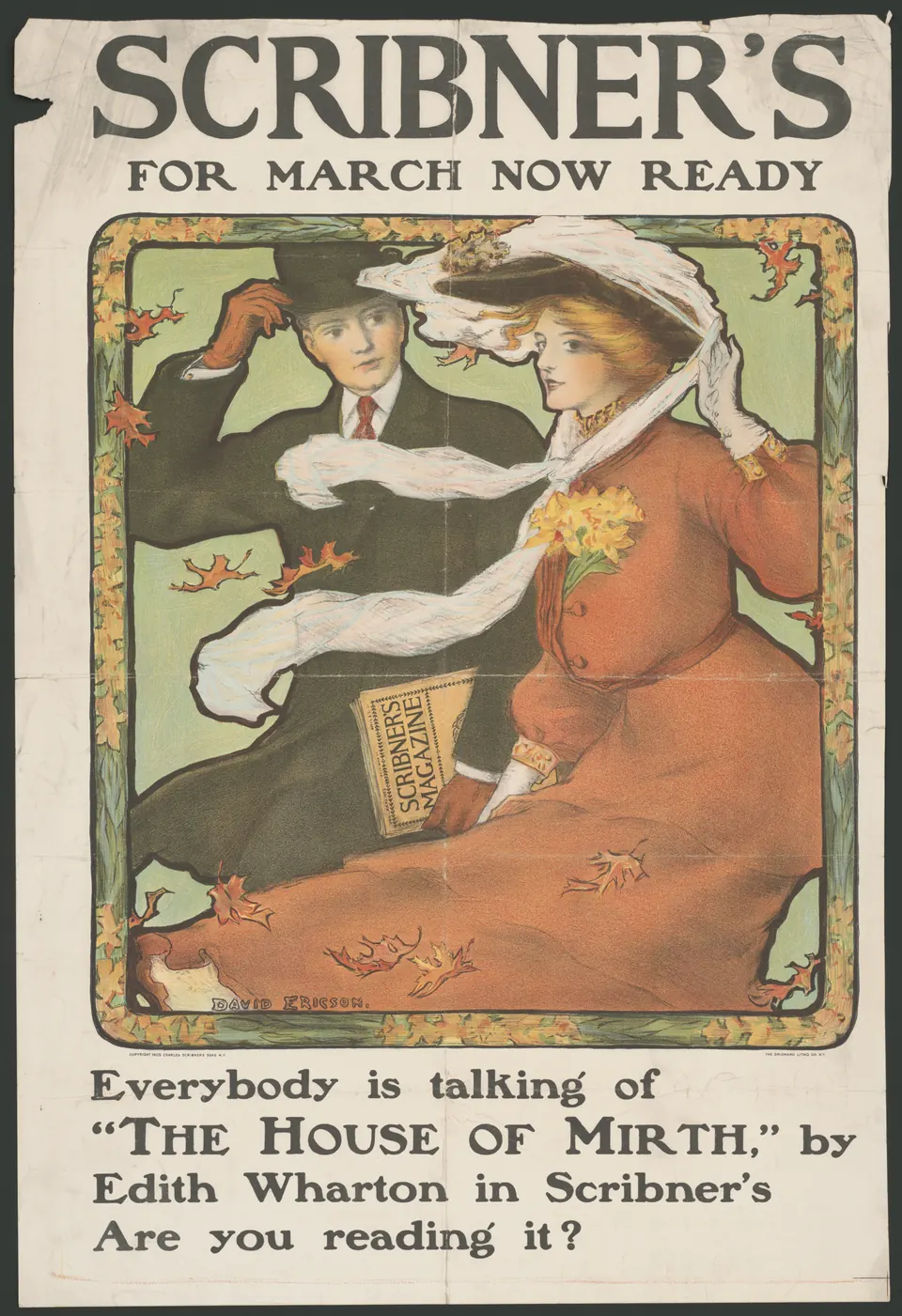
The title comes from Ecclesiastes: “The heart of the wise is in the house of mourning; but the heart of fools is in the house of mirth.” The novel follows Lily Bart, a woman from New York society who loses her money and her place and ends up living in a rented room in a boarding house.
So read the tent again. Refugees give their shelter the title of a bestseller about a woman who loses everything and ends up in a rented room. Then they hang out a sign offering furnished rooms. I wonder whether whoever painted it knew the book, the verse, or just the words that seemed to be everywhere that year. Any of the three would make it a good joke.
Reading a Card Like This
Stereograph cards turn up in boxes at estate sales by the dozen, and most of them carry more information than the picture does. This one prints its own number, 8212, and a caption along the bottom with “Copyright 1906 by Underwood & Underwood” and a second number, B-91370, that I couldn’t decode. Down the left edge it lists the firm as publishers in New York, London, Toronto and Ottawa, Kansas. That last one is where the brothers Elmer and Bert Underwood started the business in the early 1880s. Down the right edge are their works and studios in Arlington and Westwood, New Jersey, and Washington, D.C.
What the card doesn’t print is the name of whoever stood behind the camera. The Library of Congress record lists only the firm. I don’t know who took the picture, and I’d rather say so than guess.
Underwood & Underwood transferred its remaining stereograph stock and rights to the Keystone View Company between 1921 and 1923, so the same picture can turn up on a later card. If you have a card like this, scan the front in What’s It Worth?, with the printed caption and both edges in the frame. Ask in Dive Deeper who published the card, when the view was copyrighted, and what would distinguish an original issue from a later reprint. After that, do what I did. Look at the edges of the picture, then go and find out what’s past them. How to try it with a saved photo
Sources and Notes
- Object evidence: Underwood & Underwood, Fun making by the earthquake refugees – a temporary home, San Francisco, Cal., stereograph, copyright 1906 (Library of Congress, LC-DIG-ppmsca-09837): the signs, the card number 8212, the caption and copyright line, and the publisher’s imprints on both edges. The Library dates the copyright August 1, 1906, and records the copyright number H77336.
- San Francisco Earthquake and Fire: House of Mirth, stereograph, Library of Congress (LC-USZ62-56473): the wider print with the same copyright number. Its record dates it “c1906 May” from an old caption card that the Library marks as unverified.
- Bancroft Library, University of California, Berkeley, Miles Bros., Makeshift businesses: House of Mirth restaurant (?) and Two Orphans barber shop. Refugee camp no. 16, Jefferson Square, 1906.
- National Archives, H. D. Chadwick for the Signal Corps, Refugee camp in Jefferson Park, San Francisco in the vicinity of Eddy and Gough Streets, about 1906.
- The identification of the spire in the wider print comes from comparing its shape with photographs of St. Paulus Lutheran Church. OpenSFHistory also identifies the church in a contemporary camp panorama. OpenSFHistory panoramas, under Jefferson Square, 1906. The church’s address at 999 Eddy Street and the 1995 fire: Wikipedia, St. Paulus Lutheran Church.
- National Park Service, Presidio of San Francisco, “1906 Earthquake: Refugee Camps”: 21 of 26 official camps run by the Army, the numbered tent streets, the cottages at $2 a month toward $50, and the last camp closing in June 1908.
- University of Virginia, bestsellers database, The House of Mirth: publication on October 14, 1905, more than 140,000 copies by the end of the year, and the epigraph from Ecclesiastes. The poster is David Ericson’s Scribner’s for March, now ready, 1905, Library of Congress.
- The company’s founding and the transfer of its remaining stereo stock to Keystone between 1921 and 1923. Smithsonian Archives Center, Underwood & Underwood Glass Stereograph Collection (PDF)