
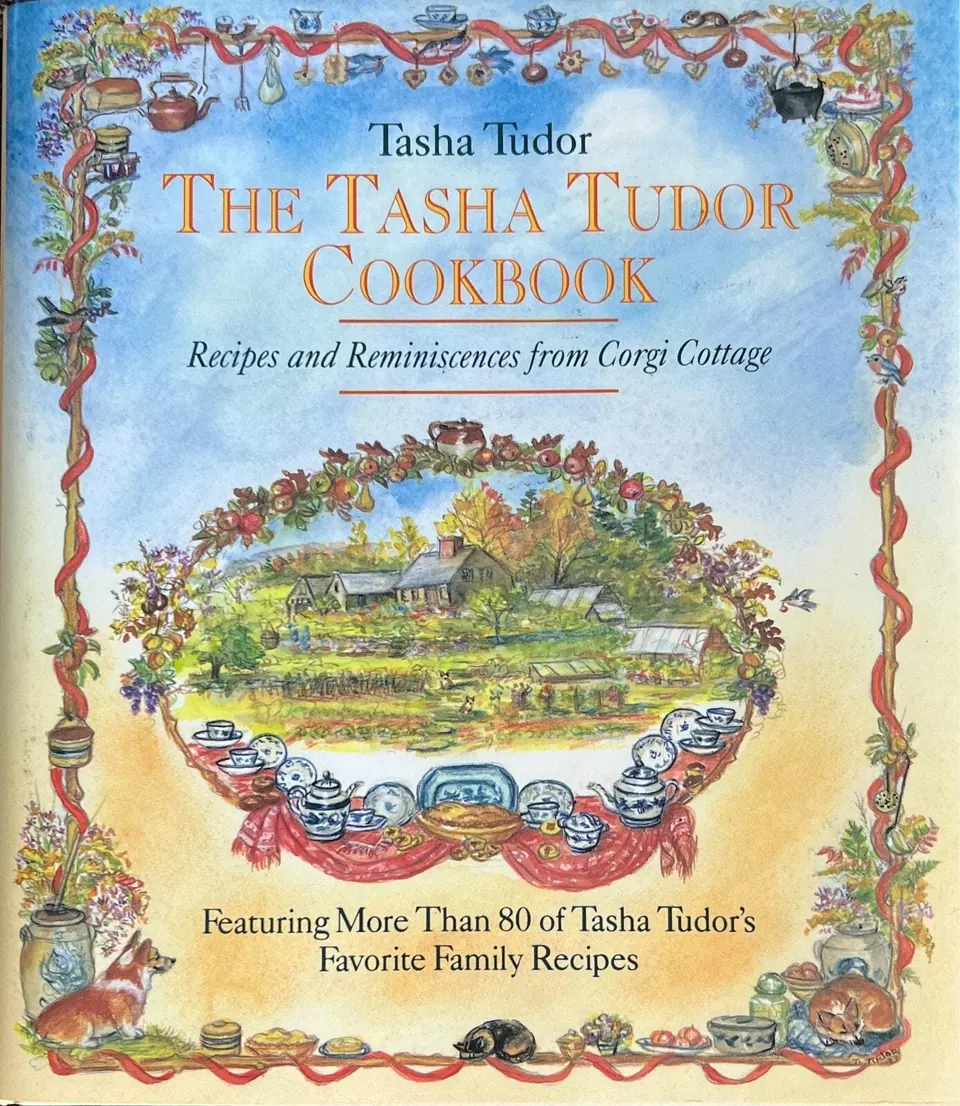
I picked up The Tasha Tudor Cookbook for the cover, which is the honest reason most people pick it up. A watercolor farmhouse sits inside a wreath of apples and pears. Blue-and-white teacups line up under it on a red cloth. A corgi lies in the bottom corner, a cat sleeps on the bottom edge, and somebody has hung a kettle, a loaf of bread and a string of cookies from the border as if the frame were a kitchen beam.
I expected recipes. I got a kitchen door.
Tudor wrote that she marked the first pitcher of iced tea each year on her kitchen door, where she kept all her important records. Births. Deaths. Marriages. Goat kids. Corgi litters. Arrivals and departures. First frost, first snow, the first birds of spring. And, once a year, iced tea.
I read that twice. Then I stopped thinking about the recipes for a while, because I wanted to know what kind of person puts iced tea on that list.
The Kitchen Door
Read the list again and notice what it is doing. Most of it is the stuff families have always written down: who was born, who married, who died. Then the farm walks in. Goat kids and corgi puppies get the same door as grandchildren. Then the weather walks in, first frost and first snow, the two dates that tell anyone who grows food how much time is left. Then the birds.
Then iced tea.
It looks like a joke at first, a small domestic thing sneaking into a list of big ones. It isn't. On a farm in the hills of southern Vermont, the first pitcher of iced tea is a weather report. It means the house has finally gotten warm enough to want something cold. It belongs next to first frost because it is first frost's opposite number. One date closes the season and the other one opens it.
She also said why it went on the door instead of in a notebook. Paper gets lost. The wall stays where it is. That is a very practical reason, and it tells you something about her: she wanted the record somewhere she would walk past it every day.
A person who keeps a list like that is not trying to be charming. She is paying attention to the year as if it were a relative.
The Receipt
She was proud of this tea. In a 1994 interview she called herself famous for her good cooking, "of which I am inordinately proud," and gave the credit to herbs. Her iced tea was one of the specialties, and she called the recipe a receipt, which is what recipes were called in American kitchens long before anyone thought the word needed updating.
It is not plain sweet tea. As the interview describes it, she started with loose English or Irish breakfast tea, then added freshly squeezed fruit juices, ginger ale, a sugar syrup and fresh spearmint. That is a party in a pitcher. The spearmint came from her garden, which she described as "a good messy garden" with no plan at all. "It just grows."
So the tea on the door was never only about weather. It was the day the garden, the kitchen and the season all agreed.
Ice, in the Family
Here is where the book stopped being a cookbook and became a rabbit hole.
Tasha Tudor was born Starling Burgess in Boston in 1915. Her father was the yacht designer W. Starling Burgess. Her mother was the portrait painter Rosamond Tudor, and Tasha later took her mother's family name. That family name has a story in it.
Her great-grandfather was Frederic Tudor, Boston's "Ice King."
In 1806 Frederic Tudor bought a brig called the Favorite and sent a cargo of New England pond ice to Martinique. The icehouse his agents were supposed to prepare was missing. The ice melted quickly, and he lost money. He kept going, building icehouses and finding buyers in warm places for something New England had lying around all winter.
The family archive says that as a child in Boston, Tasha learned about his business, especially his success in shipping ice to warmer places.
A Boston fortune was made by a stubborn man who believed people in hot places would pay to have something cold to drink. Well over a century later, his great-granddaughter, in a dark Vermont farmhouse with no television, writes down the date of the first cold drink of the year next to the births and deaths. I wonder if the thought ever crossed her mind.
The family went from shipping ice across the world to celebrating one pitcher of it. That feels like the right direction.
Corgi Cottage
The house on the cover is real, and in a sense it is the book's real subject.
By the early 1970s, Tudor had spent decades as a working illustrator. Her first book, Pumpkin Moonshine, came out in 1938. She won Caldecott Honors for Mother Goose in 1945 and for 1 Is One in 1957, and Corgiville Fair, the first of her books about a town of corgis, came out in 1971. Around then she decided to downsize and move to Vermont, where she had long wanted to live.
Her son Seth built the house. He modeled it on a 1740s Cape Cod-style house that belonged to a friend in New Hampshire, and the family archive says he used only hand tools. She wanted it dark inside, like the old houses she loved. "I love it dark."
Around it went the life the cookbook comes from. Goats instead of cows, because the farm sat higher than her old one. Corgis, sometimes up to a dozen at once, descended from a dog called Mr. B. who arrived from Britain in 1958. Chickens, geese, a cat. Bread from her own wheat. A root cellar and a woodpile filled when the garden said it was time. No television, ever. "I don't think progress is beautiful," she said, "so I'm really behind the times."
It would be easy to make that sound like a costume, and plenty of people have. The record reads more like work. She won a first prize at the Danbury Fair for her oatmeal bread in the 1930s. She wove, dyed wool, made dolls and put on marionette shows, and guests at the house often found themselves milking goats or weeding. She called the place her "Paradise on earth," and she died there on June 18, 2008, a little over two months short of 93.
The kitchen door makes more sense once you know the house. It is a calendar for a life that ran on seasons on purpose.
What You Actually Get from the Book
If you are deciding whether to keep a copy or buy one, here is the honest version.
The Tasha Tudor Cookbook: Recipes and Reminiscences from Corgi Cottage was published by Little, Brown in 1993, written and illustrated by Tudor with Carol Johnston Lueck. The cover promises more than 80 of her favorite family recipes, and the recipes excerpted alongside that 1994 interview give the flavor: Irish stew, soups, breads, pies, gingerbread, a summer chicken salad with her French dressing, slow-roasted leg of lamb with spearmint sauce. Her gingerbread cookies have their own small claim to fame, because the same cookies decorated the White House Christmas tree during the Johnson administration.
Her watercolors run through it, and the recipes come wrapped in stories about the people, animals and seasons they were cooked for. It is a year at Corgi Cottage that happens to tell you how much flour to use.
One warning for anyone shopping: it is not the same book as The Tasha Tudor Family Cookbook, published in 2016 by her grandson Winslow Tudor. Same house, same family, different book. Check the title and the date before you compare prices.
Which Tasha Tudor cookbook is this?
Having fallen into the story, I wanted the plain facts about this particular copy, which is where What's It Worth? earns its place. A Tudor cookbook is a common book in the sense that plenty were printed, and an uncommon one in the sense that people who love her work care a great deal about condition. The questions that move the answer are small and physical. Is this a first printing? Does it still have its dust jacket, and is the jacket clean? Has the spine faded? Has anyone written in it, and is that a family note or something more interesting?
Those are the details I would photograph: the copyright page, the jacket front and spine, and any inscription. A cookbook that lived in a kitchen will show it, and that is part of its story too. It just isn't part of the price in the direction you would hope.
I did not mark the date on my own door when I made the tea. I'm renting. I wrote it on the inside of the back cover instead, in pencil, small. Having just written a paragraph about condition, I am aware that is exactly the kind of thing that lowers the price. Worth it.
Sources and Notes
- Object evidence: the cover of a copy of The Tasha Tudor Cookbook (Little, Brown, 1993).
- Mother Earth Living, "Tasha Tudor" (Kathleen Halloran, 1994): the kitchen door records, the iced tea receipt and its ingredients, her garden, the gingerbread cookies on the Johnson White House tree, and her lines on cooking and progress.
- Tasha Tudor and Family, "Tasha's Corgi Cottage" and "Tasha's Life": Seth Tudor building the house by hand on a 1740s Cape model, "I love it dark," the corgis and goats, the Danbury Fair bread, Frederic Tudor as her great-grandfather, and her death at Corgi Cottage in 2008.
- American Library Association for the Caldecott Honors. Tasha Tudor and Family’s bibliography for the books.
- City of Boston, Tudor family history for Frederic Tudor’s voyages and the surviving notice for the Favorite.