
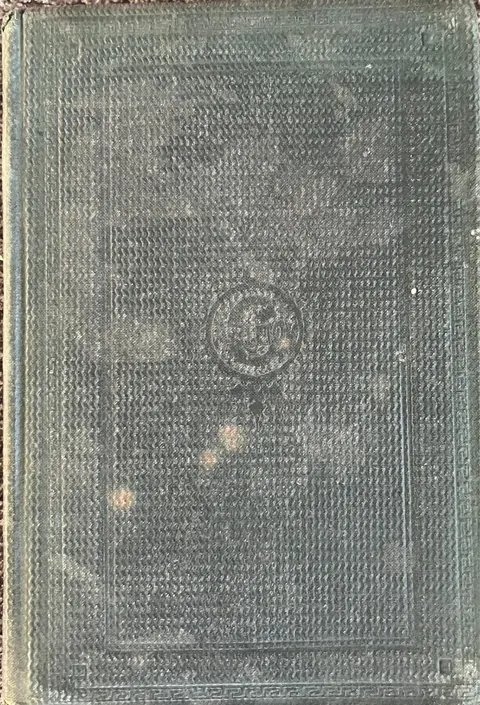
The cover tells you nothing. Dark cloth, a Greek key running round the edge, a blind-stamped medallion in the middle, and not one letter of type. You have to open it to find out that it is a book about who everybody in New York used to be.
Jon bought it because the title sounded like trouble.
He was right that it was trouble. He was wrong about whose.
The app said it did not know enough yet

What's It Worth? got the book on sight and then did the more useful thing:
A couple of details, it said, could change the answer significantly. So the conversation kept going, which is the only reason any of the rest of this exists. Somewhere in that back and forth it named the man behind Walter Barrett, Clerk, and once you have that name the book stops being a directory and starts being something closer to a confession.
Hold that. First you need to know what kind of book you are holding.
It is not a history. It is an appraisal.
Open it anywhere. Here is page 71, four pages before the passage that made Jon sit up.
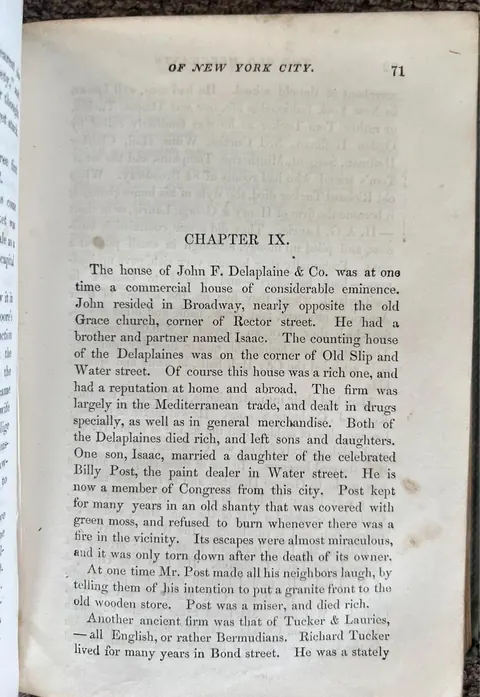
“Both of the Delaplaines died rich, and left sons and daughters.”
And a few lines down, about a paint dealer who kept his store in a moss-covered shanty and joked about giving it a granite front: “Post was a miser, and died rich.”
That is the book's grammar. A man gets a paragraph, sometimes a page, and then a verdict. The verdict is a number, or the absence of one.
Run the digitised First Series through a word count and the obsession is not subtle. Money appears about 116 times. Rich 98. Worth 79. Dollars 67. Poor 55. The word died turns up roughly 237 times in one volume, and it is very often followed immediately by the score.
Nobody in 1862 called this an appraisal. But that is what it is. A five-hundred-page book in which several hundred men are identified, described, and then assigned a final figure. The subject is not commerce. The subject is what each man turned out to be worth at the end.
Which is a strange thing to find yourself reading on a phone that was, forty seconds earlier, being asked what the book is worth.
Page 75, and what he thinks is the funny part
This is the passage Jon photographed, and it is the best short answer to what kind of book is this.
Granville Sharp Oldfield ran a commercial house at Broad and Garden streets. Good dinners, good company, every visiting Englishman of note. He was, Scoville says, a real merchant. Then comes the sentence that detonates the next page and a half:
What follows in the book is an explanation of that habit, and it is ugly. Scoville writes that Bernard “was a Dutch Jew, and did not believe there was a virtuous Christian woman in the United States.” That is not a slip of period vocabulary. It is a man offering a person's religion and ethnicity as the cause of his sexual behaviour, in print, without any sense that a reader might object. It is in Jon's copy and I am not going to quietly leave it out, because the temperature of this book is part of what the book is.
Then the story itself, which is pure theatre. The Woods are singing at the old Park Theatre. The opera is La Sonnambula. Mrs. Wood is midway through “False one, I love thee still” when the house hears a thump and then a shriek.
Bernard has been sitting behind a lady and her husband, doing what he does. She whispers. The husband turns, identifies the offender, and waits. Bernard does it again. The husband stands up and puts his fist through the man's gold spectacles, driving the glass into his eyeball.
And then Scoville, in the same flat tone he uses for shipping tonnage:
The firm dissolves. Oldfield moves to Baltimore and rebuilds a large fortune. His only son has his arm shot off and dies. Oldfield himself ends up an inmate of the Baltimore Lunatic Asylum, “and yet signs mad checks for the expense!”
That exclamation mark is the whole man. A family has been destroyed inside two paragraphs, and the detail Scoville finds worth an exclamation mark is that the lunatic is still solvent enough to pay his own asylum bill.
Then he moves straight on to the other Oldfield brother, Tom, who was adored by every actor in New York and could not be got to work before two in the afternoon, because he did not breakfast until one, because he did not rise until past twelve, because he did not go to bed until daylight. Tom caught smallpox and died in the hospital on Staten Island.
Six lives, ruined or ended, in about four hundred words, told the way you would tell it across a table. This is not what a reference book sounds like. It is what a man sounds like.
The man
Walter Barrett, Clerk, did not exist.
The author was Joseph Alfred Scoville, 1815 to 1864, a New York journalist who had once been a merchant and who had been, before that, private secretary to John C. Calhoun. He was at Calhoun's side through the last years of the great sectional fight, and he was writing this book in the middle of the war that fight produced.
You can feel the politics in the text if you look. Of a merchant who helped fund the abolitionists, Scoville writes that the man “sowed the abolition seed that has produced the overshadowing oaks of 1862 — secession, dissolution, anarchy, bloodshed.” In 1862 a New York author is putting the Civil War at the feet of the people who opposed slavery. It is right there in the middle of a chapter about the leather trade.
But the politics are not the surprise. The surprise is in Chapter XVI.
He is in his own book
Fifty-odd pages later, Scoville starts describing a firm called Scoville & Britton, set up in 1838 and bankrolled by a Paris financier who wanted two nephews established in business.
“The senior partner was Joseph A. Scoville, who had been regularly educated in a counting-house.”
Third person. The book says I constantly, hundreds of times, and here it says Mr. Scoville. The man writing under a false name has walked into his own history under his real one and introduced himself as somebody else.
And what he has come to tell you is how he lost everything.
The firm was good. Bankers in London and Paris, a bondsman at the Custom House, business pouring in from every quarter. They got hold of the papers of the American envoy who had made the treaties with Muscat and Siam, and opened a trade with Zanzibar. They built a barque for it and named her the Archibald Gracie, after the old merchant who had trained Scoville as a boy.
Then, in his own words: “Misfortunes never come single.”
- The ship William Brown struck an iceberg on the run from Liverpool and sank in half an hour, with many passengers. “Scoville & Britton never received a dollar of insurance.”
- The Virginia was lost on the bar at Galveston. “In a week more she would have had a freight of $13,000 to Liverpool!”
- The brig Wyoming was seized off the Cape Verde islands by a British warship on what he calls the frivolous charge of being suspected of fitting out for the slave trade.
- And the Archibald Gracie was on the wrong side of the Cape of Good Hope with $250,000 aboard at the exact moment the money was needed at home.
She came in at last, loaded and valuable. Scoville gives it four words.
The house had already suspended. Then, with the firm dead, the Sultan of Muscat's own ship arrived in New York consigned to them, the first real fruit of years of work, “and of course, this first fruit of their energy and enterprize was reaped by others.” The forced sale of the barque named after the man who raised him finished it. “Not long after Mr. Scoville went to Holland.”
The line he left blank
Here is where the book gives itself away.
Scoville does what he always does, and accounts for everyone. The special partner, Sargent: “was wealthy.” The junior partner, Britton, went back into business, married well, built a hotel in Albany, “became wealthy,” and now owns the Everett House. Their children are named and their ages given.
And then the senior partner. Joseph A. Scoville. He married a Miss Caroline Schaub of South Carolina. He has one child, a daughter, Mary. He was private secretary to John C. Calhoun until the great statesman died in 1850. He once owned a paper called the Pick.
A wife. A daughter. Two jobs.
No number.
In a book that assigns a figure to several hundred men, and that will tell you without being asked that a paint dealer died rich and a grocer died not worth a copper, the author is the one man who gets no valuation at all. He appraises the entire commercial class of a city and leaves his own line empty.
And he is in the index. Turn to the back of Jon's copy and there it is between Scott and Scraley, in the same type as everybody else: Scoville, Joseph A. 128, 129, 131. He filed himself under S.
Woe to the great merchant who comes down
Two hundred pages on, the tone breaks.
He has been describing a merchant named Root, ruined when cotton collapsed under him, a man who once moved thousands and now, Scoville writes, “has hard work to negotiate weekly $1 50 to pay for humble lodgings, somewhere in the Bowery.” He passes along the streets unrecognised by the rich men of the present, and forgotten by most of the people who admired him when he had money.
Then the gossip columnist stops and something else starts talking.
And then, in the middle of a book of anecdotes about other people's money, he starts campaigning.
There should be a home founded for the broken-down merchants of New York, he writes. Old sea captains have Sailor's Snug Harbor. The merchant who has failed has nowhere to go but the poor house. Frequently the most deserving and the most honest are the most unfortunate. Any prosperous young merchant could spare five thousand dollars for such an institution, and in all human probability will one day be glad to get inside its doors himself.
Then eight words that are the truest thing in the volume.
He is not observing that. He is reporting it. The man asking New York to build a shelter for ruined merchants had his own house go down twenty years earlier and never got it back.
The verse he stopped at
Which brings us back to the front of the book, and to the thing I did not expect to find on a title page.
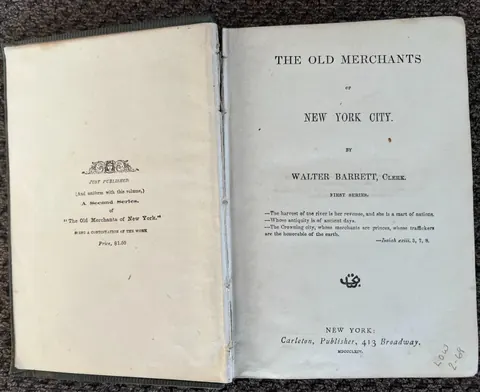
Under the author's name, Scoville set an epigraph. Three lines, credited to Isaiah xxiii. 3, 7, 8.
—Whose antiquity is of ancient days.
—The Crowning city, whose merchants are princes, whose traffickers are the honorable of the earth.
Read on its own it is a compliment. A great trading city, ancient and rich, whose merchants are princes. Exactly the flag you would want flying over a book like this.
Isaiah 23 is the oracle against Tyre.
It is a prophecy of the destruction of a merchant city. It opens the burden of Tyre, howl ye ships of Tarshish, for it is laid waste, and it ends with the harbour ruined and the trade gone. And the verse Scoville quotes last is not a statement at all. In the King James it is a question:
Scoville lops off the first half, which asks who is coming to destroy the place, and prints the second half, which flatters it.
And then he stops. Because the next verse is the answer to the question.
One verse further and the epigraph on this book says that the merchant princes are going to be humiliated on purpose. He stopped one line short of it.
I do not know whether that was deliberate, and I am not going to pretend I can settle it from a photograph of a title page. There is a perfectly ordinary explanation: a man hunting for a grand-sounding text about merchant princes found one, took the flattering clauses, and never read to the end of the paragraph. That happens constantly and it would be its own kind of perfect.
But the other reading is available, and it is hard to put down once you have seen the rest of the book. A ruined merchant, writing under a false name, opens his history of the richest men in America with a prophecy about a trading city being brought into contempt, and cuts it off exactly where the judgment begins. It is the same instinct as leaving his own number out. He knows what the last line says. He just does not print it.
The ship I could not settle
One loose thread, left loose on purpose.
Scoville says his ship the William Brown struck an iceberg on a voyage from Liverpool and sank in half an hour with many passengers aboard, and that the firm never saw a dollar of insurance.
There is a famous ship of that exact description. The William Brown left Liverpool in March 1841 carrying mostly poor Irish and Scottish emigrants, struck an iceberg southeast of Newfoundland on the night of 19 April and went down. Thirty-one people died with her. What happened next is the reason the name survives: the overloaded longboat began taking water, and the crew threw roughly sixteen passengers into the sea. One sailor, Alexander Holmes, was tried in Philadelphia and convicted of manslaughter, and United States v. Holmes is still taught to law students as the case about who may be sacrificed to save a boat.
That ship was bound for Philadelphia. Scoville says New York. I have not been able to establish who owned her, and I am not going to assert that the author's lost vessel and the most notorious lifeboat in American law are the same hull, because I cannot show it.
What I can say is that he gives it one clause. Whatever ship it was, people drowned in it, and the sentence he builds around them ends with the insurance.
So what is it worth?
The book itself is a modest object and the market is thin. Carleton kept these in print and the series ran to five volumes by 1870, so First Series copies turn up, usually rubbed at the corners like this one, usually under a hundred dollars unless the set is complete and clean. The pencilled bookseller's code still sitting in the lower corner of the title page suggests somebody once priced it without much ceremony either.
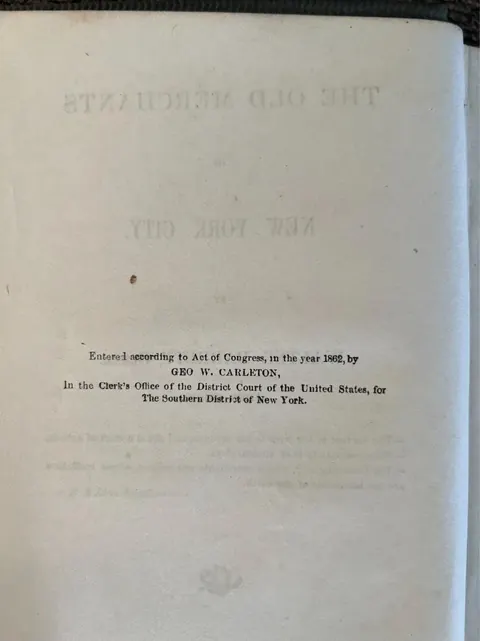
There is one small wrinkle worth stating plainly rather than hiding. The copyright page in Jon's copy reads 1862. The title page reads MDCCCLXIV, which is 1864. Both are correct and neither is a problem: the work was entered for copyright by George W. Carleton in 1862 and this particular printing went out two years later. The app initially read 1864 off the title page and the copyright page says otherwise, and the honest answer is that they are describing different events.
So: a common-ish book, in honest condition, worth somewhere in the range of a nice dinner.
That is the number. It is not the answer.
What the appraisal came back with
Joseph Alfred Scoville died in 1864, the year printed on this title page. He was forty-eight or forty-nine. The series he had started as throwaway newspaper columns went on without him and reached five volumes by 1870, and it is still cited, because for a lot of these men and these addresses it is the only account anybody wrote down.
Which means the gossip won. A man who admitted in his own preface that the work “cannot, necessarily, be entirely free from inaccuracies” is now, for certain corners of old New York, the source. The barroom voice outlasted the respectable ones because the respectable ones did not bother to write any of it down.
And the joke he did not live to hear is this. Everyone in the book is scored. Delaplaine died rich. Post died rich. Somebody else died not worth a copper. The man holding the pen recorded all of it, assigned the figures, filed himself in the index under S, and left his own column empty.
A hundred and sixty-odd years later a stranger in Michigan picked the book up because the title sounded like trouble, pointed a phone at it, and asked what it was worth.
The app answered about the book. It did not know it was finishing a sentence.
He wrote that no merchant is beyond the reach of poverty, and that it has long arms. He was not warning the reader. He already knew the length of them.