
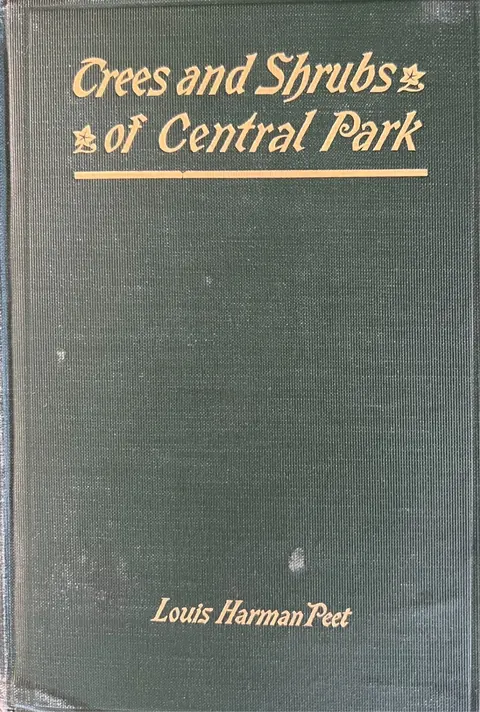
The book looked almost too harmless.
Small, green, old, a little rubbed at the edges. Trees and Shrubs of Central Park, by Louis Harman Peet, 1903. It had the polite air of a book that wanted to be useful and then quietly return to a shelf. Jon had paid forty dollars for it, which is just enough money to make you hope you did not buy a decorative rectangle by accident.
So I opened What's It Worth? and scanned it.
The app did the practical thing first. It identified the book as Peet's 1903 first and only edition, put the working value around $90, called reliable resale roughly $60 to $120, and warned that pricing confidence was low. Fair enough. A narrow local-history book with maps and photographs is collectible, but it is not a gold bar with bark descriptions.
Then the object refused to stay in the money lane.
I asked whether the maps could help reconstruct old Central Park, and that was when the book began changing shape. It was no longer only an antique field guide. It was a way to walk into the Park as it existed in 1903, when the Great Lawn was still a reservoir, when Peet could point to individual trees by map number, and when a visitor was expected to stand at a fork in the path, look for a lamp-post, and find a living thing.
The original question was: what is this worth?
The better question turned out to be: what does this book know that the Park has forgotten?
The Book Is A Walking Machine
Peet explains the whole problem in the preface, and it is more modern than it has any right to be.
He is writing for the "non-technical city nature lover." He says it is exasperating to walk the Park paths, see handsome trees and shrubs, and not know what they are. The point of the book is not scholarship for its own sake. It is relief. Name the thing in front of you and the walk becomes larger.
That is a very familiar itch. You see an object, a mark, a tree, a little green book, and the mind snags on it. For a few seconds the world has a handle. Then, if nobody helps, the moment goes away.
Peet's solution was a 363-page machine made of maps, numbered specimens, photographs and walking directions. He does not simply list species. He tells you where to stand. He gives you forks, statues, arches, lamp-posts, walls, bridges, drive crossings, shelters and bends in the path. Then he says, in effect: there. Look.
He also admits the limit. He cannot map every tree and shrub. That would only produce a mass of black spots. So he marks representative specimens and asks the rambler to work from those, checking the text against the world.
This is not a nature book that wants to replace the walk. It wants to make the walk possible.
The Map Starts Misbehaving
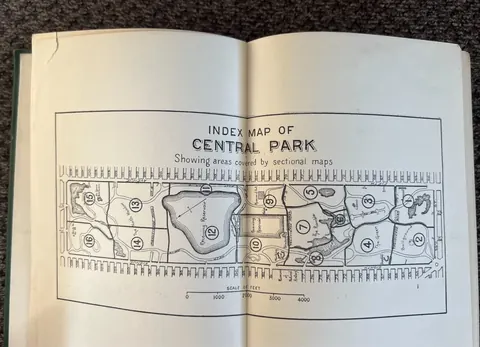
The first temptation was to use the guide like a ghost tour: walk Central Park today with Peet in hand and see which trees survived.
That is still tempting. It may even be possible in a few places. Central Park has old trees. It has American elms on the Mall that still form one of the most famous tree canopies in New York, even after Dutch elm disease made that kind of stand rare. It has individual veterans that modern Parks and Conservancy material treat almost as civic elders.
But the book kept pushing me toward a stranger question. Not only which trees survived. Which version of the Park survived?
Peet's sectional map looks familiar until it does not. Some places still answer to the same names: the Pond, the Mall, the Terrace, the Ramble, Harlem Meer. Other parts make the modern map wobble. He is walking around a Park where the old Receiving Reservoir still occupies what most visitors now think of as one of Central Park's great open democratic spaces.
The modern Great Lawn was not there for him.
The Central Park Conservancy explains the blunt fact: the Great Lawn replaced a large reservoir in the 1930s. The older Receiving Reservoir stood between 79th and 86th Streets and held up to 180 million gallons of water. It pre-dated the Park. It was a fort-like piece of city infrastructure that Olmsted and Vaux had to design around, not a pastoral meadow waiting politely to be discovered.
So when I tried to imagine walking Peet's route through the modern Park, the ground itself started arguing. A person can sit today on the Great Lawn and believe he is having an old Central Park experience. In one sense he is. In another, he is picnicking on top of a vanished tank.
That is the first real discovery the book gives you: Central Park is not old because it stayed still. It is old because it has been rewritten so many times that the rewrites have begun to feel natural.
The Yellowwood Becomes A Suspect
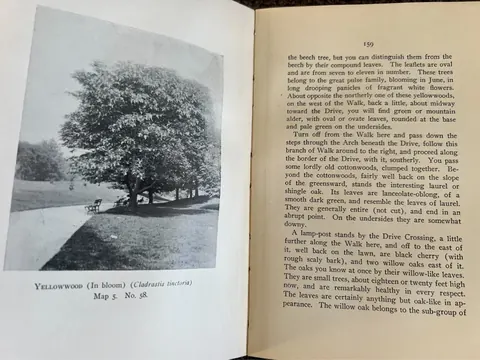
The yellowwood spread is the place where the book stopped being abstract.
On the left is a photograph: a yellowwood in bloom, labeled Cladrastis tinctoria, Map 5, No. 58. On the right, Peet places it south of the Boat House, in a border bed, side by side with another yellowwood. He gives the bark, the compound leaves, the June flowers, then moves the walker onward: turn off here, pass down the steps, go through the arch beneath the Drive.
That is not just identification. That is a little spell of location.
So I went looking. The Central Park Conservancy's current plant guide says there are fewer than a dozen American yellowwoods in the Park. That does not prove Peet's two trees survived. It does something more irritating. It makes survival plausible enough to want proof and uncertain enough to deny you the comfort of having it.
Could one of Peet's yellowwoods still be alive? Maybe. Yellowwoods can live long enough for the question to be worth asking. The modern guide confirms the species is still there. The old book gives a map number and a setting. But without current arborist records or a field check tied to Peet's exact Map 5, No. 58, I cannot responsibly point at a present tree and say: this is the one.
That failure is not dead space. It is the Story doing its job.
The book turns one tree into a suspect. Suddenly a species page is not enough. A map is not enough. A photograph is not enough. You want the trunk, the current location, the planting record, the scar tissue, the age estimate, the person at the Conservancy who knows where the old bodies are buried, arboreally speaking.
A normal book about trees tells you that yellowwood blooms in June. Peet's book makes you wonder whether a particular tree has been standing there through the draining of a reservoir, the building of a lawn, Dutch elm disease, hurricanes, restorations, concerts, runners, tourists, dogs, weddings, phones, and millions of people not knowing its name.
That is a better kind of uncertainty than a solved fact would have been.
The Mall Was Already A Church
Peet is not a dry guide. He cannot get through the Mall without turning it into a cathedral.
He calls the four rows of elms a vast open-air sanctuary. The effect, he says, depends on elms: their lift, their arch, their perspective, their capacity to make a public walkway feel like architecture built by leaves. The prose gets purple because the place makes him purple. I am not sure I blame him.
The important part is that the Mall is one of the places where the then-and-now question does not collapse into loss. The Mall still does the thing Peet says it does. Modern visitors may not use his vocabulary, and most of them probably do not pause to identify elm species between selfies, but the long green vault is still there.
That does not mean it simply survived by accident. Living things do not remain picturesque for 120 years by being admired. They are pruned, monitored, protected, replaced, rescued, defended against disease, and occasionally lost. The famous continuity is made out of constant intervention.
This is where Central Park starts getting less natural and more interesting.
The Park is full of imported species, designed views, engineered water, curated woodlands, restored lawns and planted effects that later generations experience as nature. Peet knew that already. He spends much of the book helping the non-technical rambler distinguish native trees from foreign ones. He is not scandalized by that mixture. He is excited by it. Central Park, to him, is not less wonderful because it has been composed. It is wonderful because attention can learn the composition.
The mistake is thinking designed nature is fake nature. It is not fake. It is negotiated nature. The trees are real. The shade is real. The roots are real. The decisions are also real.
The Tree Already Holding Its Own
One of the oddest entries sits near the Mall.
Peet points out an English oak planted by the Prince of Wales, later Edward VII. The tree, he says, has had every care, but for some reason is not doing especially well. It is "just about holding its own."
That little sentence is better than a plaque.
A ceremonial tree is supposed to carry a clean public meaning: prince visits, tree planted, friendship symbolized, history rooted. But Peet catches the less obedient version. The symbolic oak is alive, famous, cared for, and still struggling. It is an international gesture with a horticultural problem.
A 1902 newspaper item was already treating the same tree as news, calling it King Edward's Oak and noting the special attention paid to preserving it. By the time Peet's book appeared, the oak was not merely part of the landscape. It was a patient with a reputation.
I do not know when that tree finally disappeared, or whether any trace of its exact spot remains meaningful to anyone walking there now. That is another thread for a future hunt. But the entry changed how I read the rest of the book. Peet is not only preserving what is glorious. He is preserving what is uncertain while it is still unresolved.
Some trees are monuments. Some trees are evidence. Some trees are failing arguments.
What The Park Lets You Forget
The deeper I got into the book, the more the object began to feel like an antidote to the way people usually experience famous places.
Fame makes a place smooth. Central Park becomes a single thing: the Park. Green rectangle, carriage rides, runners, Bethesda Terrace, the Mall, the Ramble, the Great Lawn, movie scenes, skyline, benches, squirrels, hot dogs, romance, crime-show establishing shot.
Peet makes it rough again.
He does not let the Park remain a green idea. He breaks it into particular things: a sycamore maple by a fork, a yellowwood near the Boat House, a white pine near a lamp, a struggling oak, a shrub whose winter berries matter, a beech whose bark can be confused with yellowwood if you are careless. He keeps forcing the grand famous place back down into local attention.
That may be why the book still works. Not because all of its mapped specimens survive. They do not. Not because its taxonomy is the last word. It is not. Not because the Park is unchanged. It absolutely is not.
It works because it teaches a posture: walk slower, name what you can, suspect that the thing underfoot has a history, and do not assume the present arrangement is the original one just because it looks settled.
That is not a defect. It is the condition of the place. Central Park is a living landscape pretending, very successfully, to be inevitable.
What The App Was Actually Good For
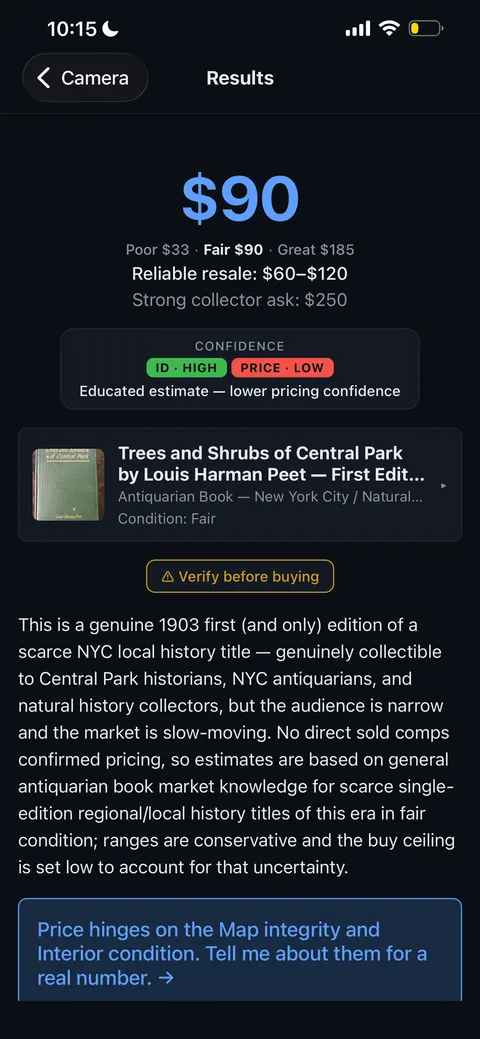
The app did not discover Central Park. That would be a deranged claim, and Central Park has enough people making confident claims about it already.
What WIW did was more useful and less grand. It slowed the object down. It identified the edition, separated a plausible resale number from an ambitious collector ask, noticed that map and interior condition mattered, and then made it natural to ask a second question.
That is the hinge. Without the scan, this could have remained a $40 green book with a nice title and a vague local-history smell. With the scan, the first answer created handles: first edition, maps, photographs, Central Park, low price confidence, narrow market. One of those handles was the map. Pull that one and the object opens into a walk.
The money still matters. WIW's $90 estimate and $60 to $120 reliable resale range feel reasonable for a scarce but specialized book in fair condition, especially with no clean run of sold comps. A seller can ask $250 or $350 for a nice copy. Asking is not selling. Rare-book pricing is patience, condition, audience and the luck of finding the person whose private obsession happens to match your shelf.
Jon paid $40. On paper, that looks fine. Not retirement. Not disaster. The conservative answer is that he likely bought it well if the maps and interior are complete and the condition holds up.
But this is the kind of object where the resale price feels almost rude as the final word. The book's better trick is not that it can be sold. It is that it can make a place millions of people think they know become uncertain again.
The Walk It Leaves Behind
I started with the simple fantasy: walk Central Park today with a 1903 guide and see what survived.
I still want to do that. I want the yellowwoods. I want the Mall elms. I want the old reservoir edge hiding in the Great Lawn's slope. I want to stand where Peet stood when he looked at the Prince of Wales Oak and saw not a royal symbol but a tree trying to remain alive under public expectations.
But the better discovery is that survival is not a yes-or-no question here.
A tree can survive and be pruned into a new life. A reservoir can disappear and leave a rise in the ground. A lawn can feel timeless and be younger than some people's grandparents. A designed landscape can become emotionally real enough that later visitors defend it as nature. A small green book can lose its practical authority and still keep its power to direct attention.
Peet died in 1905, only two years after this book appeared. His guide outlived him, but not in the simple way authors imagine. It did not freeze Central Park. Nothing could. It left behind a method for noticing change.
That may be the thing I like most about it. The book does not let the past sit safely behind glass. It asks you to go outside and test it against the path.
And now I do want to point it at the Park.
Sources
Primary object and public-domain text: Louis Harman Peet, Trees and Shrubs of Central Park, New York: Manhattan Press, 1903, via Internet Archive, Biodiversity Heritage Library, and Google Books. Central Park history and current landscape context: Central Park Conservancy pages on the Croton water system, the Great Lawn, American yellowwood, American elms on the Mall, and London plane. Additional tree-map context: International Oak Society on Central Park Entire. Market context: WIW result screenshot supplied by Jon, Jon's $40 purchase price, one active eBay asking listing, and the absence of direct sold comps found during this pass.