
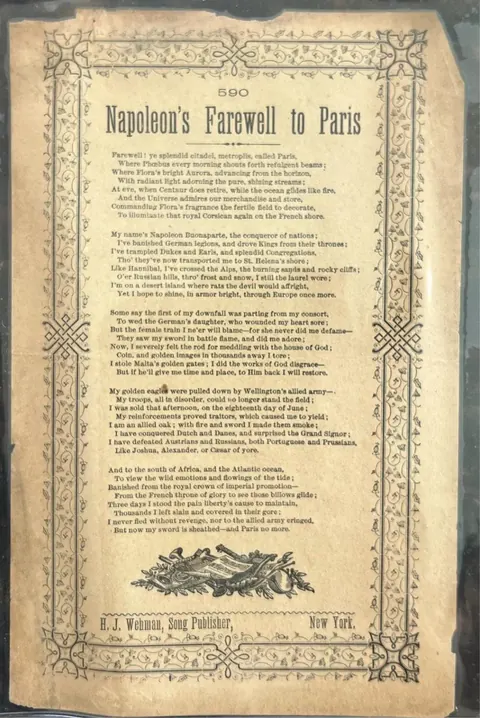
The sheet looks too small for the life it is pretending to contain.
One leaf of browned paper. Worn corners. Decorative border. A little martial cut near the bottom, all flags and weapons and public feeling. At the top, above the title, one blunt catalog number: 590.
Then the title: Napoleon's Farewell to Paris.
I opened What's It Worth? because the practical questions come first. What is it? How old is it? Is it sheet music, a poem, a broadside, a later reproduction, some decorative souvenir? The app identified it as a broadside song sheet issued by H.J. Wehman in New York, a text-only lyric sheet rather than notated music. That was useful, and also insufficient.
The real problem was the first person.
This is not a song about Napoleon. It is a song as Napoleon. The speaker does not stand at a historical distance and summarize the emperor's career. The speaker climbs into the emperor's coat, stares back toward Paris, remembers victories, exile, Waterloo, religion, marriage, defeat and the possibility of return.
Napoleon did not write it.
Somebody else did, and that somebody gave ordinary singers permission to say I.
That is where the sheet stopped being a Napoleon collectible and started becoming stranger. The emperor of Europe had become a part you could buy.
The Voice Is Older Than The Sheet
The first discipline is boring but necessary: Jon's sheet is not where the song begins.
H.J. Wehman belongs to the late nineteenth-century American song-sheet world. The Traditional Music Library's page on Wehman's Universal Songster describes a Wehman publishing operation in New York and Chicago, issuing cheap song books between roughly 1884 and 1899 for mainly urban middle- and working-class readers. That fits the object in front of us: low-cost popular print, not luxury Napoleonic memorabilia.
But the song itself is older. Much older.
The University of Chicago's Song Sheet and Broadside Poem Collection lists Napoleon's Farewell to Paris in an undated 1815 example and again in a Pitts printing from around 1830. The East Anglian Traditional Music Trust identifies the song as Roud 1626. Mainly Norfolk points to the same Roud number and gathers modern folk-performance traces under that master title.
So the Wehman sheet is not the original event. It is a later American carrying case for a voice that had already moved through British and Irish broadside culture.
That matters because it changes the object. If this were an American publisher inventing a Napoleon novelty song from scratch, the story would be one kind of commercial afterlife. Instead, Wehman appears to be reprinting or adapting a song that had already proved it could travel. The voice had survived long enough to become stock.
By the time it reaches number 590, Napoleon has already been translated into popular memory. Wehman is not creating him. Wehman is stocking him.
Cheap Paper, Large Feelings
A song sheet is not a polite format.
The Center for Popular Music at Middle Tennessee State explains the basic American form: a single sheet, often around six by nine inches, with lyrics printed inside a decorative border, usually with no engraved music. The Manchester Digital Collections broadside-ballad guide makes the same point from the British side: cheap, mass-produced, one-sided street literature, often authorless, often undated, with poor survival because nobody was supposed to treasure it.
This is important because the sheet's physical cheapness is not a defect outside the story. It is the story's delivery system.
Napoleon usually arrives in bronze, oil paint, military maps, memoirs, medals, schoolbook chapters and stern museum labels. Here he arrives on the sort of paper meant to pass through hands and disappear. No score. No grand binding. No guarantee of authority. Just words, border, title, publisher, number.
That is how famous people stop belonging to themselves.
After a while, the historical Napoleon is only one of the Napoleons in circulation. There is the military Napoleon, the tyrant Napoleon, the romantic exile, the anti-British hero, the cautionary example, the common man made emperor, the monster, the martyr, the stage role, the tavern song, the cheap American print.
This sheet belongs to the last group, which may be the most revealing one. Monuments tell you what institutions want remembered. Cheap songs tell you what ordinary memory was willing to put in its mouth.
Number 590
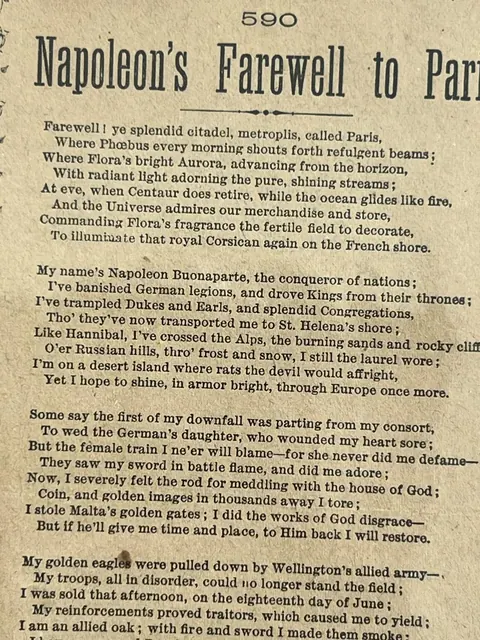
The number at the top keeps bothering me.
Not because it proves a precise date. It does not. Not because it solves the publication sequence. It does not do that either, at least not from the evidence I have. It bothers me because it is so ordinary.
590.
Napoleon had conquered and lost kingdoms. On this sheet he is an item in a publisher's run.
That is funny, but not only funny. It is also how mass culture handles greatness. It does not necessarily destroy it. It files it. It gives it a border, a title, a price, a number, and a place in the stack next to love songs, comic songs, patriotic songs, Irish songs, sentimental songs, topical songs and whatever else a customer might buy because the title caught.
There is something wonderfully rude about that. History becomes merchandise, and merchandise becomes memory. A person does not need to have studied Napoleon to buy the sheet. He only needs to know the name, recognize the drama, and want the feeling for a few minutes.
That is not ignorance. It is a different kind of historical use.
The song is not reliable biography. It gets things wrong, compresses causes, turns politics into melodrama, and lets Napoleon narrate himself with all the convenience of an absent fact-checker. But the errors are evidence too. They show which parts of Napoleon remained useful after accuracy stopped supervising the room: exile, glory, betrayal, defeated greatness, possible return.
The sheet is less interested in what Napoleon said than in what people wanted Napoleon to sound like.
Napoleon Gets A Throat
The discovery that changed the piece was not on Jon's sheet.
It was in a folk-song listing.
In January 1905, Ralph Vaughan Williams was collecting songs in Norfolk. The East Anglian Traditional Music Trust's listing for Napoleon's Farewell to Paris says the tune was sung by Mr. Christopher Woods on January 9, 1905, in King's Lynn Union. The note is almost painfully small: the manuscript says the tune is doubtful because Woods was very hoarse.
That sentence did more to me than another database entry would have.
I do not know who Christopher Woods was in any satisfying biographical sense. I am not going to turn him into a symbol just because the scene is tempting. But I know enough to feel the oddness of it. A song that lets someone borrow Napoleon's first person is being collected not from an emperor, not from a statesman, not from a grandee's library, but from a hoarse man in King's Lynn Union.
The imperial voice has entered an ordinary throat, and the throat is giving out.
That is the part a catalog record cannot quite domesticate. The song's first-person trick is not just literary. It is physical. Somebody has to sing it. Somebody has to stand or sit there and let the defeated emperor's voice pass through his own damaged one.
This is where the word "folklore" starts becoming too tidy. We say a song survives, but survival is not abstract. It survives because printers reprint it, collectors file it, singers remember it, publicans hear it, revivalists cut verses, websites index it, and one person in 2026 can point a phone at a battered sheet and begin tugging on the same line.
The sheet is quiet. The song was not.
The Back Has A Later Date
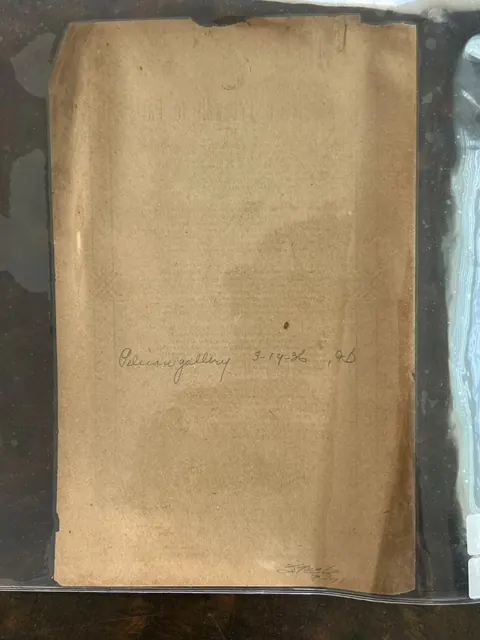
Then the back gives the sheet another life.
In pencil, someone appears to have written "Pelican gallery," then "3-19-36," then what may be ".95" or another short price mark. There is also a lower scribble that I cannot settle from the photograph. I do not need to settle it for the piece to work.
What matters is the change in use.
By March 19, 1936, if that date is what it appears to be, this was not functioning as disposable song commerce. It had become an old paper thing someone handled as a collectible, an antiquarian curiosity, gallery stock, bookstore stock, or private inventory. The sheet had crossed from performance into preservation.
That is a second afterlife, and it is quieter than the first one.
First Napoleon becomes a voice for popular song. Then the song sheet becomes an object for someone to mark and keep. Then it passes through sellers and collections and book people until Jon has it in a sleeve and asks a phone what it is.
I cannot tell you the whole chain. I can tell you the chain exists because the object carries its scratches. The front says cheap song. The back says somebody later thought cheap song had become worth saving.
What The App Was Good For
The app mattered here because it refused to let the first answer be the last one.
It identified the object as a broadside song sheet, noticed the Wehman imprint, distinguished the thing from full sheet music, and put a cautious date and value frame around it. Then the conversation moved where it had to move: did Napoleon actually say any of this?
No.
That answer sounds like a correction. It was really the hinge. Once the app separated Napoleon's actual historical farewells from this invented first-person song, the object became bigger instead of smaller. The false voice was the interesting part.
That is a useful pattern for WIW. The point is not that the app replaces curiosity. It gives curiosity somewhere to go before it evaporates. A scan becomes an identification. The identification becomes a question. The question becomes a tradition. The tradition becomes a hoarse singer in Norfolk, a New York publisher's catalog number, a pencil mark from 1936, and a modest little market for a sheet that was never meant to become precious.
Without the app, this could have stayed an old Napoleon lyric in a sleeve. With the app, it became a trail of borrowed voices.
So What Is It Worth?
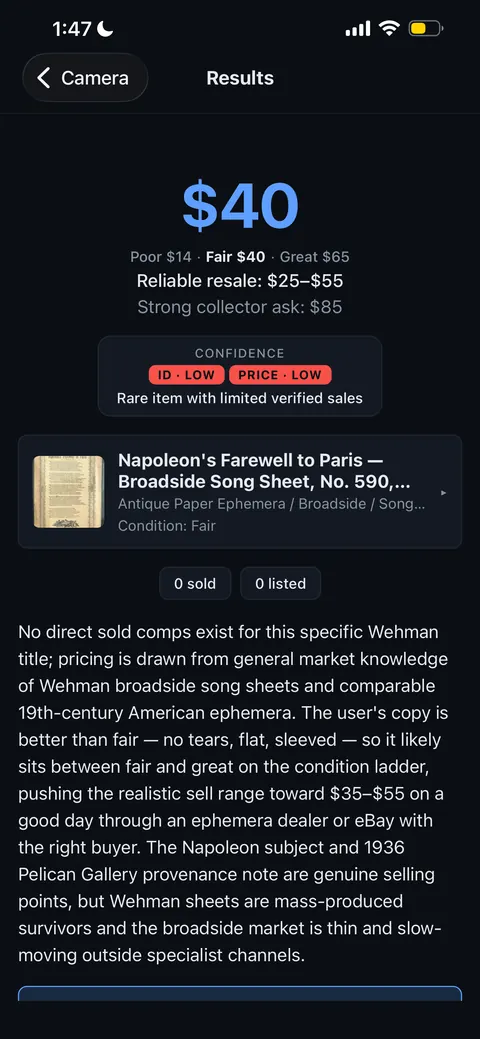
WIW put the value at $40, with a reliable resale range of roughly $25 to $55, a stronger collector ask around $85, and low confidence on both identification and price. That sounds modest because it is modest.
There are reasons someone might hope for more. Napoleon is a good subject. The sheet is visually strong. The Wehman imprint is visible. The reverse note gives it a later collecting life. Similar active listings can ask far higher prices.
But asking is not selling.
The app's restraint is the right kind. No direct sold comps for this exact Wehman sheet surfaced in the app result. The broader market for nineteenth-century song sheets and broadsides is real but thin, and condition matters. This copy is browned and edge-worn, with corner loss and handling wear, even though it presents well and survives in one piece.
So the honest answer is small and interesting: it is probably worth more as a story than as inventory. Not worthless. Not secretly a fortune. A legitimate piece of popular print, connected to a long song tradition and to the nineteenth-century habit of turning history into portable entertainment.
That is a better answer than a big fake number.
The Thing That Would Not Stay Imperial
The object began as a question about value and ended as a question about control.
Who gets to speak as a famous person after history is done with him?
Not legally. Not officially. Culturally. Once a figure becomes large enough, his life turns into material. Songs borrow him. Printers stock him. Singers inhabit him. Collectors keep the paper. Later sellers price it. Apps identify it. Writers come along and try to explain why a cheap sheet has started making them uneasy.
Napoleon is not special in that. He is only unusually good at showing the process because the distance between his scale and the sheet's scale is absurd. One of the most consequential men of the nineteenth century, reduced to a single leaf, a decorative border and a number at the top.
But reduction is not the whole story. The sheet does not simply make Napoleon smaller. It makes him usable. People could buy the voice, sing the defeat, admire the ambition, forgive or condemn the pride, and then put the paper away. It let history become performance.
That is why the Christopher Woods note stays with me. The song finally becomes most alive, not when it tells me something accurate about Napoleon, but when it makes me imagine a non-famous person giving breath to a famous man's invented regret.
The emperor did not write this farewell.
That may be why it survived.
Sources
Primary object: Jon's photographed H.J. Wehman song sheet, Napoleon's Farewell to Paris, no. 590, and WIW app screenshots supplied in the object folder. Broadside and song-sheet context: Middle Tennessee State University Center for Popular Music, American Song Broadsides; University of Manchester Digital Collections, Broadside Ballads. Song history and survival: University of Chicago Library, Guide to the Song Sheet and Broadside Poem Collection 1700-1899; East Anglian Traditional Music Trust, RVW King's Lynn & West Norfolk Collections; Mainly Norfolk, Napoleon's Farewell to Paris (Roud 1626). Wehman context: Traditional Music Library, Wehman's Universal Songster. Market context: WIW app result supplied by Jon, direct inspection of the photographed object, and active asking evidence treated as asking evidence only.