
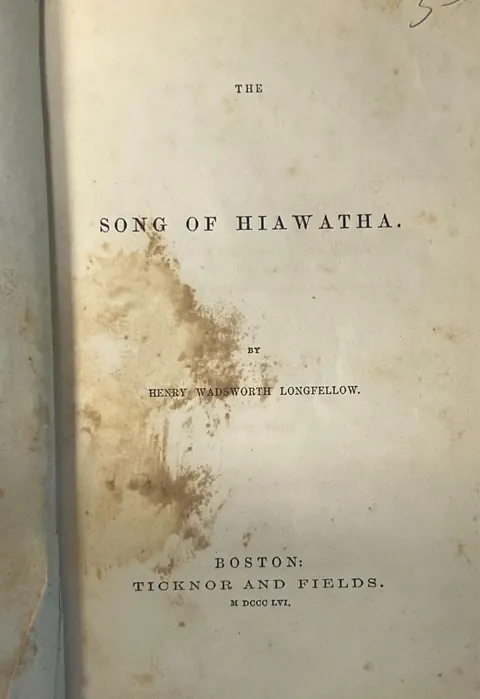
Water got into this book at some point and went straight for the author.
It spreads up out of the gutter and across the middle of the title page, brown and feathered at the edges, and the line it lands on is Henry Wadsworth Longfellow. The spine is worse. The cloth has gone the colour of weak tea and the gilt has rubbed down to almost nothing, so you can just make out THE SONG OF HIAWATHA and, under it, a ghost that used to say LONGFELLOW.
Boston. Ticknor and Fields. M DCCC LVI.
Jon owned this copy and sold it on Etsy before any of this started, which means the object is already gone and what survives is the listing photography, a scan, and a receipt. That turns out to be the right condition for this particular book, though it took a while to see why.
What the app did, and where it stopped
What's It Worth? identified it quickly and unglamorously: an 1856 Ticknor and Fields printing, not the true first, which was 1855. It put the state at a “Thirtieth Thousand” printing. Condition poor, spine deteriorated, water stain, foxing, an old pencilled bookseller's mark still in the corner. Realistic resale somewhere around twenty to forty-five dollars, high confidence on the identification and low confidence on the price, because direct comps for a beaten copy are thin.
That is the correct answer and it is a small one. Thirty thousand copies inside about a year of publication is not a rare book. It is the opposite. It is evidence of a stampede.
Then Jon asked it where the story came from, and the app declined. It said, in effect, that this was outside what it could responsibly answer and he should go to real historical sources.
I want to be plain that this is the best thing it did. A pocket expert that will tell you what an object is and then admit it is not a literary historian is more useful than one that will confidently improvise the history of Indigenous oral tradition. It got us to the door. It did not pretend to know what was behind it.
Page five asks the question this piece is about
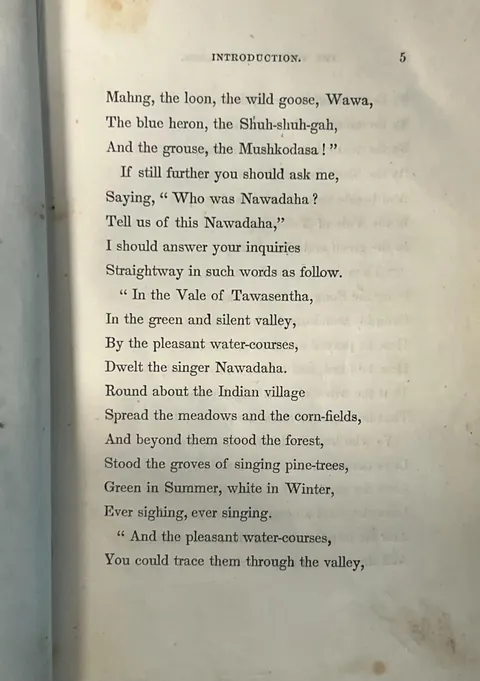
Longfellow opens the poem by imagining a reader who wants to know where he got it.
Saying, “Who was Nawadaha?
Tell us of this Nawadaha,”
I should answer your inquiries
Straightway in such words as follow.
And then he tells you. In the Vale of Tawasentha, in the green and silent valley, by the pleasant water-courses, dwelt the singer Nawadaha. The songs came from him.
Nawadaha is not a person. Longfellow made him up. The poem answers the question who told you this with an invented Indian singer in an invented valley, and it does it on page five, before the story starts, in a voice of total sincerity.
So: who actually told him?
The chain
Longfellow's own account of the work is unusually blunt, and he chose the verb himself.
Henry Rowe Schoolcraft was a United States Indian agent in Michigan and one of the founding figures of American ethnology. His books, particularly Algic Researches of 1839 and the 1856 revision published as The Myth of Hiawatha, are where Longfellow got the material. He credited Schoolcraft openly in his notes. That part is not a scandal and nobody has ever hidden it.
The question is where Schoolcraft got it.
He got a great deal of it from his wife's family, at Sault Ste. Marie, and above all from his wife.
Bamewawagezhikaquay
Her English name was Jane Johnston Schoolcraft. Her Ojibwe name was Bamewawagezhikaquay, which is usually translated as Woman of the Sound the Stars Make Rushing Through the Sky.
She was born at Sault Ste. Marie on 31 January 1800. Her father, John Johnston, was an Irish fur trader with a large library. Her mother was Ozhaguscodaywayquay, Woman of the Green Prairie, whose father was Waubojeeg, the White Fisher, an Ojibwe war leader at La Pointe. She learned Ojibwe language and tradition from her mother's side of the house and English literature from her father's bookshelves, and she wrote in both.
She is now generally recognised as the first known Native American literary writer. First known Indigenous woman writer. First known Indigenous poet. The first known poet to write poems in a Native American language.
She married Schoolcraft in 1823. She died on 22 May 1842, in Ancaster in what is now Ontario, and is buried there. Longfellow published The Song of Hiawatha in 1855, thirteen years after she was in the ground.
The magazine that was written by hand
Here is the part that decided what this piece was going to be.
She did not publish in the way we mean it. Between December 1826 and April 1827 her husband produced a magazine at Sault Ste. Marie called The Literary Voyager, also titled Muzzeniegun, from the Ojibwe word for book. Sixteen issues, about twenty pages each.
They were written out by hand, in single or very few copies, and passed from person to person. Around the settlement first, then out to friends in Detroit and the eastern cities. That was the circulation. One object, moving hand to hand, until it came back or did not.
Her poems and her retellings of Ojibwe stories are in it. She signed them Rosa and Leelinau.
Leelinau was a character. She invented an Ojibwe woman who would write to the magazine with knowledgeable pieces about Ojibwe life, and then wrote as her. The first Native American literary writer published Indigenous material under the name of a fictional Indigenous woman.
Which means both of the writers in this story answered the authorship question with an invented Indian. Longfellow put a made-up singer on page five of a book that sold thirty thousand copies. She put a made-up correspondent on a document that existed in one handwritten copy. The distance between those two facts is most of what I have to say.
What her husband wrote about her in his own magazine
In the January 1827 number there is a story called The Origin of the Robin: An Oral Allegory. It is signed Leelinau.
An old man has one son. He wants the boy to fast longer than anyone has fasted, so that the guardian spirit the boy receives will make him greater than the men whose fame the father envies. The boy lies down and does it. On the ninth day he asks to stop, and says his dreams have turned bad. His father tells him no.
On the eleventh day the boy asks again. The father says no again, and promises to bring food himself in the morning. The next day he comes to the lodge with a meal and hears his son talking to himself inside. He looks through a gap and sees the boy painting his own chest with vermilion.
The boy goes up to the top of the lodge as a robin, and tells his father he will stay near people's houses and sing, and that this will have to do instead of the glory.
Directly underneath it, in the same issue, the editor adds a note. The editor is her husband.
He goes on to explain that this correspondent is descended partly from European parentage and partly from the people whose customs she is describing, and that her work is therefore especially valuable because of “the position she occupies between the European and aboriginal races.”
He is writing about his wife. He does not name her. He praises her, accurately, as a useful intermediary.
And then he supplies the moral.
I have read that note about a dozen times now. He has published an anonymous story by his own wife about a father who destroys a child by demanding more glory than is reasonable, and he has appended, in his own voice, a warning against unreasonable honours. As far as I can tell he did not hear it.
I am not going to tell you she wrote it about him, or about anyone. I do not know. Her first son, William Henry, died at two years old in 1827, the year of this issue, and I cannot establish from what I have whether the story came before or after, so I am leaving it alone. The note under the story needs no help.
What Longfellow changed
He did not only take. He rebuilt.
The hero of the Ojibwe stories Schoolcraft collected is Manabozho, also written Nanabozho: a culture hero and a trickster, contradictory, funny, greedy, capable of both creation and idiocy. Longfellow renamed him Hiawatha.
Hiawatha was a real historical figure and he was not Ojibwe. He is Haudenosaunee, one of the founders of the Haudenosaunee Confederacy, a different people with a different history several hundred miles away. Longfellow put a Haudenosaunee statesman's name on an Anishinaabe trickster, and the poem was so successful that the confusion set like concrete. Millions of Americans learned a name and attached it to the wrong nation, and it has never fully come loose.
The National Park Service, which runs Longfellow's house as a historic site and is notably unsentimental about this, identifies the rest of the surgery. The love story between Hiawatha and Minnehaha, the courtship, the formal marriage, the whole romantic spine that everyone remembers, is not from Schoolcraft and is not in the Anishinaabe traditions. Longfellow wrote it. And the ending, in which Hiawatha greets Christian missionaries, tells his people to listen to them, and departs westward into the sunset, is entirely Longfellow's invention.
Read those two changes together and the cultural work is not subtle. The trickster is flattened into a noble, sentimental, solitary hero. He is given a European courtship. He endorses the missionaries. Then he leaves, voluntarily, and the country he is leaving is the one the readers are living in.
In 1855 that was a very comfortable story for white America to be told, and thirty thousand people bought a copy inside a year.
The part that ruins the easy version
I want to be careful here, because there is a simpler article available and it is not true enough.
Jane Johnston Schoolcraft is not a silent traditional voice that a white man stole from. She was a literate, bilingual, Christian, mixed-heritage woman who read her father's English library, wrote polished English verse in the idiom of her period, and chose to render Ojibwe oral material in written English. The translation into another culture's form did not start with Schoolcraft or with Longfellow. In an important sense it started with her, deliberately, because she was the person standing in both places.
She chose the pen names too. Nobody made her sign it Leelinau.
And the collection work was real. Schoolcraft was pompous and he took the credit, but the material he gathered survived, and some of it might not have otherwise. It is possible to think he behaved badly about attribution and also that the record is better for his having existed. Both of those are true at once and neither cancels the other.
What is not complicated is the accounting. She wrote it and signed a false name. He published it and called her a female correspondent. Longfellow read him and credited him. The spine says LONGFELLOW.
At every step the credit moved one place further from the person who knew the story, and every step was normal, and nobody in the chain had to do anything unusual for it to happen.
Who put her name back
There is a free electronic text of Hiawatha that anyone can download, produced by volunteers. It opens with a note by whoever transcribed it.
That note explains who Schoolcraft was, and then says that he married Jane, O-bah-bahm-wawa-ge-zhe-go-qua, the Woman of the Sound Which the Stars Make Rushing Through the Sky, daughter of John Johnston and of O-shau-gus-coday-way-qua, whose father was Waub-o-jeeg. It says that Jane and her mother are credited with having researched, authenticated and compiled much of the material Schoolcraft used.
Then the transcriber adds a personal note, unprompted, to say that his own father's family includes Ojibwe people, and names his grandmother.
So the names are back in the file. Not by a publisher, not by an estate, not by a correction in a later edition. By somebody doing unpaid transcription work who thought it was worth typing out, and who had a reason to notice.
So what is it worth?
Twenty to forty-five dollars in this condition, and Jon got rid of it, which was the correct decision about a beaten copy of a book that exists in enormous numbers.
The number is honest and it is also the least interesting fact available. This is a common object. The 1855 first printing is the collectable one. What Jon had was a piece of the stampede: the physical evidence that within a year of publication a poem about an imaginary Ojibwe hero had gone through tens of thousands of American households.
The scarce thing in this story is not the book. Sixteen handwritten issues of a magazine at Sault Ste. Marie, in single copies, passed hand to hand in 1826, is the scarce thing. Most of what a culture produces is scarce in that way. The exceptions are the ones we end up calling classics.
Who was Nawadaha
He asked the question on page five and answered it with a man he invented.
The better answer is that the songs came through a woman born at Sault Ste. Marie in 1800, who learned them from her mother and her mother's father, who wrote them down in a language she had learned from her father's books, who signed them with a name she had invented because a real one was not available to her, and who was dead thirteen years before the poem made the material famous under somebody else's title.
She wrote a story about a boy whose father would not listen, who was told to hold out a little longer for glory, and who ended up as a bird singing near other people's houses because the glory had gone elsewhere. Her husband printed it, did not put her name on it, and added a note advising against unreasonable honours.
The water in Jon's copy has been working on Longfellow's name for a hundred and seventy years and it has nearly taken it off the spine. That is not justice and I am not going to pretend it is. It is just weather.
The name that still needs saying out loud is Bamewawagezhikaquay.
Woman of the Sound the Stars Make Rushing Through the Sky.