
Imagine taking this book to bed with the intention of reading one scene. Your thumb lands in Macbeth. A man has been told he’ll be king, and now everybody in the house would be better off if he went to sleep. So would you. The book has thoughtfully provided a tab for getting straight to the trouble.
A whole library in one book
In April 1925, Walter J. Black advertised a one-volume Shakespeare in The New Yorker for $2.98, plus postage. You could send the coupon without paying up front. An extra $1.50 bought the deluxe version with a thumb index and suede binding. The postman could deliver the entire English stage to your front door and wait while you found the change. Walter J. Black’s 1925 advertisement
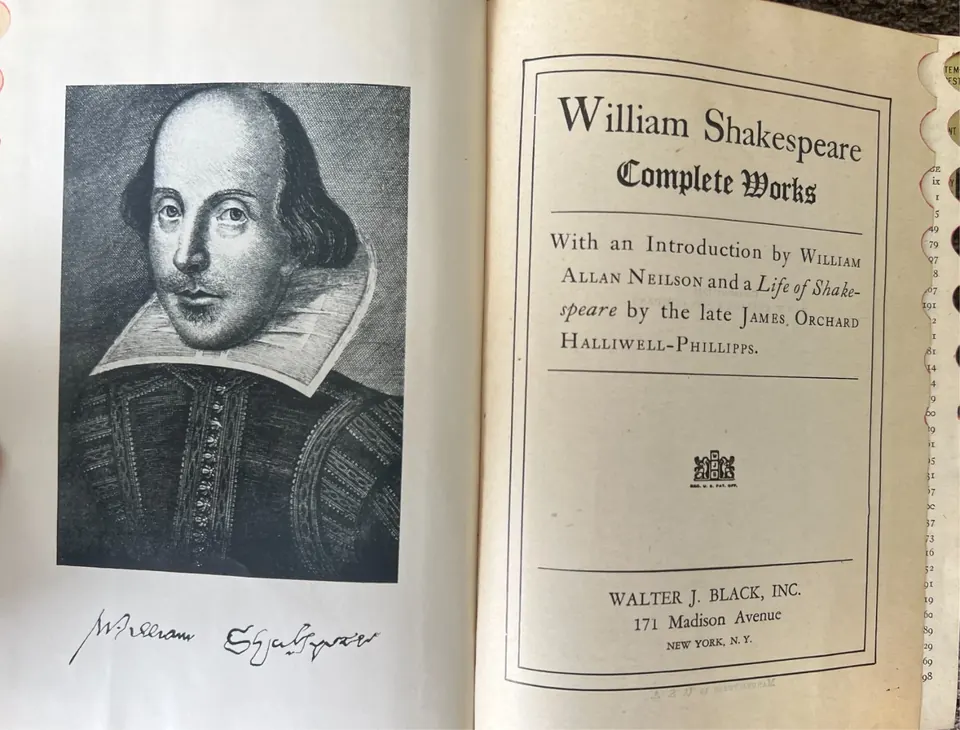
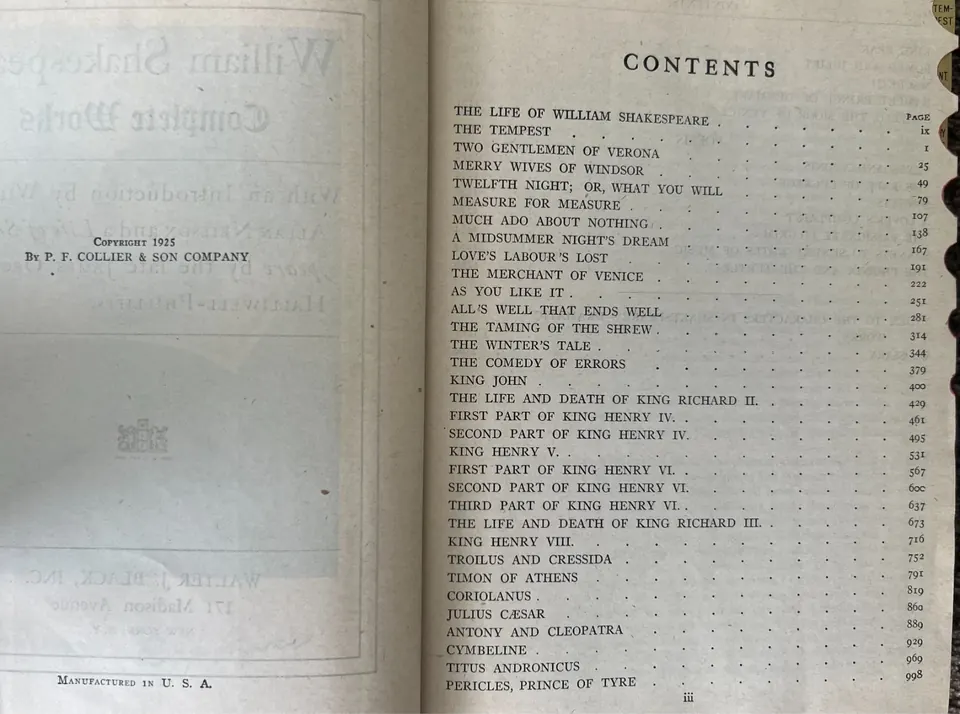
That ad names the Sir Henry Irving edition and an introduction by St. John Ervine. The red hardcover pictured here credits William Allan Neilson and names James Orchard Halliwell-Phillipps as the biographer. Its title page gives Walter J. Black’s Madison Avenue address. Turn that page over and a second publisher appears in tiny print: the copyright is dated 1925 and credited to P. F. Collier & Son Company. A library copy cataloged under Walter J. Black in 1925 runs to 1,312 pages. The printing year of the red copy remains open. University of Michigan copy in Google Books
What’s a Walter J. Black Shakespeare worth?
The copy pictured here was listed at $29.99 or best offer, with the thumb tabs still there and an intact binding according to the listing. Another Walter J. Black copy was listed at $6.50 with loose boards and a missing title page. Those are two asking prices, and the cheaper book has already lost the page you need to identify it. For your copy, match the publisher and binding first. Then check whether the front cover pulls away when you open it, whether the first few leaves are still attached, and whether the tabs survive all the way down the edge. Listing for the pictured copy, comparison listing
What to photograph in the app
In What’s It Worth?, start with the spine and title page, then add a close-up of the tabs and a photo of the hinge if it’s loose. A useful follow-up is Which details would make another copy a fair comparison? Open the Full Breakdown to see what sellers are asking and how the app weighs your copy’s condition. The portrait is the handsome part. The hinge gets the final word.
For more on comparing listings, read how to make sense of asking prices.