
The mirror is selling a drink for a nickel and promising it relieves fatigue. Those are two things you will not find printed on a can of Coca-Cola today, which is the first hint that the front of this mirror is not telling you what year it is.
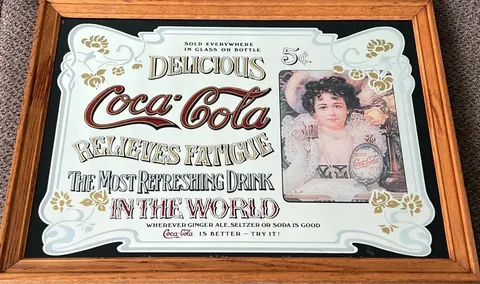
It hangs in a plain oak frame. Black glass, a silver Art Nouveau border, gold roses climbing the corners. Delicious. Coca-Cola. Relieves Fatigue. The Most Refreshing Drink in the World. Up in the corner, 5¢. On the right, a young woman in a white lace collar and a feathered hat raises a glass at you with the expression of someone who has never once been tired.
Everything about the front says 1900. The real question, the one people type into a search bar with the mirror leaning against the couch, is simpler: is this thing old?
Short answer: the picture is old. The mirror is not. And the way you find that out is more fun than the answer.
The Front Is Telling the Truth About the Wrong Year
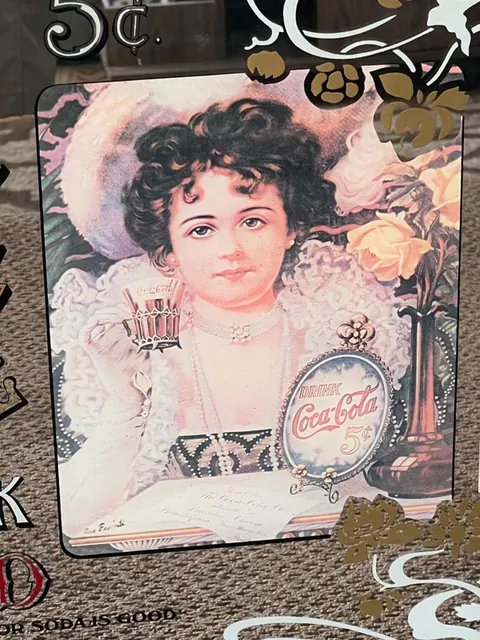
The woman is almost certainly Hilda Clark, a Boston soprano and Broadway singer who is often described as the first person hired to represent Coca-Cola in its advertising. Her portrait ran on Coca-Cola trays and calendars around the turn of the century. Collector references put the first of her trays in 1899 and the last in 1904. A knee injury ended her stage career in 1901, and she retired from public life when she married in 1903. The drink kept her image a little longer than the theater did.
So the face is real early Coca-Cola. A dealer who stopped there would call the mirror "circa 1900" and feel good about it.
Keep reading the glass, though. Along the very bottom, in small letters, there is a second slogan: Wherever ginger ale, seltzer or soda is good, Coca-Cola is better. Try it!
That line has a history of its own, and it is a wonderful one. Diffords Guide, quoting Coca-Cola's own archive, connects it to 1908 trays made by the Western Coca-Cola Bottling Company without the company's permission. Those same unauthorized trays pushed Coca-Cola as a mixer, down to Coca-Cola Gin Rickies. Ginger ale, seltzer and soda were what you poured into a highball. The line was not about refreshment. It was about the bar.
Now look at what the mirror has done. It has put a face whose trays ended around 1904 on the same glass as a bottler's line from around 1908, under a health claim, in a frame. I could not find an original advertisement that combines all three. That is the tell. An original ad comes from one year and one campaign. This front is a greatest-hits album.
Turn It Over
Most of the answer to "is my mirror old" is on the side nobody photographs for the listing.
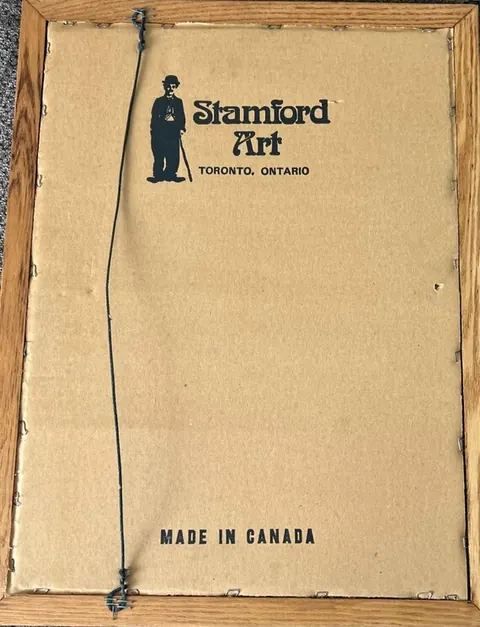
This one has a cardboard backing held in with metal points, a hanging wire, and a printed label that settles the age question in about four seconds: Stamford Art, Toronto, Ontario. Made in Canada.
Stamford Art was a Toronto company that made framed decorative mirrors with printed glass. Its name turns up on mirrors for Coca-Cola, beer and whisky brands, cars, football teams, Marilyn Monroe, Elvis and Charlie Chaplin. Sellers mostly date its mirrors to the 1970s and 1980s. On a collectors' forum, the owner of a Stamford "Relieves Fatigue" mirror like this one is told by another member that he got his in 1977, while he was in the army in Germany. Another Stamford mirror on the resale market is dated 1986. Neither of those is a company record, but together they sketch a working life of roughly the late 1970s to the mid 1980s.
And then there is the logo. Stamford Art's maker's mark is a little silhouette of Charlie Chaplin with his cane and bowler hat.
Stop and count the decades. A 1970s or 1980s Canadian company used a silent-film star as its mascot, to sell a mirror reproducing advertising from about 1900. The object is nostalgia three layers deep. Nobody involved was pretending it was old. It was made to look old on purpose, the way a diner is made to look like 1955.
Two Stories, One Mirror
Here is where it gets honestly uncertain, and where I would rather show the fork than pick a side for you.
Story one: a 1970s piece from the first wave. The forum member who got his in 1977 puts this design on walls by then. In this story the mirror went up behind a basement bar or in a rec room during the Carter years, and the wood frame has been quietly darkening ever since.
Story two: a 1980s piece from later in the run. Companies that find a good design keep printing it. A Stamford mirror on the resale market is dated 1986 by its seller, and nothing on this back gives a year. In this story the mirror is a few years younger, one of many pulled from the same artwork while the company was still working.
Both stories agree on the important part, and the Stamford Art label is why: this is a decorative mirror about forty to fifty years old, not an advertisement from 1900. The front can be copied by anyone, in any decade. The label on the back names who made this one, and that is the strongest dating clue on the whole object. What would settle the decade is small and physical. A copyright or date line printed along the edge of the glass. A sticker or stamp hiding under the frame lip. A receipt or a box. A memory of where it was bought. Those details are worth more to the answer than another photograph of the front.
How to Tell If a Coca-Cola Mirror Is Old
This mirror is a good teacher, because it fails every test a real 1900 piece would need to pass while still looking great. Use it as your checklist.
- Read the back before the frontThis is the strongest clue you have. A maker's label, a city, and wording like "Made in Canada" or "Made in USA" usually date a decorative mirror faster than anything on the glass. Stamford Art and similar names belong to the decor trade of the 1970s and 1980s, not to Coca-Cola's own early advertising.
- Check whether the front belongs to one yearOriginal ads come from one campaign. If the face, the slogans and the logo come from different years, you are looking at a later design that collected its favorite parts.
- Do not date it by the priceCoca-Cola sold for a nickel for a very long time, and reproductions love that 5¢. A nickel price on the glass is decoration, not evidence.
- Look at the materialsA printed glass panel with cardboard backing and modern fasteners points to factory decor. Real age shows up as honest wear in the places hands and time actually reach, not as a pristine picture under glass.
- Search the maker, not the sloganTyping the slogan finds every reproduction ever printed. Typing the maker's name from the back finds the right market for your mirror.
Where the Scan Helps
The front of this mirror is built to win an argument it should lose. A quick look says 1900, a hopeful listing says antique, and both are reading the wrong side. So I scanned the front first, on purpose. If What's It Worth? was going to fall for the costume, I wanted to watch it happen.
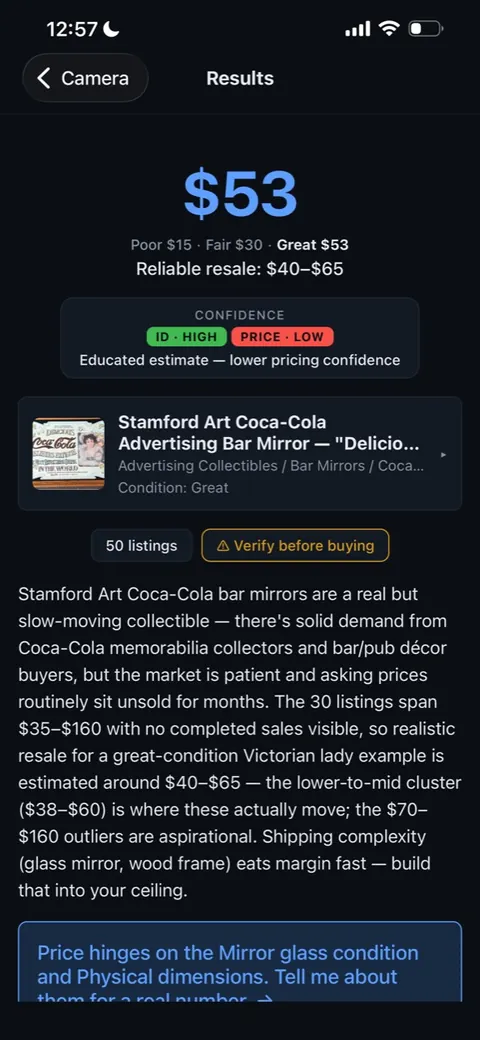
It did not fall for it. Before it had finished searching, it had a name: a Stamford Art Coca-Cola advertising bar mirror, the "Delicious / Relieves Fatigue" Victorian lady. It had recognized the maker from the front alone, while the label was still facing the wall.
The Results screen put a great-condition example at $53, with a resale range of $40 to $65. Confidence in the identification was high. Confidence in the price was low. The app gave more weight to the lower asking prices and flagged the cost of shipping a glass mirror in a wood frame, which anyone who has packed one already knows.
When I opened the follow-up chat, it asked two questions before anything else: how big the glass is, since larger Stamford mirrors list higher, and whether the silvering has gone dark or cloudy anywhere, especially at the edges or behind the printed picture. Silvering loss is the common hidden flaw on these, and it would drop this one to fair condition on its own. Those are things you check standing in front of the mirror, not things a photo of the front can tell you.
Then I added a photo of the back label and asked what it changed. The app read the label as confirmation of Stamford Art, the maker it had already named from the front. For the price, it still wanted a measurement and a closer look at the glass. If a seller is dating the mirror by the picture on the front, you have a maker’s mark to show them.

So the scan and the back of the mirror tell the same story, and the scan got there from the front. The face says 1900. The app said Stamford Art, $40 to $65, and here is what to check before you believe even that.
The woman on the glass has been raising that same glass at strangers for more than a century now, on trays, calendars, and now a Canadian mirror with Charlie Chaplin on the back. She still has not had the drink. Somebody should tell her it relieves fatigue.
Sources and Notes
- Object evidence: photographs of the front, the portrait panel, the frame and the back label reading Stamford Art, Toronto, Ontario, Made in Canada, with a Charlie Chaplin silhouette logo.
- Scan evidence: the What's It Worth? Results screen for the front of the mirror, and the follow-up chat about the back label. The range quoted above is the one on the Results screen.
- Wikipedia, Hilda Clark (soprano): her career, her work for Coca-Cola's advertising agency, and Allan Petretti's dating of her trays from 1899 to 1904.
- Diffords Guide, Coke and Highballs: Coca-Cola's archivist on the unauthorized 1908 Western Coca-Cola Bottling Company trays, Coca-Cola Gin Rickies, and the "Wherever ginger ale, seltzer or soda is good" slogan.
- Collectors Weekly: a "Relieves Fatigue" Coca-Cola mirror marked Stamford Art, Made in Canada, with a commenter who got one in 1977.
- Resale listings on Kijiji, eBay and Etsy: Stamford Art mirrors with Coca-Cola, beer, whisky, car, football and celebrity designs, mostly dated by sellers to the 1970s and 1980s, one dated 1986. These are sellers' descriptions, not company records.