
The doll looked ready for a show nobody had told the rest of the room about.
Everything else on the table had the normal estate-sale posture: waiting, dusty, slightly apologetic. This thing was still in its box with a microphone in one hand, a glittering glove on the other, dark sunglasses on, red stage clothes blazing away under old plastic. It had not accepted that the eighties were over. It had barely accepted that it was in a box.
Objects like this have a way of bullying the room into a first opinion. Someone sees the costume and says Michael Jackson. Someone sees the box and says collector. Someone sees the wear on the corners and says not as much as you think. Someone else sees the face on the package and stops having a clean feeling.
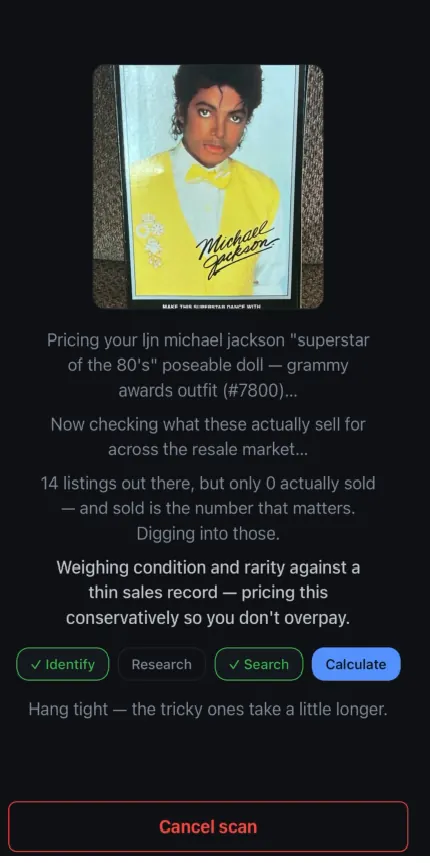
I opened What's It Worth? because "Michael Jackson doll" is only the beginning of the answer. With pop-culture objects, the first name is usually the loudest fact and not always the most useful one. The app caught the basic identity: LJN, 1984, Superstar of the 80's, boxed, poseable, collectible. Then it slowed down, which was the correct move. The outfit, barcode, accessories, box condition, and actual sold evidence all had to agree before the price meant anything.
The Doll From Before The Argument
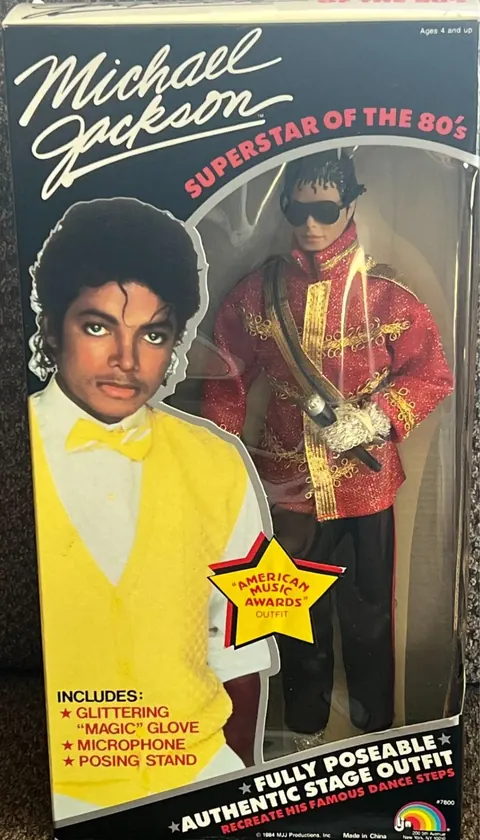
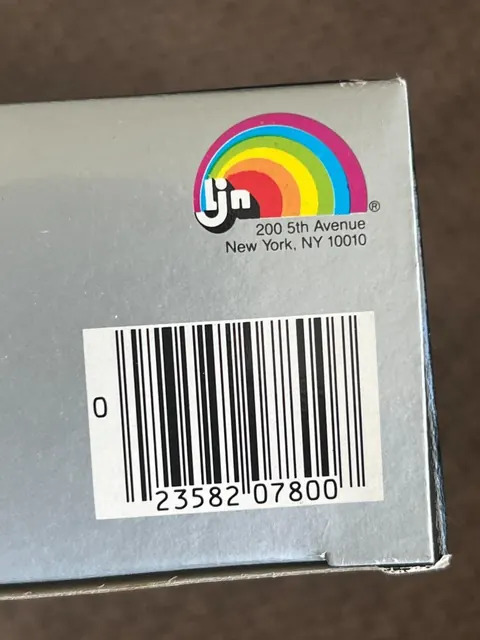
The box says Michael Jackson, Superstar of the 80's, "fully poseable," "authentic stage outfit," and, in the yellow star, "American Music Awards" outfit. The bottom corner gives the number: 7800. The barcode detail backs that up with UPC 0 23582 07800 7 and LJN's New York address.
That matters because these dolls live in a fog of costume names. Grammy. Thriller. Beat It. American Music Awards. Separate outfits. Separate loose accessories. Separate seller titles written by people who may be guessing from memory, or from a red jacket, or from another listing that was already wrong. The object in front of me was not shy. It said American Music Awards, so that is where I started.
A museum record for another boxed example places the LJN doll in the boom of Michael Jackson merchandise after Thriller, and identifies this costume as the outfit from the 1984 American Music Awards. A specialist doll reference says the same LJN line included the American Music Awards, Grammy, Thriller, and Beat It versions. That checks against what the box itself is saying.
But what the box is really selling is not vinyl. It is a particular moment in American pop memory, before the argument got complicated enough to follow the object home.
In 1984, Jackson was not just famous. He was being converted into merchandise while the applause was still hot. Thriller had made him a household figure. At the 1984 American Music Awards, he won eight awards. At the Grammys that same year, he won eight more. It is hard now to explain how total that kind of fame felt without sounding like you are exaggerating. He was a singer, dancer, video artist, celebrity, child star grown into something nobody had quite seen before, and a face that could be put on a lunchbox, a poster, a jacket, a button, a glove, a doll.
The doll belongs to that clean version of mass adoration. Not clean because the real person was simple. Clean because the product required him to be. A child did not buy a boxed moral ambiguity in 1984. A child bought the star in the red outfit.
The Face On The Box
This is the part where a shorter collectible note would change the subject.
I do not think the subject lets us. A Michael Jackson object made for children cannot be handled honestly in 2026 as if nothing happened after the cardboard dried. The later record is not a rumor cloud; it is part of the public life of the object now. Jackson was accused of child sexual abuse in 1993, denied the allegation, and the civil case settled. In 2005, he was tried in California on criminal charges and acquitted on all counts. After his death, new public accusations and defenses kept the argument alive. People who believe he abused children and people who believe he was falsely accused are often not having the same conversation, even when they use the same facts.
I am not going to adjudicate Michael Jackson from a doll box. The object cannot do that, and neither can I. But avoiding the discomfort would be its own kind of dishonesty. This was licensed childhood iconography attached to a performer whose adult public memory became impossible to keep innocent.
That tension is why the doll is more interesting than the price.
Look at it long enough and the box starts doing two jobs at once. It preserves the uncomplicated version because that is what packaging does. It also shows how strange packaging becomes when the culture around the subject changes. The smile stays printed. The glove keeps glittering. The yellow star still shouts American Music Awards. The doll still holds the microphone as if the next chorus is about to solve everything.
Objects are bad at updating themselves. That is part of their power and part of their trouble.
Condition Is Memory With Corners
The object still has to be dealt with as an object.
The box promises the glittering glove, microphone, and posing stand. In the photos, the glove and microphone are visible. The stand is harder to confirm cleanly from the front shot, so I would not sell it as complete without better angles or a direct view of the insert and base. The doll appears still boxed, but I would not call it factory sealed from these images. Old plastic can hide a lot of small human decisions.
There is visible edge and corner wear. The window has the old-box plastic look. The front still presents well, which matters because boxed dolls are partly bought as display objects. A mint box asks one kind of price. A surviving box asks another. A box that lets the object stay legible but not pristine is where most real estate-sale collectibles seem to live.
That is why WIW's first useful contribution was not a number. It was friction. The app kept the famous name from taking over the whole answer. Which version? Which outfit? Which box number? Which accessories? Which condition? Which sold comps, not just asks? In other words: stop treating celebrity as if it were a price guide.
What The Money Can And Cannot Say
The market is thin enough to deserve caution. One eBay sold listing for a Michael Jackson 1984 American Music Awards LJN doll unused in box closed at C $100, shown by eBay as about US $72.50, plus international shipping. Another sold eBay listing for an AMA-outfit doll shows US $80 accepted on a listing with Best Offer. I found a US $150 sold result too, but that listing's seller note muddies the outfit description, so I would treat it as supporting context rather than a clean comp.
Asking prices are louder. I saw current and recent asks around $125, $150, and much higher, including a UK listing using the same UPC and model number at £208.77. Those are not sold comps. They are weather. You can feel them, but you do not build the house out of them.
My practical read from the available evidence is roughly $75 to $125 from the photos alone, with upside only if better photos confirm completeness, strong box condition, and a buyer who specifically wants the American Music Awards version. Below that, it is a fast-sale object. Above that, it becomes a waiting game.
That number is smaller than the fame and larger than the plastic. That feels about right.
The doll was manufactured for uncomplicated applause. The resale market is asking a less glamorous question: how much money does somebody want to spend on a boxed piece of that applause now, knowing everything that came after?
Sometimes nostalgia survives by staying shallow. This object does not quite let it. The smile on the box still works, and then it doesn't, and then it works again in a different key. That is what makes the thing hard to put down. Not the idea that a doll can solve Michael Jackson. The opposite. It cannot solve him at all. It can only show how a culture once made him small enough to fit in cardboard, and how badly that trick has aged.
Sources And Market Notes
- Object evidence: WIW photographs and scan video; box front; barcode showing UPC 0 23582 07800 7; visible LJN/MJJ Productions packaging details.
- Powerhouse Collection: boxed LJN Michael Jackson doll, c. 1984, American Music Awards outfit, dimensions and production notes.
- Celebrity Doll Museum: LJN, 1984, American Music Awards version, and other outfit versions in the line.
- Recording Academy / GRAMMY.com: Jackson's eight Grammy wins in 1984.
- FBI Vault, Michael Jackson files: public FBI records released through FOIA; the 2005 case ended with Jackson acquitted of all charges.
- eBay sold listing: American Music Awards LJN doll unused in box, C $100 / about US $72.50.
- eBay sold listing: American Music Awards #7800 in box, US $80 accepted.