
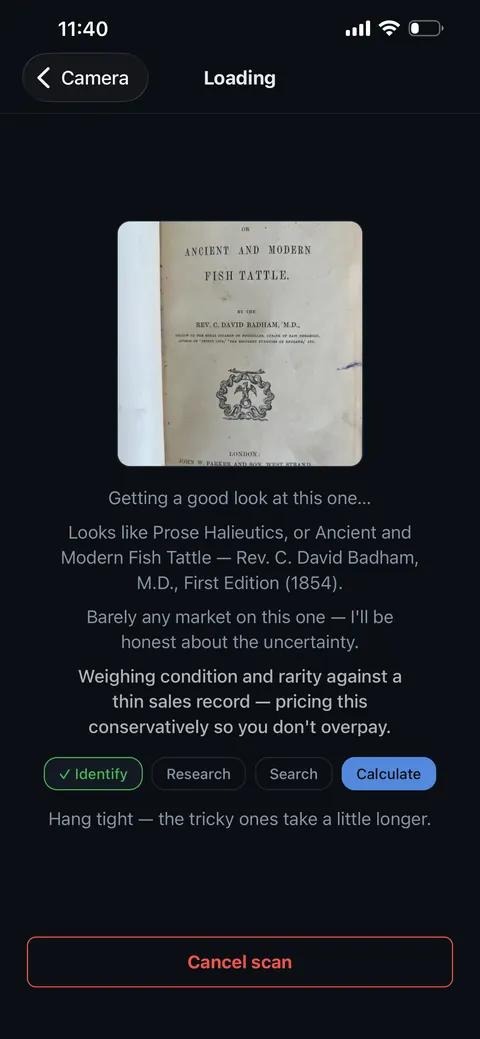
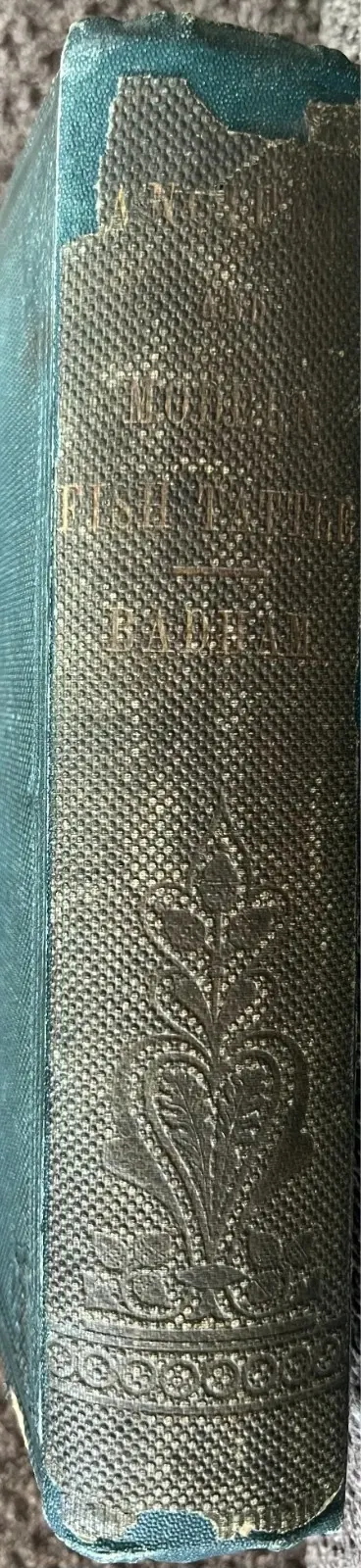
A little green nineteenth-century book landed in front of me looking like it had no intention of causing trouble.
At first glance it seemed to be an old fishing book, and old fishing books can go either way. Some are beautiful. Some are four hundred pages of tackle, Latin names and men being patient near water. I did not yet know which kind this was. I only knew it was small, green, worn, and respectable in the way old books become respectable after enough years of not being thrown away.
So I opened What's It Worth? and scanned it. That is the useful first move with an object like this: not deciding too soon. The app gave me the plain identification: Charles David Badham, 1854, John W. Parker and Son, London, first edition, 552 pages. A real Victorian book, not a decorative antique with a fake smell and a handsome spine.
Then I read the title properly.
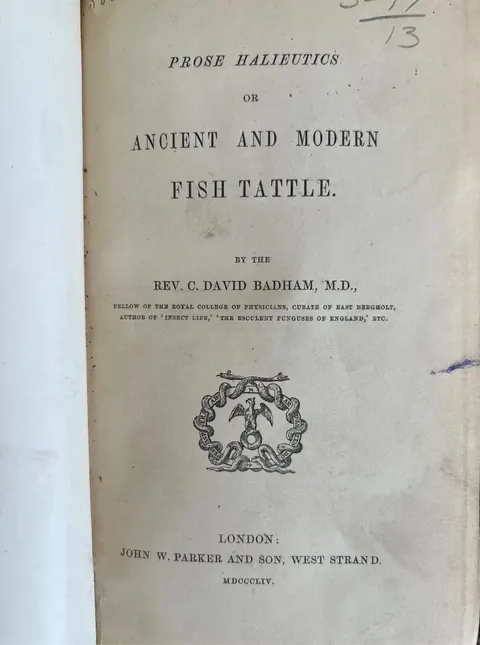
Prose Halieutics; or, Ancient and Modern Fish Tattle.
Not fish science, or angling instruction, not even a sober catalogue of species. Fish tattle.
I thought this was a little fishing book. That was the first thing I had wrong.
The Green Book Starts Behaving Badly

The phrase bothered me. It had the cheerful nerve of a joke that might be smarter than you first think, so I asked the app what Badham meant by it. WIW pointed me to his own advertisement, where he says he wants "to treat of fish ichthyophagously, not ichthyologically."
That is an obnoxious Victorian way of saying something good. Badham is not mostly interested in fish as classified specimens. He is interested in fish as things people catch, eat, overpay for, preserve, brag about, prescribe, ferment into sauce, and drag through old stories until the fish are barely the strangest part.
A fishing book is one thing. A 552-page book by a doctor-turned-priest on the gossip of human appetite is another.
The title page made the problem worse. The author is Rev. C. David Badham, M.D., F.R.C.P., Curate of East Bergholt. Reverend. Doctor. Fellow of the Royal College of Physicians. Curate. Author of books on insects, edible mushrooms, and now fish gossip.
What kind of man becomes a physician, stops practicing because of his health, becomes a priest, tries to get the English to eat wild mushrooms, and then writes 552 pages about what Greeks, Romans, doctors, cooks, merchants, invalids, rich collectors and ordinary hungry people have believed about fish?
That is funny because it is actually funny. It does not need decoration.
So I asked WIW to stay with the author instead of the object for a while. The app had already done the auction-house part: identify the thing, date it, place it, look for the market. Now I wanted the human problem under the binding.
Doctor, Priest, And The Missing Bridge
Charles David Badham was born in London in 1805. The Royal College of Physicians has him educated at Westminster School, then Emmanuel College, Cambridge, then Pembroke College, Oxford for medicine. He took his medical degree, became a Fellow of the Royal College of Physicians, and practiced in Rome and Paris.
Then ill health ended the medical career.
That much is in the record. He returned to England in 1845, was ordained deacon in 1847, priest in 1848, and held curacies in East Anglia. He kept writing: insect life, edible fungi, fish tattle. He died in July 1857, only weeks before turning 52.
That means the second act was short. From the return to England to the grave is only about twelve years. From priesthood to death, not quite a decade. The part of Badham that now seems most Badham to me - the mushrooms, the fish gossip, the priest who still writes like a physician with dirt under his nails - belongs to a compressed life after one career had already failed his body.
The record explains the exit from medicine better than it explains the entrance into the Church.
This is where a writer gets tempted to build the missing bridge himself, because silence feels untidy. I went looking for a cleaner motive and did not find one. Ill health is clear. Ordination is clear. The interior passage between them is not.
But the silence is not empty. Badham was a physician and naturalist who had spent his adult life around bodies, illness, food, plants, animals, death, old medical belief and the stubborn limits of knowing. His edible-fungi work and ordination belong to the same rough mid-1840s turn. We do not know that mushrooms had anything to do with his religion. We do not know that they did not. We absolutely cannot write the cheap version where Badham eats a mushroom and finds God.
What we can do is wonder honestly.
Maybe it is not so bizarre that a very curious physician-naturalist, after looking closely enough at the world to see how much of it remains mysterious, would be drawn toward God. There is a long human history of plants, fungi, altered states, religious awe and attempts to touch whatever lies beyond ordinary perception. Some famous theories along those lines, including psychoactive interpretations of the Eleusinian Mysteries, remain debated rather than settled. Badham gives us no license to turn that into his biography.
Still, the editorial question remains useful: what happens to a man after he has spent years examining bodies, illness, food, nature and belief, and discovers that the world has not become smaller under inspection?
Badham did not become a priest and retreat into pious abstraction. His writing after the turn is still crowded with bodies. Markets. Poverty. Ancient jokes. Bad remedies. Rich people's appetites. Useful plants English people ignore because prejudice has made them stupid. Fish as food. Fish as money. Fish as medicine. Fish as an excuse for scholars to quote Athenaeus and then talk about dinner.
Whatever changed in Badham's life, the man did not stop being interested in the embarrassing practical business of being alive. If anything, the shortness sharpens the work. There is something moving about a sick former doctor, now a priest, spending his remaining years insisting that fish, fungi, markets, sauces, remedies and appetites all deserve attention because they are how human beings actually meet the world.
The Mushrooms Are The Clue
WIW pulled up Badham's mushroom book next, and this is where he became a person to me rather than a Victorian author with a funny title.
Before Prose Halieutics, he wrote A Treatise on the Esculent Funguses of England. It sounds like a book meant to punish a child for laughing in church. It is not. It is an argument with an entire country.
Badham thinks England is wasting food.
He says edible fungi are abundant, wholesome and neglected. English people leave them to rot because they do not know them, fear them, or treat them as suspicious continental behavior. Meanwhile France, Germany and Italy gather them, cook them, preserve them, sell them. In Rome, he describes a market where fungi are inspected and regulated. Bad mushrooms are thrown out. Good ones become food and money.
This is not cute mushroom trivia. It tells you how Badham's mind works.
He notices the thing underfoot that custom has made invisible. He looks at English fear and sees waste. He looks at poverty and sees knowledge that could become dinner. He looks at the natural world and refuses to leave it in the safe category marked "interesting." Interesting is not enough for him. Can it be eaten? Sold? Misunderstood? Regulated? Poisonous? Useful to the poor? Ruined by prejudice? Improved by attention?
Mushrooms are not a side alley. They are rehearsal.
The fish book does with fish what the fungus book does with mushrooms, only on a bigger, older, stranger stage. Badham is not content to say fish exist. He wants the whole human mess around them.
The Contents Page Gives Up The Game
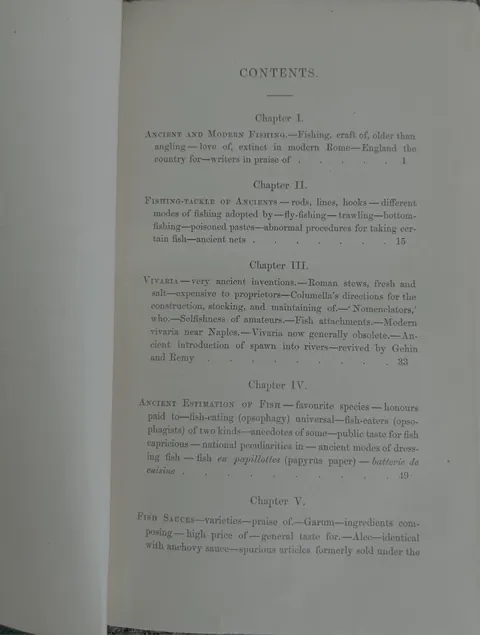
The contents page is when I stopped thinking of this as a fishing book at all.
Ancient and modern fishing. Tackle. Roman fish ponds. Ancient estimates of fish. Opsophagy, which is a beautiful word for people getting too excited about delicacies. Fish sauces. Fish in medicine. Naples and its fish market. Mullomania.
Mullomania: not the haircut. The mullet is a fish, and wealthy Romans apparently found ways to make it everybody else's problem.
I asked the app whether that was as good as it sounded. It was.
Badham is talking about the ancient obsession with mullet, especially among wealthy Romans who spent absurd amounts of money and attention on fish ponds. The stories are old, filtered through classical writers, and Badham enjoys them as stories. Men stock ponds, visit them, feed fish, brag over them, treat them almost as dependents, and then, because human affection is complicated by saucepans, eat them.
Fish as food, preservation, commerce and practical knowledge were not inherently ridiculous subjects in the nineteenth century. People could not walk into a bright grocery store and forget how food arrived. Badham is distinctive for something better than quaintness. He keeps noticing where nature collides with human behavior.
The Roman with the mullet pond is ridiculous in the specific and familiar in the general. Every age has its luxury fish pond. Sometimes it is wine, watches, cars, sneakers, orchids, bourbon, audio gear, knives, rare books, or whatever object lets appetite put on a waistcoat and call itself discernment.
The mullet people are funny because they are not safely gone. Some of them now own ring lights.
Garum Enters The Room
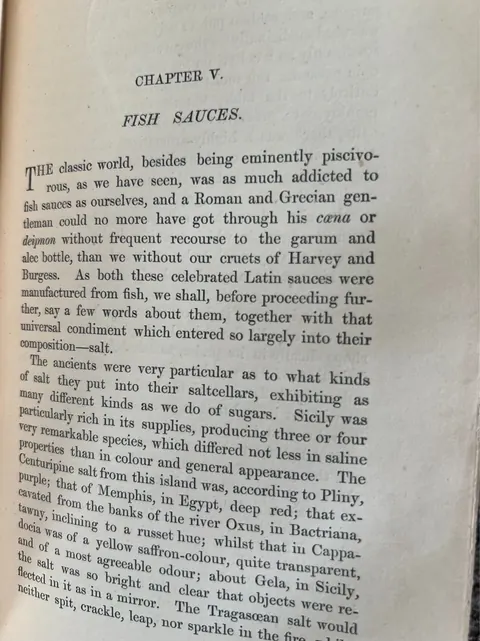
Then I asked about the sauces, because there is no dignified way to avoid Roman fish sauce once it has appeared in a book you are already reading against your better judgment.
What in the world is garum? And while we are here, what is allec?
Garum was the famous fermented fish sauce of the ancient Mediterranean, a salty liquid seasoning made from fish and brine. Allec, or alec, was related but not simply the same word with worse manners; it usually referred to the thicker sediment or paste left from the process, and ancient writers could treat grades and uses differently. The details get technical quickly. Badham's larger point is simpler: fish sauce was food, trade, status, taste and argument in one jar.
People had to catch the fish, salt them, ferment them, ship them, price them, judge them, imitate them, praise them, complain about them, and put them on food. Somewhere inside that dark, salty substance are trade routes, kitchen habits, class signals, storage problems, regional tastes, and the permanent human willingness to acquire a taste and then look down on people who have not.
This is where Badham's word "tattle" earns itself. A scientific account might tell us what fish were used. A culinary account might reconstruct the flavor. Badham wants the talk around the jar. Who valued it? Who bought it? Who thought it cured something? Who found it disgusting? Who could afford the good kind? Who was pretending?
I did not expect a Victorian clergyman to make fermented fish sauce feel socially alive, but here we are.
Fish Medicine, Or The Old Panic In A New Bottle
Badham's medical chapter is even better, partly because you can feel the physician still awake inside the priest.
He collects claims about fish as medicine, including ancient recipes that wander into hair loss. This is a reliable test of human dignity. Give civilization enough time and it will start rubbing unlikely things on the head.
It would be easy to sneer at Pliny and friends for believing that sea creatures, burned or mixed or otherwise punished, might help the scalp. Badham laughs, but not with the clean superiority of someone who thinks his own century has escaped nonsense. He knows bodies make people desperate.
Hair falls out. Bodies hurt. People age. Vanity survives. Fear survives. Hope survives. Markets hear all of it.
Ancient people make strange remedies. Modern people fill bathrooms with different bottles. The ingredients change. The panic does not.
That is why the fish medicine belongs in the same book as the Roman ponds and the Naples market. These are not random curiosities. They are ways fish pass into human need: hunger, vanity, status, commerce, fear, hope.
I asked WIW to keep showing me these links because this is exactly where I would have gotten lazy on my own. I would have skimmed the medical chapter as quaint. The app kept pushing back toward the question underneath: why would Badham care about this?
Because he had been a doctor. Because he had watched the body make fools and believers of people. Because old remedies are not just wrong chemistry; they are records of need.
Naples Was Not There For Scenery
Badham had lived abroad, and you can feel it most clearly when the book gets near markets.
The Naples fish market is not a postcard in Prose Halieutics. It is the living version of the ancient material. Fish are not just in texts. They are in baskets and on slabs. They smell. They are judged by eye. They are priced by people who know what they are looking at. They move through hands before they move into kitchens.
This matters because Badham's Italy is not vague romance. It is practical education. Italy taught him that nature becomes culture through markets as much as through books. The mushroom market in Rome and the fish market in Naples belong to the same mental world. Badham notices systems: inspection, trade, habit, local knowledge, ordinary people doing the daily work that makes a delicacy or a staple possible.
That also helps explain why he can be learned without becoming airless. The classics are not dead shelves for him. They keep brushing against living markets, recognizable hunger, practical knowledge, languages and habits rubbing against each other in public.
He had the kind of education that can become unbearable in the wrong hands. In his, at least at his best, it stays hungry.
The Magazine Shape
At this point I asked the app why the book felt less like a single argument than a man opening cabinets.
The answer was publication history. Wellcome and HathiTrust both note that much of Prose Halieutics had appeared in Fraser's Magazine. That explains some of the motion. These were magazine essays before they were gathered into a 552-page book, and magazine essays have a different metabolism. They need to move. They need to keep a reader who has other things to do.
You can feel that origin. The book rambles, but not lazily. It changes rooms. It follows a word, a recipe, a fish pond, a source, a market, a medical claim. Sometimes it behaves less like an argument than like a dinner companion who keeps remembering one more thing and somehow the thing is relevant.
This is also where the object changed what I wanted. I came in with a green fishing book I did not expect to care about. Now I want the Fraser's versions. I want the mushroom book beside it. I want the insect book. I want to know whether Badham's jokes got sharper or softer when the magazine pieces became a volume.
I have not found that answer yet. But the hunt has changed. The book has created new objects to look for, and I already know who is going with me.
Some Leads Stay Loose
Objects like this generate tempting scraps.
There is a bibliographic record for an 1831 piece under Badham's name called "Pathological Waltz." I have not read the full piece, so I am not going to turn it into a claim. But as a title it sits very comfortably beside the Badham we can document: a medical man alert to the comedy of culture entering the body.
There are also Badham-family stories involving men waving rakes at trains. I went looking because of course I went looking. The trail did not settle cleanly on Charles David Badham, and the likelier direction seems to be elsewhere in the wider Badham family. That is disappointing in the narrow sense, because rake-and-train material is not something a writer likes to give back. But it is also clarifying.
Badham does not need borrowed eccentricity.
The documented man is enough. Westminster. Cambridge. Oxford medicine. Fellow of the Royal College of Physicians. Rome. Paris. Illness. Anglican priesthood. East Anglia. Insects. Fungi. Ancient literature. Markets. Medicine. Fish.
Do not call him a genius because that makes him smaller. Just put the evidence in a row and let the reader feel the shape of the mind.
So What Is It Worth?
Eventually the story has to come back to the object on the table.
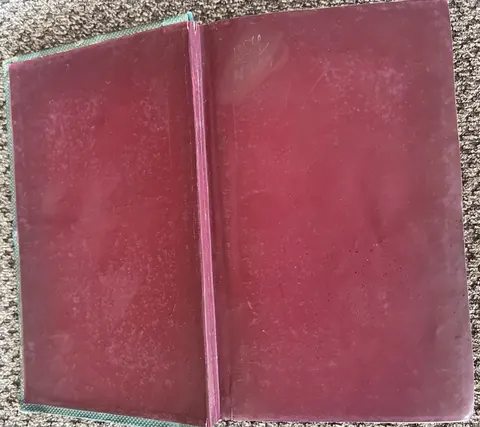
This copy is an 1854 first edition of Prose Halieutics; or, Ancient and Modern Fish Tattle, published in London by John W. Parker and Son. The standard bibliographic description is xii plus 552 pages. Original cloth is important. So are condition, completeness, the state of the spine, the title page, and whether the book still presents as a coherent nineteenth-century object rather than a pile of interesting paper making a legal argument for being a book.
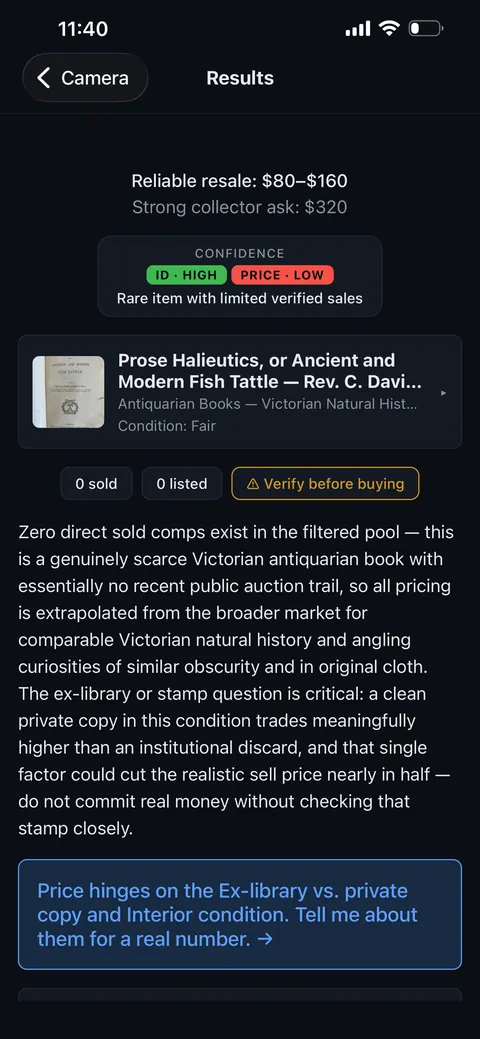
WIW's result put reliable resale at $80 to $160, with a strong collector ask at $320. It also flagged the important caution: high identification confidence, low price confidence. Zero direct sold comps appeared in the filtered pool. In other words, the book is scarce enough to be interesting, but not liquid enough for a tidy number.
That is the right kind of restraint. Rare-book pricing is judgment, not barcode scanning. You look at condition, edition, binding, institutional marks, completeness, dealer asking evidence, actual sold evidence where it exists, and the likelihood of finding the particular buyer who cares about a Victorian doctor-priest writing fish gossip.
The broader evidence stays mixed. Current dealer asks for first editions can sit around the high double digits to upper hundreds, including examples in the $170 to $190 range. Sold evidence I could verify is lower: PBA shows a copy sold for $62.50, and Bonhams records one at GBP 35.85 including premium. That does not make the app's range wrong; it explains why price confidence should be low. Thin markets do not reward false precision.
A seller can love the story and still price the book with discipline. A buyer can love Badham and still notice that the broader market has not formed a bidding cult around him. The historical value and the cash value are related, but they are not the same thing.
The book may be more interesting than it is expensive. That is not faint praise. Plenty of expensive things are boring at any price.
The Door The Object Opened
I started with a little green fishing book I expected not to care about very much.
I ended with a physician-priest who seems to have spent his best attention on the places where nature becomes human behavior: mushrooms in markets, fish in sauces, mullet in luxury ponds, remedies in medical books, old appetites dressed up as refinement, ordinary food made strange by prejudice or memory.
WIW did not create that curiosity. It gave it handles before the moment disappeared: scan the book, name the title, ask about "fish tattle," follow the reverend-doctor, let mushrooms explain fish, let the value question wait until the object had earned it.
Badham called it tattle, and that is still the right word. Tattle is not trivial here. It is social evidence. It is the talk around the thing. The stuff people believe, buy, cook, fear, waste, brag about and pass along.
The money matters. It tells you what the market will probably do with the object if you put it there. But the object does not end at the market. This one kept opening: from a title, to a man, to mushrooms, to Rome, to sauce, to medicine, to Naples, to a future hunt for magazine appearances I did not know I wanted until the book made me want them.
Badham wrote 552 pages because fish would not remain merely fish for him.
Now I have the same problem.