
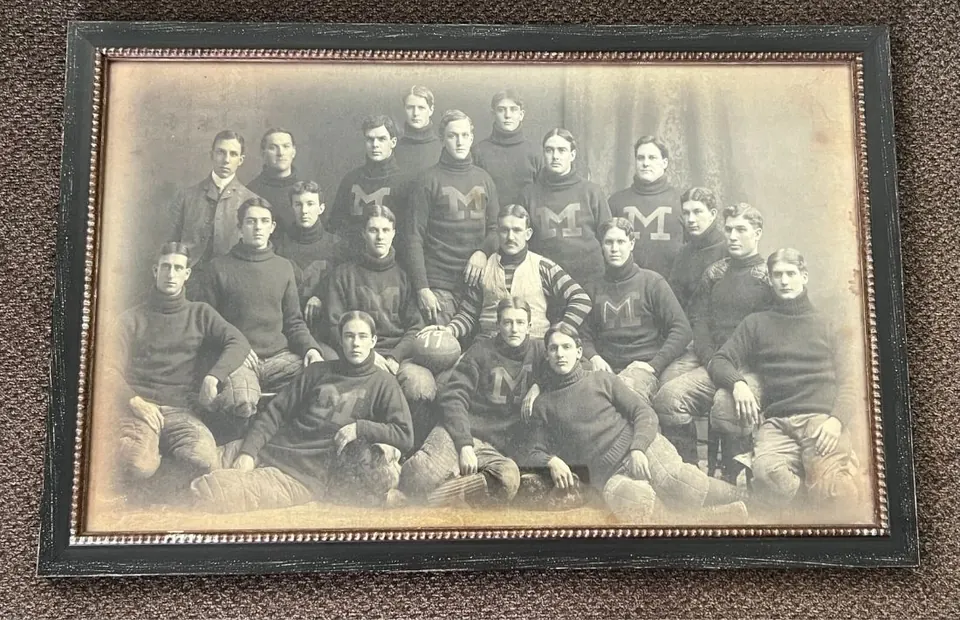
An old football photograph showed up in a frame with two heads peeking over the back row and a football sitting at the feet of a man in striped sleeves. I wanted to know the year. The archives supplied 1899, and then I realized I had asked the question badly. I had the year the team posed. I still wanted the age of the thing in the frame.
Put the scene on the calendar
Find one feature you can search without already knowing the date. A storefront name, a photographer’s studio, a school crest, or a building under construction can get you to a much smaller set of pictures. For the football photo I’d give What’s It Worth? the whole group and a close-up of the sweaters. In Dive Deeper I’d ask whether an archive has a photo with the same arrangement. The Bentley Historical Library’s 1899 team page shows the same two heads at the top and the same stripes by the football. Bentley’s team photo and roster and the story of the coach in the photo
A landmark can give you a date range even if you never find the same image. A Library of Congress researcher narrowed the date of an aerial view of Washington to 1910–27 by noticing that one wing of the Jefferson Building had its new book stacks and the stacks for another had not been built yet. Look for a good reason a landmark would have been visible from the camera’s position before you use its absence as a clue. The Library of Congress worked example
Read the mount and the back
Measure the whole item and the picture separately. Photograph the edges and the back, along with any studio address, caption, number, publisher’s credit, or handwriting. Note where each bit of text appears. A copyright date under the image can refer to the view. A newer publisher’s name on the card can send you looking for the later issue you actually have.
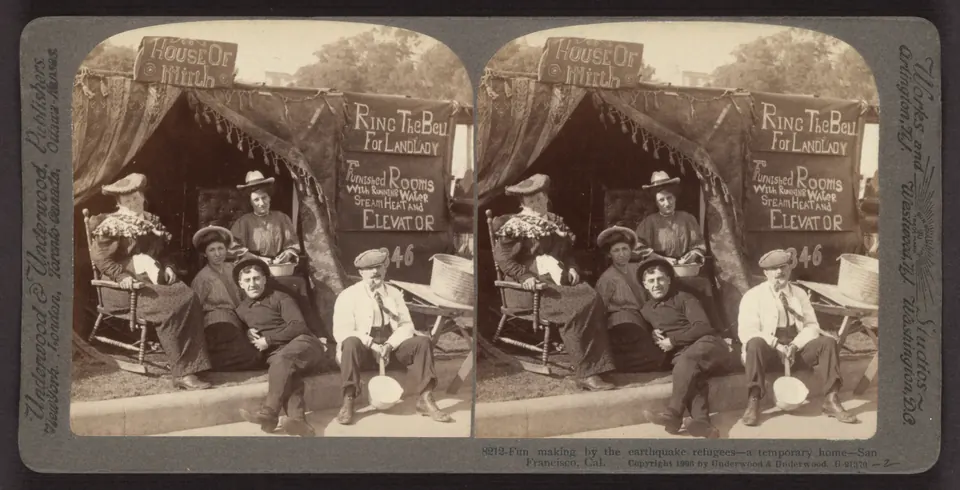
The card with the San Francisco tent that advertised an elevator is a stereograph, with two views intended to be looked at together. The publisher put the caption on the mount. Some publishers printed their names and captions on the back. When a later company acquired the rights to a view it could print the same scene on another card. Library of Congress guide to stereograph cards and the story behind the tent
Keep two dates in your notes
Add the back and the clearest mark to your scan. Ask What’s It Worth? to give you the date of the scene and the likely date of the physical print separately, with the clue behind each answer. If all you can establish is the year of the team or the year of the earthquake, write that down and leave the printing date open. For the framed football photo I can put 1899 beside the team. I’m still looking for a date to put beside the paper.