
I wanted to know who the man in the striped sleeves was. That seemed like a reasonable thing to want from an old football photograph. I ended up reading about a coach whose mail came back from Alaska stamped address unknown.
In the frame are men in dark sweaters, a few block M’s, and a football low in the middle. Two faces peek over the top of the group. The first question I’d take into What’s It Worth? is whether the university has the same photograph. A sweater can get you to Michigan. The way twenty men sit and stand can get you to a particular afternoon.
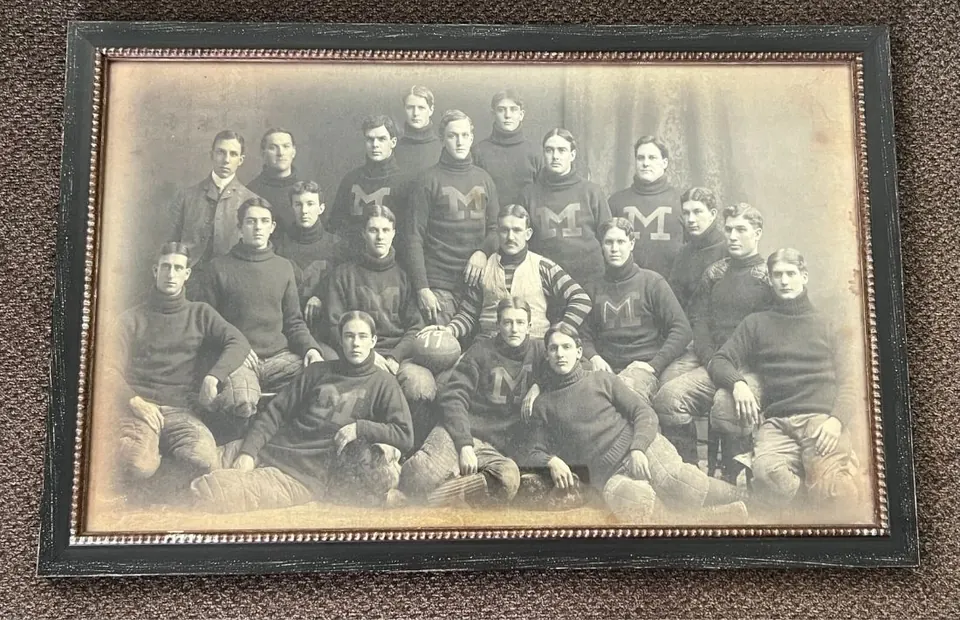
Who’s in the 1899 Michigan football team photo?
The Bentley Historical Library has a labeled 1899 team photo. The two faces above the group and the striped sleeves by the football line up with the picture in this frame. Bentley identifies those two men in back as Milo White and Everett M. Sweeley. Its seated row includes captain Allen Steckle, and its third row includes Neil Snow. Even Bentley adds a question mark after one name in the front row. I like that the archive leaves the question mark where it belongs. Bentley’s team photo and roster
The Wolverines went 8–2 that season. The first loss was by one point to Pennsylvania. The second was to Wisconsin on November 30. The record gives the coach’s name as Gustave Ferbert. I went looking for his next season at Michigan. There wasn’t one.
The coach went looking for gold
In 1900, Ferbert left football for the gold rush. He made it west and headed for the gold fields. Then letters started coming back. A friend gave up and sailed for Seattle while Ferbert headed toward Nome. Years passed. Back home, the stories about what had happened to him got more elaborate as the actual news got thinner.
In 1909 a newspaper announced that he had made his fortune in Alaska. The University of Michigan account points out that the report offered no named source for the fortune. What stuck with me was a line it found on his death certificate. After all those years in mining, the person filling out his occupation wrote one word: Coach. University of Michigan’s account of Ferbert, pp. 54–56
How to date a framed copy
The archive can help date the image. To date the object in the frame, photograph the mount, the edges, and the back if you can see them. Look for a studio mark, an inscription, or a publisher’s credit. Take a close-up in raking light to see how the image sits on the paper. An image from 1899 can be printed many decades after the team sat for it. If you scan both sides in WIW, try asking what identifies the team and what identifies the printing. I’d keep those answers on separate lines.