
I thought the typesetter had sneezed. On page 111 of the 1930–31 Southwest Blue Book, four Frost households have four different telephone exchanges. They’re printed WAshington, ORegon, ATlantic, and GRanit. Say them aloud and the effect is of a perfectly ordinary person getting a little too loud at the beginning of every word. Those first two letters were the part you needed to notice.
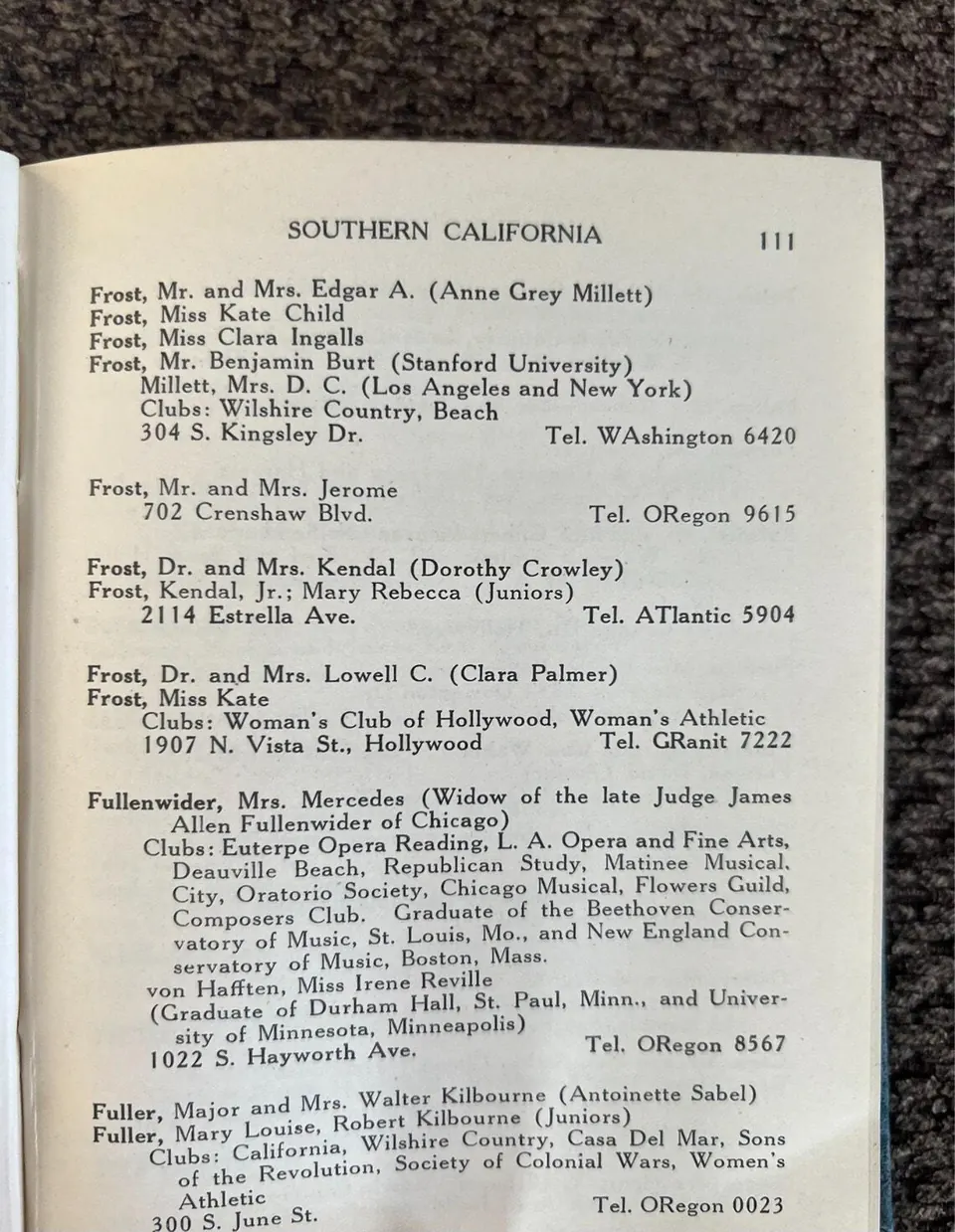
Just below the Frosts is Mercedes Fullenwider. The book introduces her as the widow of a Chicago judge, then spends most of her entry on what she did herself. There are two music conservatories, in St. Louis and Boston, followed by the Euterpe Opera Reading club, the Oratorio Society, and enough other memberships to make me wonder when she was home to answer the telephone. I’d started on the page looking at numbers. Here was someone I could go looking for in an old concert program.
Lenora King Berry’s Los Angeles society directory
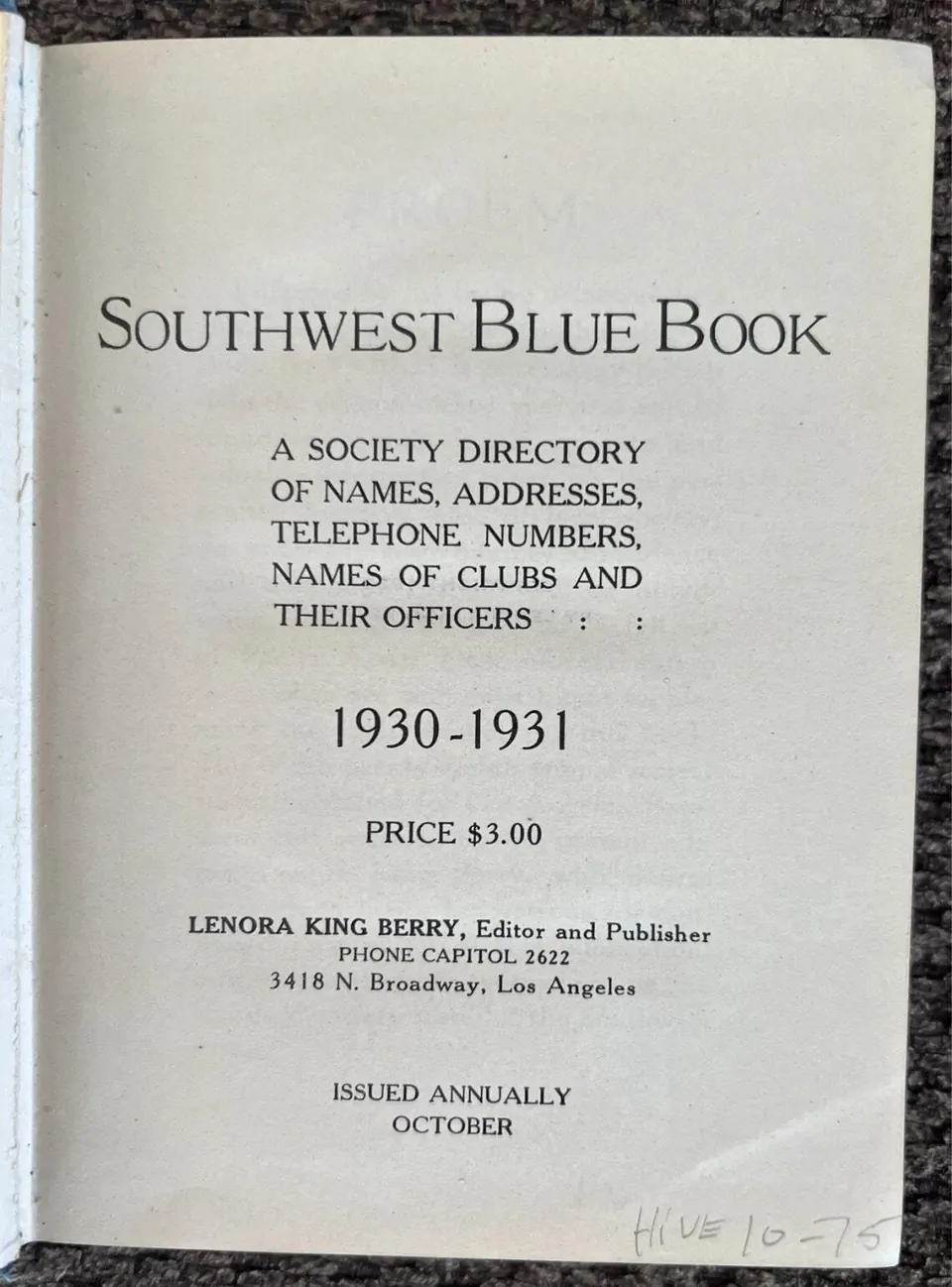
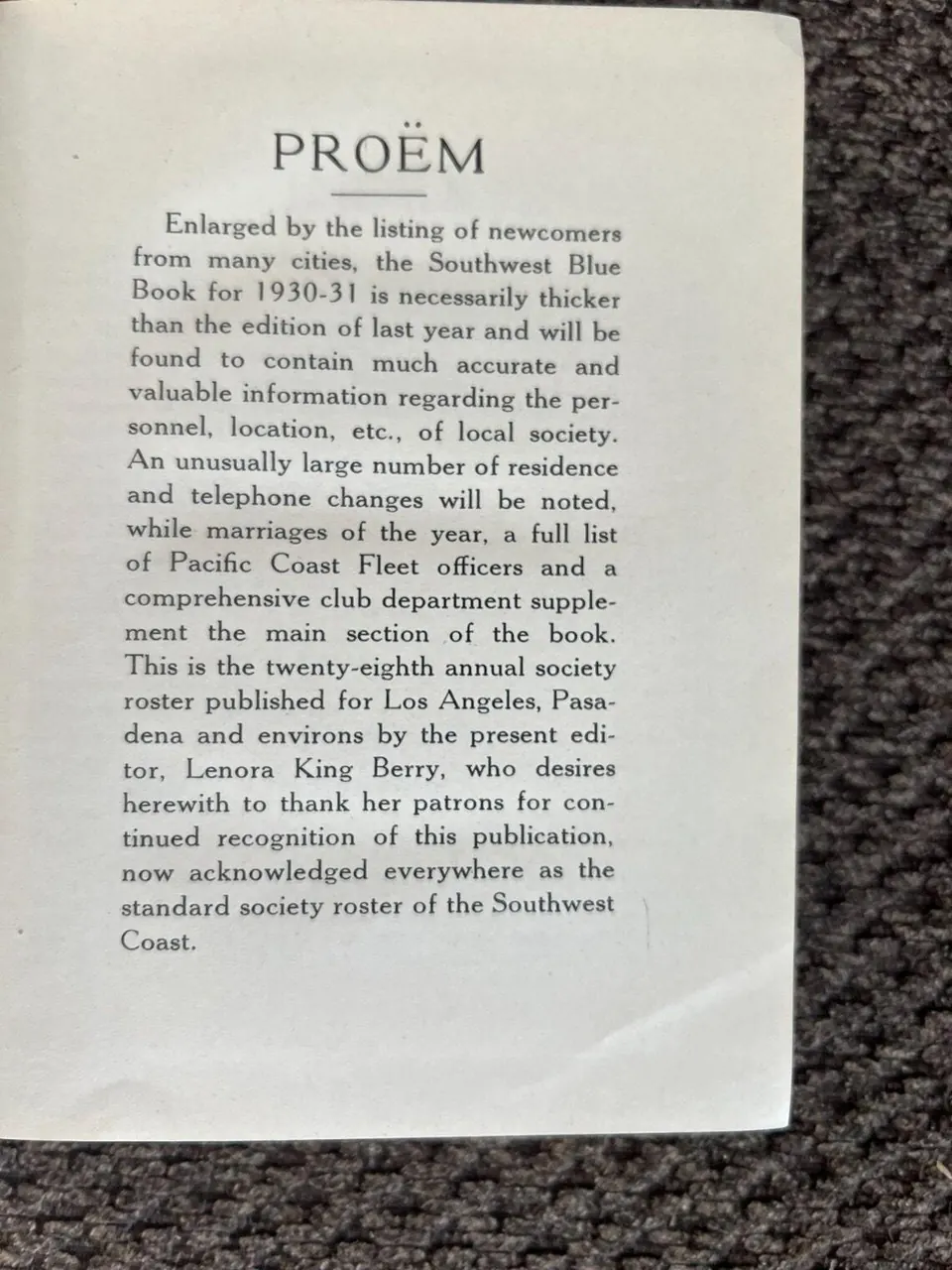
The title page calls it a society directory, puts the price at three dollars, and says it comes out every October. The editor and publisher, Lenora King Berry, writes that this is her twenty-eighth annual roster for Los Angeles, Pasadena, and the surrounding area. She gives herself a little room up front, under the gloriously formal heading Proëm, to explain why the book has got thicker. There were newcomers from other cities. She’d also noticed an unusually large number of address and telephone changes. A marriage could move someone into another entry. A move across town could send readers to a different exchange. Berry had to get it all right and then do it again next October.
A society book gives you an editor’s slice of the city. That’s useful if you want to follow a club or a family, and it gives you somewhere to start if your person is missing. The Los Angeles Public Library has digitized city and street-address directories. Try the surname in a nearby year, or try the address if you have it. Street directories let you start at a building and work toward a person. If all you have is an old exchange name, a period telephone book can show you how it was printed. LAPL city and street directories and Los Angeles telephone directory, 1935
I’d put the title page and one inside page into What’s It Worth? The question I’d take into Dive Deeper is What kind of directory is this, and which record would you check next for someone in it? I’d still end up at the library. But I’d go with an issue year, a few places to look, and the name of a woman who apparently could hear music in two cities and still find time for a flowers guild. Another name that sent me out of a book and into the archives