
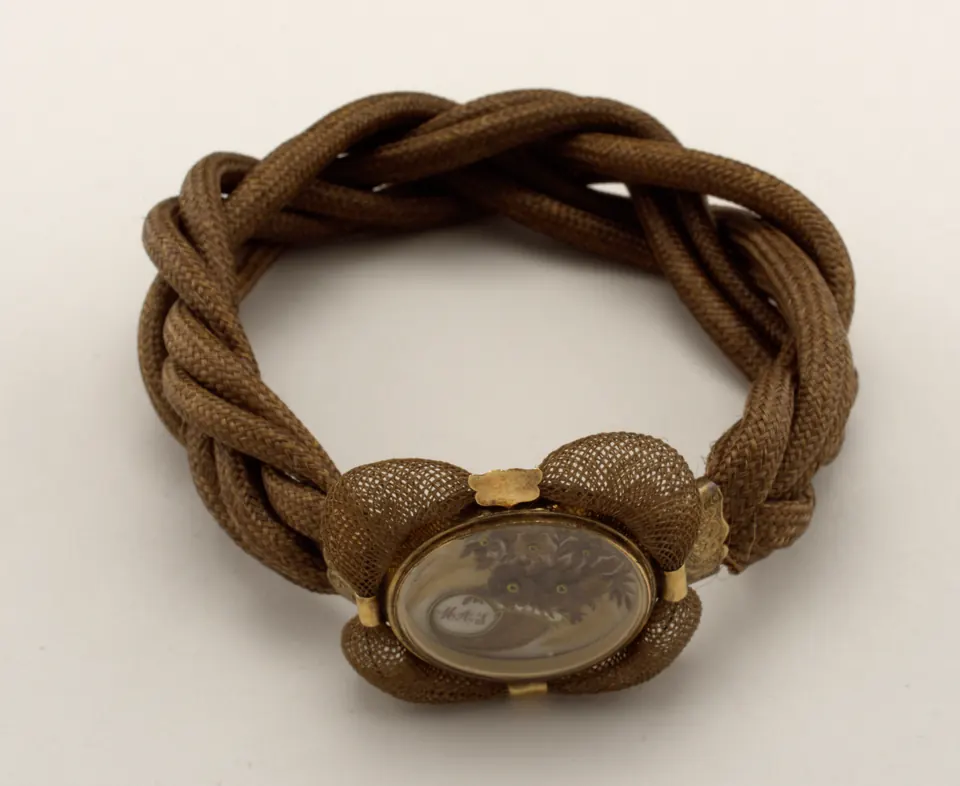
The bracelet is a rope of brown hair, braided so tightly it looks like cord, knotted around itself and closed with a little gold-framed picture. I found it on the Cooper Hewitt museum’s website and saved the photo to my phone. There was no price listed with the photograph. So I opened What’s It Worth?, tapped Library, picked the photo, and asked what a bracelet like this would be worth if one came up for sale.
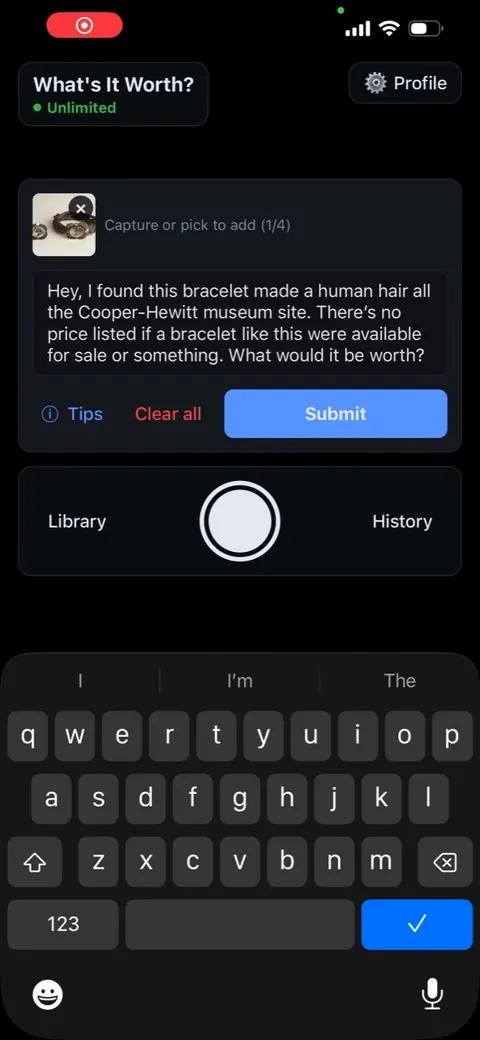
What the Scan Said
The app called it a Victorian mourning hair jewelry set, a braided hair bracelet and brooch. The museum photo I’d saved shows the brooch sitting beside the bracelet, so it was right to count both. It found 82 similar listings and came back with $475 for a comparable set in great condition and a resale range of $350–$600. It gave high confidence on the identification and medium on the price.
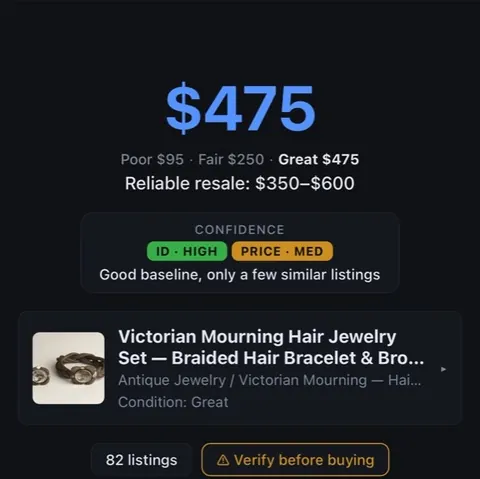
It was frank about the evidence. The listings were asking prices from $137 to $980, and it had found no confirmed sold prices. Most of them were simpler single pieces, lockets and pendants, rather than a bracelet and brooch together. It said the bracelet would carry most of the value. Then it asked me two things: what metal the fittings were, and whether the brooch belonged with the bracelet.
“Do the Initials Appear on Both?”
I went into Dive Deeper. I told it the bracelet carries the initials M.A.S., and that the museum shows the matching brooch, and I asked about the brooch alone and the two together. It put the brooch on its own at around $80–$150. For the pair it repeated $350–$600 and talked about a matched-set premium. A confirmed pair, it said, with the same monogram, hair color and construction, is the thing a collector pays extra for. Those are the app’s estimates, built from asking prices and judgment rather than sales. The question it ended with was the useful part:
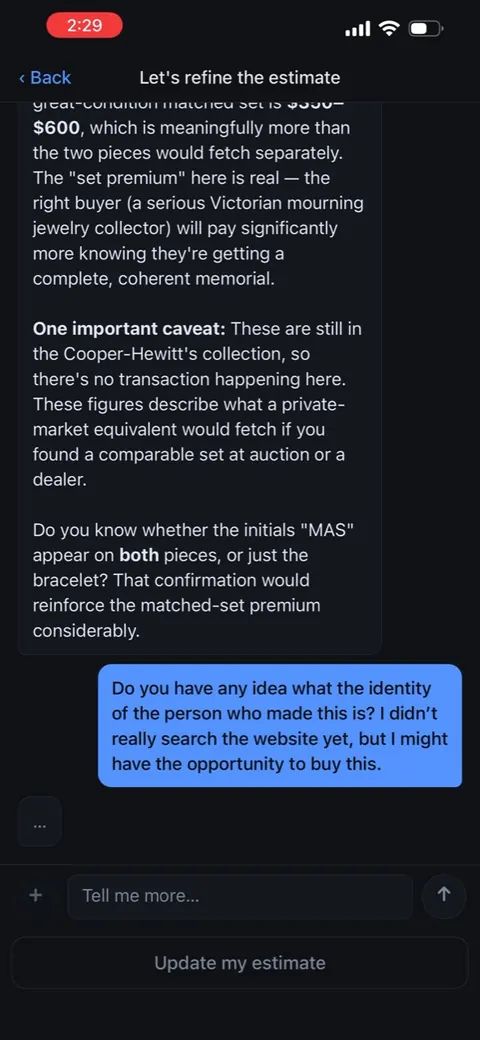
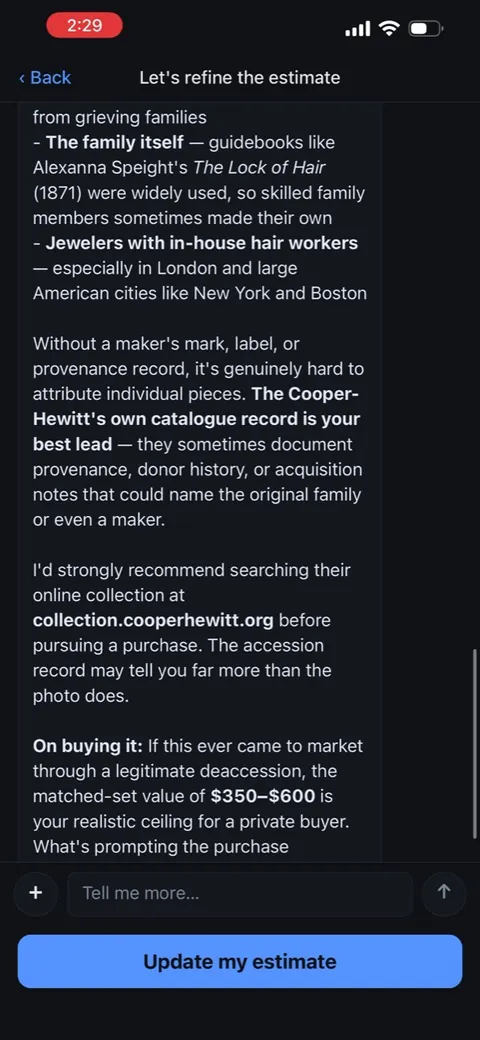
I didn’t know. I asked who made it instead, and I said I might have a chance to buy it. I’ll admit that was a daydream. Nothing in the museum’s article suggests the set is going anywhere. The app treated a sale as a hypothetical too. Then it went through the people who might have made a piece like this: specialist hair workers, jewelers with hair workers on staff, and families following published instructions at home. Without a maker’s mark or a provenance record, it said, the piece is hard to attribute. It told me to look up the Cooper Hewitt’s own catalogue record before I did anything else. “The accession record may tell you far more than the photo does.”
The Answer Was No
So I went to the catalogue. The brooch has its own record, 1960-17-2, right after the bracelet’s number. It has the same frame of woven hair and the same oval under glass. Inside are the same horn of plenty, the same flowers with yellow centers and the same short curve of seed pearls. The museum lists the same materials for both: hair, gold, ivory, seed pearls and pailettes, which are small spangles. It dates both to about 1837 and gives the place as England or the USA.
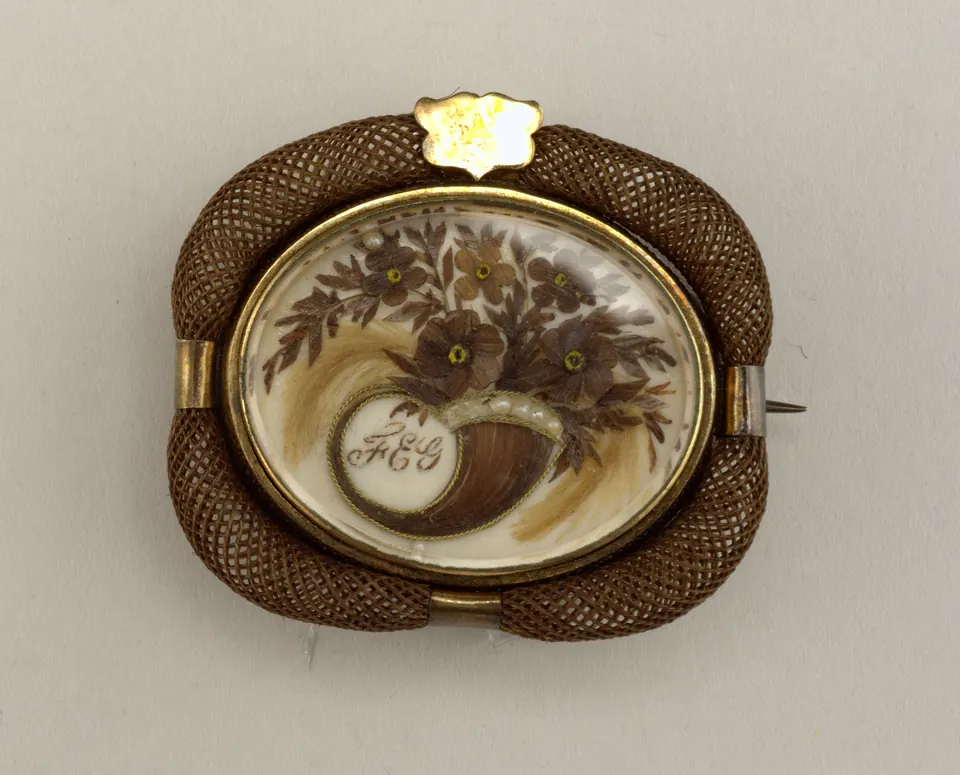
The initials in the little white cartouche are different. The bracelet says M.A.S. The museum reads the brooch as FEG.
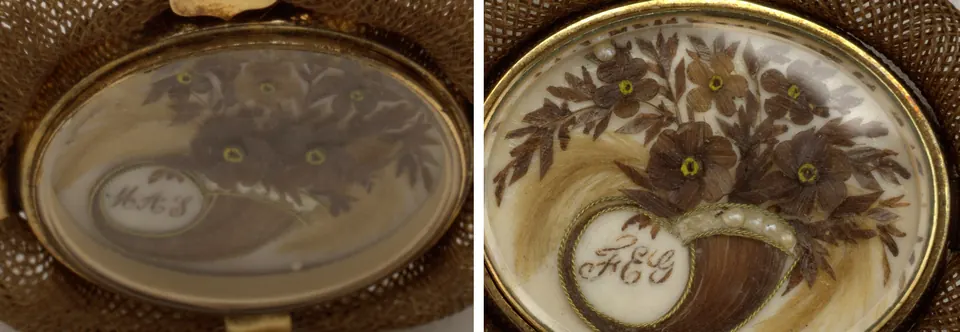
Look at the pictures, too. The app called them painted memorial miniatures. The museum says the horn of plenty is made of hair, and up close the petals have the fine, straight grain of cut hair laid flat. The whole brooch is less than an inch and a half tall.
What Makes Two Objects a Pair?
A matching design is weaker evidence than it looks. The museum’s article about this set explains that hair work became a home craft in the nineteenth century, partly because customers stopped trusting tradesmen. They sent a loved one’s hair off to be worked and sometimes got back a ready-made piece with someone else’s hair in it, or horsehair. Instruction books followed. Mark Campbell’s Self-Instructor in the Art of Hair Work came out in the United States in 1867, and The Lock of Hair in London in 1872. The article says those books illustrated preferred designs, including one that matches this ornament, and that many women must have worn nearly identical pieces. Rebecca McNamara for Cooper Hewitt
So a horn of plenty and five hair flowers don’t prove anything by themselves. There’s a reason to look at these two together. They have the same materials and approximate date, and they came to the museum from the same donor and carry consecutive accession numbers. And the brooch has a back.
The Name on the Back
The brooch’s record says it’s inscribed on the back: MARY ANN GROVES 1804–1837.
The year on the back fits the museum’s date of about 1837. It also changes my question. Could the S in M.A.S. have been an earlier surname for Mary Ann Groves? Could FEG have been the person who wore the brooch and missed her? The museum’s record gives me a name to look up. It leaves both sets of initials open.
The app was right about where to look, though. The photo gave me a price question. The catalogue gave me a name, two years and two sets of initials to explain. The app had asked me to look for matching monograms. What I found was more interesting. I’d want to know whose hair is in the horn of plenty. How to scan a saved photo of an object
Sources and Notes
- Object evidence: the Cooper Hewitt photograph of the bracelet and brooch, saved to a phone and scanned from the library in What’s It Worth?, with the app’s results and Dive Deeper replies shown above. The app’s figures describe comparable pieces drawn from asking prices; they are not prices for these objects, which are in the museum’s collection.
- Cooper Hewitt, Smithsonian Design Museum, bracelet catalogue record, 1960-17-1, and brooch catalogue record, 1960-17-2: dates, materials, dimensions, the initials MAS and FEG, the brooch’s inscription for Mary Ann Groves, and the gift of Mrs. Charles W. Lester. Museum photographs released under CC0.
- Rebecca McNamara, “Precious Jewelry of Hair: A Brooch and Bracelet Set for Mourning,” Cooper Hewitt, March 9, 2014: hair work as a mourning custom, the distrust of tradesmen, Campbell’s Self-Instructor (1867), The Lock of Hair (1872), and the published design matching this ornament.
- The app’s reply dates The Lock of Hair to 1871. The museum’s article gives 1872, which is the date used here.
- The museum catalogue records the two sets of initials and the inscription. It leaves the identities behind the initials open.