
I would have sworn the wave was the same every time. I knew the claws of foam, the boats pointed into trouble, the little white mountain that takes a second to register as a mountain. Then I put two impressions of Hokusai’s Great Wave next to each other. At the far right of one, just above the boat, a line of blue ink stops in the middle of being a line.
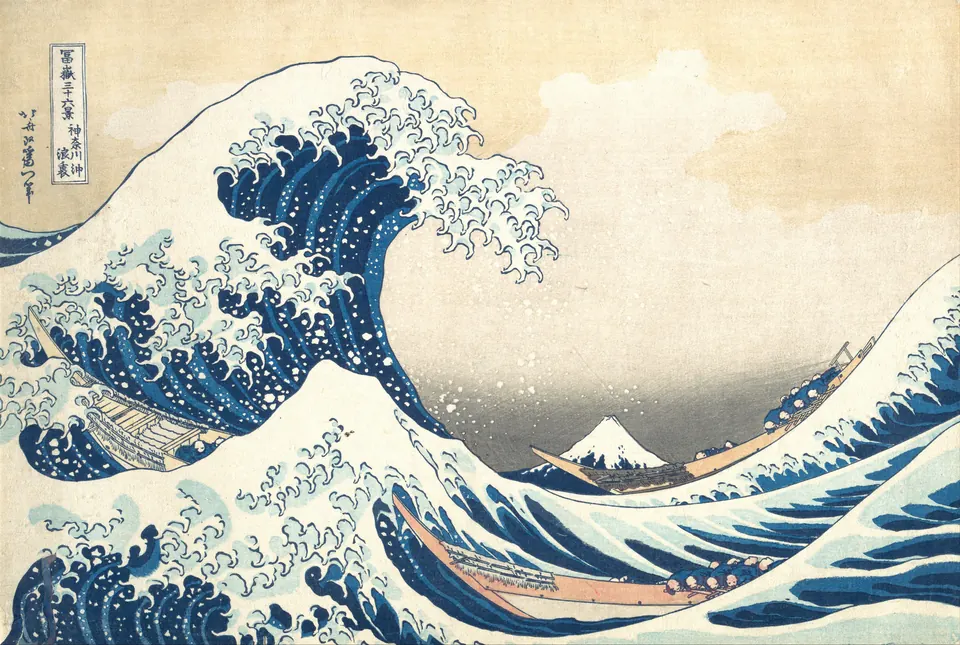
Look at the little wave on the right
The full title is Under the Wave off Kanagawa. The Met dates both of these impressions to about 1830–32. Both belong to Thirty-six Views of Mount Fuji, which helps explain why there’s a mountain almost small enough to miss in a picture that everyone remembers for its water. The line I’m looking at belongs to the swell that rises out of the right edge. Follow it toward the point of the boat, where the people are hunched in a row. That’s where the two sheets disagree. The Met’s catalogue entry for the second impression
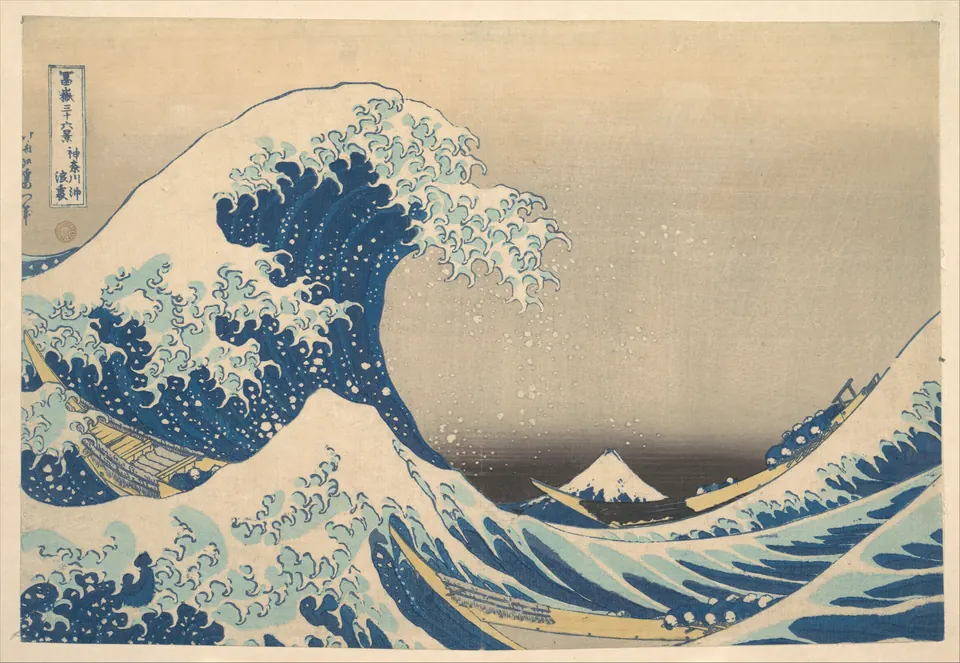
What a worn woodblock leaves behind
British Museum scientist Capucine Korenberg gathered images of 111 impressions to see what changed as the blocks wore down or were replaced. She used the gap in JP10 to illustrate what happens when a thin raised ridge on a block breaks. A missing bit of wood leaves a missing bit of ink. You can follow that tiny absence from sheet to sheet. Suddenly a picture of one instant, just before a wave comes down, has its own history of things happening slowly. Capucine Korenberg’s study, figures 2 and 28 and table 6
There’s a good trap on the same sheet. The little title box at the upper left of JP10 looks almost intact. Korenberg says that doesn’t square with the wear elsewhere. Examination with a magnifier at The Met confirmed that the box had been retouched. If I’d known only to check the box, I would have stopped looking at exactly the wrong moment. Korenberg’s discussion of the retouched title box
You can recognize the wave and still have a question
Suppose one turns up online in a gilt frame with a description that just says “Japanese print.” I’d save the photograph and put it into What’s It Worth? The design gives you a useful name to search. For Dive Deeper, I’d add the best photo the seller has of the margins and ask which details would help separate a vintage woodblock print from a more recent reproduction. I’d ask for the back too, and for the size of the paper inside the frame. The useful answer might be one extra photograph to ask for. I’d leave the date open until I could see what that photograph showed. How to work from a saved listing photo
After all this I still look at the big wave first. Then I look at the little one on the right. It takes about a second now, and I see the printmaker’s work in a place I used to hurry past. Another print with a story hiding outside the picture
Sources and Notes
- Both images are public-domain photographs of prints held at The Met. Compare the right-hand swell in JP1847 and JP10.
- Capucine Korenberg identifies the wave-line break in figure 2, lists JP1847 among the early impressions in table 6, and discusses the retouched title box and examination at The Met alongside figure 28. The Making and Evolution of Hokusai’s Great Wave