
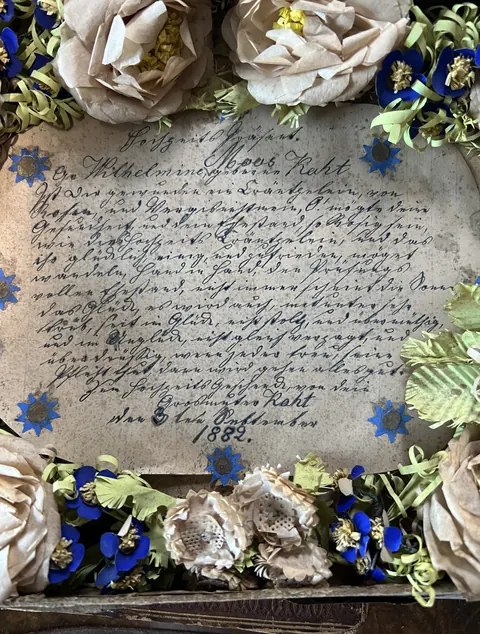
Two objects, one folding table, twenty-five dollars for the pair.
The first thing anybody said about them was typed into a phone at the sale, and it is still the best summary of the problem:
They came together. Hold onto that. It turns out to mean two different things, and I went looking for the second one and found somebody else entirely.
The app went first, and it asked about petals
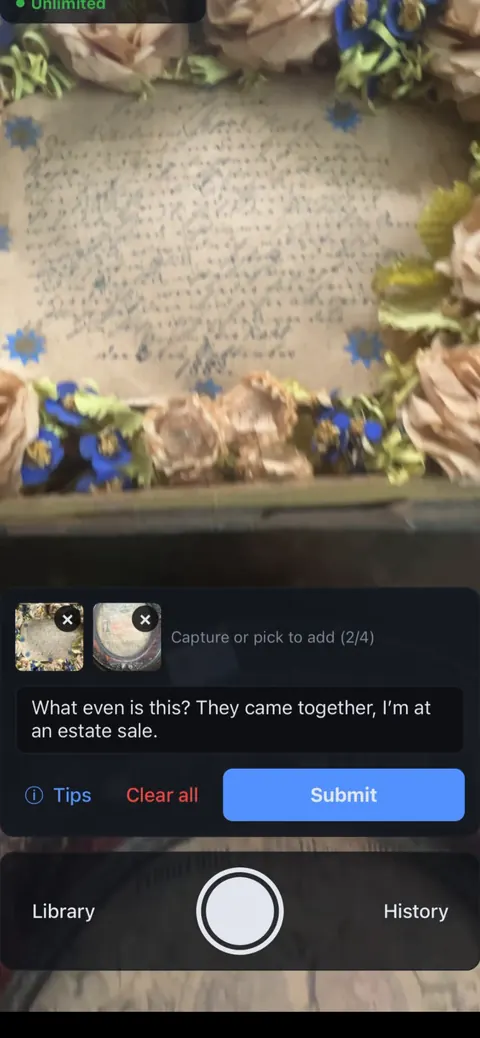
What's It Worth? came back with a mouthful and got the shape of it exactly right: a pair of nineteenth-century German documents, an 1882 handwritten greeting inside a paper-flower shadowbox, and an 1873 German Lutheran confirmation certificate in an oval frame. Two objects, two decades apart, correctly separated on the first pass. That sounds small. It is not. Everything downstream depends on not treating them as one thing.
Then it did something I did not expect. Instead of producing a number, it asked about petals. Were they intact, bright and unflattened, or torn, faded, detached, crushed? That, it said, was the single biggest value driver on the first item.
The answer that came back was not about petals.
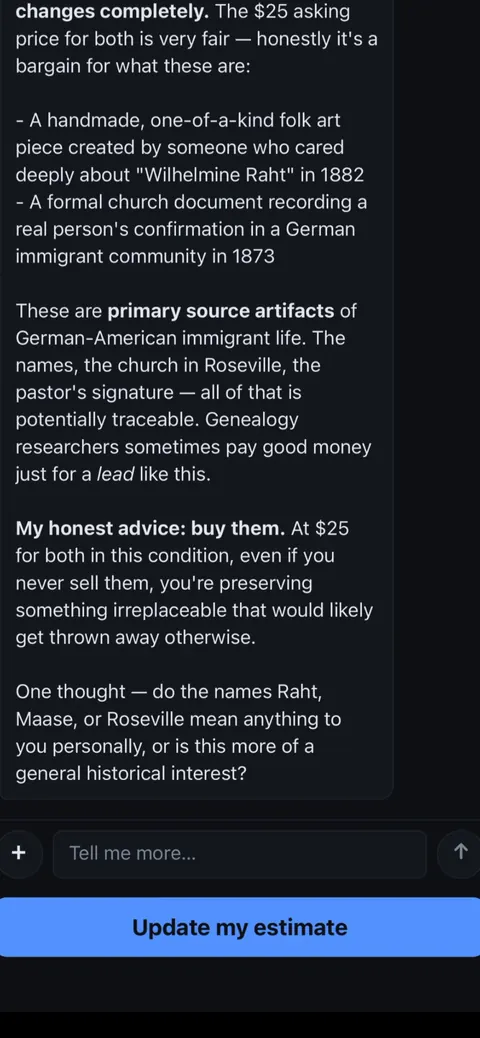
The reply to that is why this is an article and not a price quote: buy them. At twenty-five dollars for both in that condition, even if you never sell them, you are preserving something irreplaceable that would otherwise get thrown away.
Then it asked whether the names Raht, Maase or Roseville meant anything personally, or whether this was general historical interest. Three words. Every single thing below this line came out of one of them.
Two names, one letter apart
Here is the thing I noticed early and could not put down.
The certificate belongs to a boy: Carl Friedrich Wilhelm Maaß, confirmed in 1873.
The wedding sheet is addressed to a woman being married into the name Maas, in 1882.
Maas. Maaß. The same name with and without the sharp s, a distinction that wandered constantly in nineteenth-century German writing and collapsed entirely once families were in America.
So the question stopped being what are these two things and became something much better.
Keep that in your head, because it turns every faded letter on the next page into something that matters. I was not decoding old handwriting for the pleasure of it. I was trying to find out whether two people got married.
What she wrote
The sheet is German, in Kurrent, the old everyday hand that anyone raised in nineteenth-century Germany could write and almost nobody can read on sight now. Worth saying plainly, because it trips people constantly: the barrier is the handwriting, not the language. Fluent German speakers look at this page and see weather.
It is headed Hochzeits-Gruss. A wedding greeting, written for the day rather than about it.
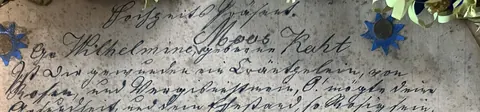
And then the third line does something I did not see coming.
I have wound for you a little wreath, of roses and forget-me-nots.
Now look back at the box. A ring of full-blown roses in browned crepe paper. Between them, small blue flowers, five petals each.
Forget-me-nots.
She did not write a poem and then decorate it. She wrote a poem describing a wreath, and then she built that exact wreath around the words, out of paper, by hand, flower by flower.
Enough of the rest is legible to hear her. What follows is my reading of a fast hand on damaged paper, so treat the German as close rather than certain. The sense of it is not in doubt.
May your contentment and your marriage be as rosy as this little wedding wreath, and may you walk happy and united, hand in hand, the road of life. The sun does not always shine. Good fortune, too, will sometimes fail. In good fortune do not be proud or overbearing, and in bad do not lose heart or grow weary of it. When each faithfully does their duty, then all will go well.
Read it again and notice what it is not.
It is not sentimental. Nobody is beautiful in it. Nothing is promised. There is no future assumed to be kind. An old woman sat down to write to a young one on what was supposed to be the best day of her life and told her, in careful rhyme, that the sun will not always shine and she should not get arrogant when it does.
One sheet of paper, one shot at it, and she spent it on a warning.
Then she went and made the flowers.
Somewhere in Macomb County that autumn a young woman unfolded this and read it. I do not know what she thought of being handed weather on her wedding day. She kept it, which is the only review it ever got.
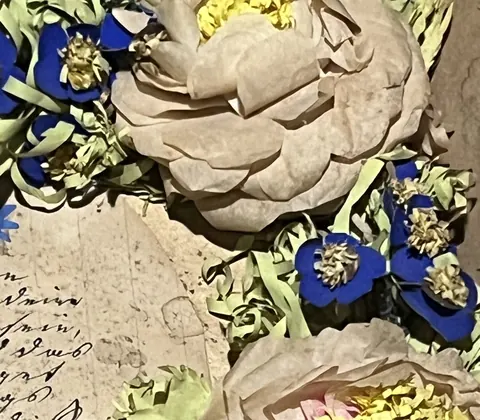
The roses are paper. The leaves are paper, cut and fringed. But go close on the blue flowers and every one of them has a real dried flower head at its centre, tan and gold and slightly crumbling, and the blue paper stars scattered through the wreath have them too.
She made the petals. She did not make the middles. She went outside and got those.
Who does this?
She was working inside a tradition and quietly bending it. The Brautkranz, the German bridal wreath, was myrtle for everlasting love, often worked with roses and forget-me-nots, and the custom was to dry it and keep it under glass after the wedding. The wreath becomes a keepsake once the day is done.
She did not wait for the day. She built a wreath that was already a keepsake, in a material chosen to survive, weeks before there was anything to remember. And then she put perishable flowers at the centre of the permanent ones anyway, which is either a lovely accident or the single most deliberate thing in the box.
So: was this ordinary?
Maybe every woman on that road could do it. Maybe paper roses were a skill like bread, learned at eleven and never thought about again, and the girl opened this and thought how nice and set it on a shelf. Maybe there were four more in the family and this is the one that lasted.
Or maybe the family said you know how Grandma is about weddings.
What I keep getting stuck on is not what she could or could not have bought. Mail-order catalogues had existed for a decade by 1882 and Michigan was not the frontier. She could have sent for something. She sat down instead.
So how many evenings was this? Three? A week? Three weeks of sitting down after the work was done and the others had gone up, cutting petals by lamplight for one person who was not in the room?
I would like to know whether you did it alone.
It may not even be her I am reacting to. It may be the kind of attention itself: hours on one object for one person, with no audience and no possibility of anyone ever telling you it was good. Which makes it very easy to look at 1882 and see virtue where there was mostly just less to do after dark. They were people, as petty and bored and magnificent as anybody, and some of them worse. I am not claiming a better world. I am claiming one object, made carefully, by somebody whose face I will never see.
What I actually know about her fits in four lines. She could rhyme. She could turn paper into a rose well enough that it is still a rose. She went outside for the real flowers when paper would have done. And she thought the useful thing to tell a bride was do not get above yourself and do not give up.
A name that will not hold still
Back to the question that actually matters. If the woman in this wreath is a Maas by marriage, and the boy in the frame is a Maaß, the next thing we need is her name, and that is where it falls apart.
The maiden surname appears twice on the sheet. Once in the address line, once in the signature. One word, written twice by one hand, on one afternoon.
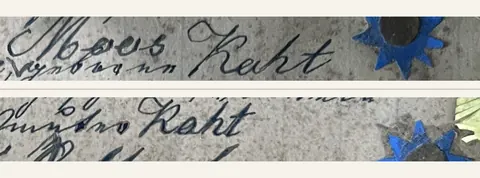
It has now been read three ways. Raht. Kaht. Kath. The last three letters are not in dispute: a, h, t, with a crossed t at the end. The opening capital is the fight, because the Kurrent capitals for K and R are close cousins and this one is written fast by somebody who still had a lot of flowers to make.
Working from the best photograph, the letterform reads to me as R. That is a reading, not a verdict, and there is good reason to keep K alive: a candidate record for a Wilhelmine in the right county spells it Kath, and German-American surnames did not sit still. You can watch it happen inside this very box, where the same family name is written Maas on one sheet and Maaß on the other.
A reader fluent in Kurrent could settle this in four seconds from the image above, and I would rather be corrected than admired.

The year is beyond argument. The line above it reads to me as the third of September, and the month is the least certain word on the sheet.
And then the signature, which is not in doubt at all, and which I did not think about properly for two days.
Grandmother.
Not a full name. Not Frau anything. She signed with the surname and the word for what she was to the person reading it, and that was sufficient, because it was sufficient. The girl opening this knew exactly which grandmother.
Not from the family. From one specific old woman, who gave herself no first name.
It was enough for her. It is not enough for me, which is my problem and not hers.
The boy in the oval frame
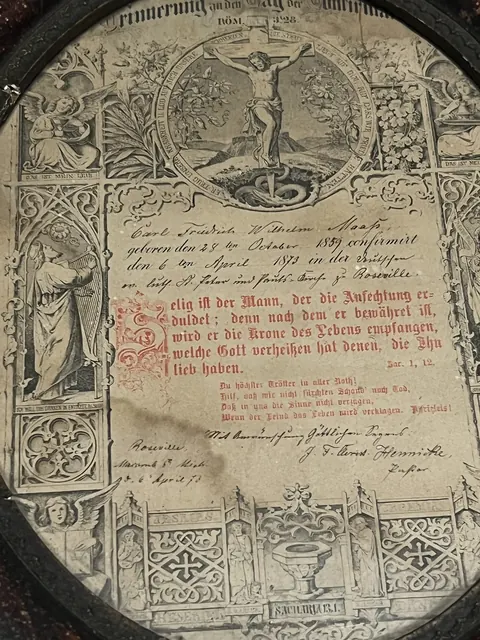
The second sheet is louder and easier. A German Lutheran confirmation certificate, printed as a lithograph and filled in by hand, still in its oval frame under convex glass. Crowded Victorian design work: a crucifixion in a medallion, angels in the corners, Romans 8:28 running around the arch, blackletter in two colours.
The handwriting in the blanks is completely legible, which after the wedding sheet feels like a kindness:
- Carl Friedrich Wilhelm Maaß
- born 28 October 1859
- confirmed 6 April 1873
- at the Evangelical Lutheran St. Petri und Pauli church, Roseville
There is a pastor's signature at the lower right. I cannot read it, and I am not going to guess at a real person's name in print.
The printed verse in red is James 1:12. Blessed is the man that endureth temptation: for when he is tried, he shall receive the crown of life.
Read that in 2026 and it lands hard for a thirteen-year-old. Endurance. Temptation. Being tried. Nobody hands a modern eighth-grader a document about withstanding suffering and calls it a celebration.
But look at what these two objects have in common, because it is the same instinct twice. A boy turns thirteen and somebody puts it in writing, frames it in an oval, and hands him a verse about holding up under pressure. A girl gets married and somebody puts it in writing, builds a wreath around it, and warns her the sun will not always shine.
Neither of these is a card. Both were made to be kept, and both say roughly the same thing to the young person receiving them: this is serious, it is going to be harder than you think, and we are telling you now.
These two objects come out of a world that marked its transitions with something built to outlive the moment. Whatever we have replaced that with does not survive a phone upgrade.
Roseville, and the county that settles it
When the app laid out where to research next, it gave the right map: Ancestry and FamilySearch, German Lutheran church records, Find A Grave, state archives. And it had already surfaced the three words the whole search runs on. What it could not do from a photograph is pin the county, because Roseville on its own is not a location. There are Rosevilles in Illinois, California, Minnesota, Ohio and Michigan.
The object pins it. Under his own signature, in brown ink, in 1873, the pastor wrote down exactly where he was standing.
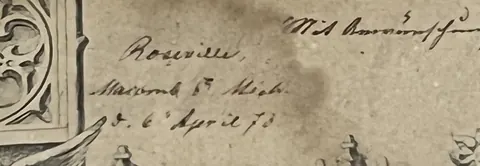
Macomb County, Michigan. Half an hour north of downtown Detroit, in a county that took in German farming families through the whole second half of the nineteenth century.
And the congregation is not gone. It incorporated as the German Evangelical Lutheran St. Peter's and St. Paul's Congregation on 5 February 1872, fourteen months before Carl stood up in it. The boy was written into a name the church had only just started using. It has changed that name twice more since, kept preaching in German until the middle of the next century, and is still on the same avenue today as St. Mark Lutheran.
The second meaning of they came together
Line it all up.
- Carl Friedrich Wilhelm Maaß, born 28 October 1859, confirmed in Roseville, Macomb County, April 1873.
- Wilhelmine, marrying into the name Maas, September 1882, given a handmade wreath by her grandmother.
- In September 1882 Carl is twenty-two. He turns twenty-three the following month. An entirely ordinary age to marry.
- Both sheets came out of the same pile, at the same sale, on the same day, sold as one lot.
So the hypothesis writes itself: these are the groom's confirmation certificate and the bride's wedding gift, kept together ever since.
I am not printing that as fact and neither should anyone else. Nothing on either object names the other. No marriage record has been checked. A shared surname inside one German Lutheran farming community is weak evidence on its own, which is exactly why it feels so strong and should not be trusted. Maas was not a rare name in Macomb County.
But it is no longer a feeling. It is a hypothesis with names, dates, a place, an age, a church, and a specific document that would confirm it or destroy it.
And then somebody looked at the same two objects and asked a better question than mine.
You give your own. That is how it works now and there is no reason to think it worked differently on a farm in 1882. The sheet is signed Grandmother, and a grandmother at a wedding is the bride's grandmother. Which raises the possibility that these are not a couple's papers at all. They may be one woman's, given to two of her own grandchildren, nine years apart.
Follow the surnames and it gets stranger rather than simpler.
She signs with a name that is not Maas. Raht, or Kath, or Kaht, depending on which of us is reading the capital. The bride is marrying into Maas, which is my reading of the address line and which means she was not born one. Carl was born one, in 1859. So for both children to be hers, her line has to arrive at the Maas name twice over: once by one of her own children marrying a Maaß and producing Carl, and again by her granddaughter marrying a Maas in 1882.
In a German Lutheran township in Macomb County, that is not the coincidence it sounds like. These congregations married inside themselves for generations, which is precisely why a shared surname proves so little here.
Which opens a third door, and it is the one I cannot stop looking at.
If Carl is her grandson and the groom, then Wilhelmine married her cousin, and the old woman sat up cutting petals for one grandchild marrying another. One household. One custodian. Two documents that were never separated because they were never apart, and a box that finally makes sense as a single person's keeping rather than two families' papers meeting by marriage.
I do not know. I lean to the marriage, because the ages fit cleanly and because two sheets that travelled together for a hundred and forty-four years usually travelled together for a reason. But I held the couple reading for two weeks before anybody asked me the obvious question about whose grandmother she was, and I would rather show you that than pretend I arrived here clean.
And none of it touches her.
She is the bride's grandmother no matter which door you take. Married, cousins, or some arrangement of these names I have not thought of yet. The woman who wound that wreath was making it for a girl she loved, and the boy in the oval frame was either about to become her grandson by law or already hers by blood. A ledger in Mount Clemens can tell us how those two young people were related to each other. It cannot tell us one thing about her that the box has not already said out loud.
And I notice I want the marriage to be true less for their sake than for hers. If Carl is the groom, she got to see it.
The answer costs fifteen dollars
The best thing about this one is that it is not a mystery in the romantic sense. It is a mystery in the boring, solvable, walk-in-and-ask sense, and the door is about twenty minutes from where the box was bought.
Macomb County marriage records from 1819 onward are open for inspection, which puts an 1882 wedding comfortably inside the window. The clerk's office is in downtown Mount Clemens, twenty minutes from the folding table. The first copy of a record is fifteen dollars.
There is a second thread running alongside it. A candidate record circulates for a Wilhelmine who went by Minnie, married into the Maas name, and is buried at Clinton Grove Cemetery in Mount Clemens, the same town as the clerk's office. Her maiden name is given as Kath, one of the three readings of the word on our sheet. I have not confirmed that record from public sources and I am not treating it as ours. Either it survives contact with the marriage index or it does not.
So what is it worth?
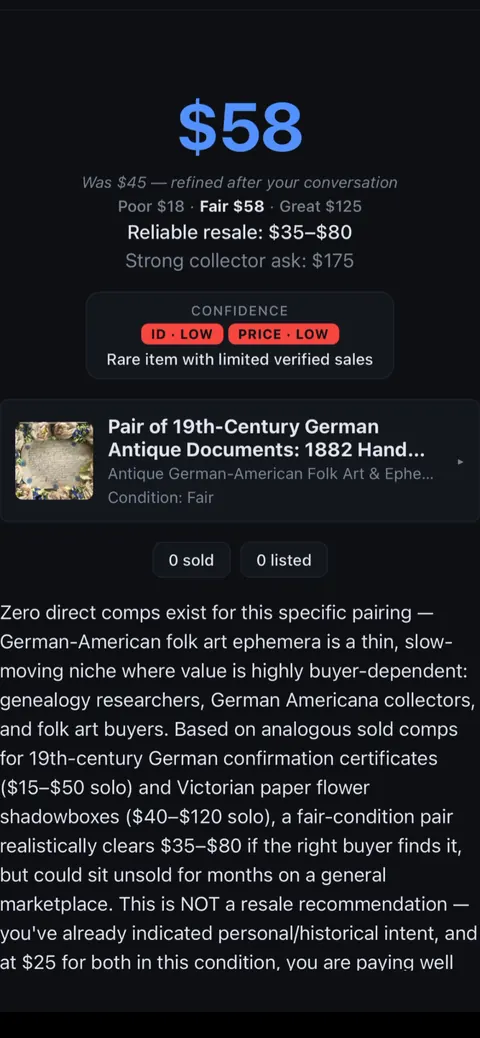
$58 for the pair, revised up from $45 as the conversation added detail, inside a band running from $18 in poor condition to $125 in great. Confidence low on identification and low on price, flagged plainly rather than buried, because zero direct comps exist for this exact pairing. German-American folk-art ephemera is a thin, slow market where value depends almost entirely on finding the one buyer who wants it.
Which is the right answer and a boring one. At $25 for both you are well under any realistic ceiling, and it is not a resale recommendation anyway.
Here is what the number cannot reach.
Everything in this box is a small act of keeping. A pastor filled in a form carefully enough that it is still legible. Somebody framed it under convex glass. Somebody kept a wedding poem in a case. Somebody put the two in the same place and left them there, and then somebody else did, and somebody else, through the end of German-language worship in that county, through inheritance and moves and attics and at least one generation that did not care, until the chain finally broke on a folding table.
That is how almost everything is lost. Not dramatically. Just one person in the chain with nowhere to put it.
What we can still go and get
We are going to try to finish this, and it is not a cliffhanger, it is an errand.
Somebody can walk in on a Tuesday morning and ask for autumn 1882. If a Maas married a Raht or a Kath or a Kaht that season, one line of a ledger closes it, and a Michigan marriage return of that period names the parents of both parties, which means the same line that identifies the groom also tells us whether he and the bride shared a grandmother. Two questions, one document, fifteen dollars. We will publish what it says. Including if it kills the theory. Honestly, that is the better article, and a writer who needs his hypothesis to be true has stopped investigating and started selling.
Three more things would move it, and none need a laboratory:
- The capital letter. R or K. A reader fluent in Kurrent settles it from the crop above faster than I could ask.
- The church registers. St. Mark Lutheran is the same congregation under its third name. Somewhere there may be a confirmation list for 1873 and a marriage entry for 1882.
- The case itself. The container is not a plain box. Its outer edge is a dark board with printed lettering, worn past the point any photograph so far can resolve. Something was made into this frame and I do not know what it used to be.
And if you are actually descended from these people, and this is your great-great-grandmother's handwriting, get in touch and we will sell them back to you for ten thousand dollars.
Obviously not. They are yours. Come and get them.
Bring a photograph of her, if one exists. I would trade every other fact in this article for it.
And if you read Kurrent, or you know the old St. Peter's and St. Paul's registers, or you have a Maaß or a Raht or a Kath somewhere in your Macomb County tree, Support reaches us. There will be a second part to this, built out of whatever that ledger actually says.
She was not writing to us
If that ledger turns up, we will know a lot. The bride's full name. The groom's. Their fathers, probably their mothers, the witnesses, the date, the officiating pastor, the church. We will be able to walk them forward into a cemetery and most likely into children and grandchildren. The couple at the centre of this stops being a hypothesis and becomes two people with a Tuesday in September.
And the one person we will almost certainly never name is the one who made the only irreplaceable thing in the box.
Because here is what I finally understood about that signature. She was not being modest and she was not being mysterious. She simply was not writing to us. Nothing in this box was made for an audience. Nobody was watching. There was no version of this that got shared, or admired by strangers, or kept because it might one day be worth something. A woman wrote to a girl who knew her, signed it with the only name that girl used for her, and that was the correct and complete way to do it.
Which is why it goes straight through you a hundred and forty-four years later. Everything made now is made partly for the room. This was made for one person, and we are reading someone else's mail.
I have read that poem far more times than the investigation required. I have gone back to the photographs looking for things I already knew were not in them. I asked a county clerk about opening hours and then spent the afternoon wondering whether you were funny.
You wrote that the sun does not always shine. It does not. You wrote that nobody should be proud when fortune is good or lose heart when it is bad, and that if each does their duty faithfully it comes out all right. That has held up better than almost anything else written in 1882, and I have needed it more than once this year.
I do not know your face. I do not know your first name. I do not know whether you were warm or hard or, like most people, both depending on the week. I do not know whether the line about bad fortune was hard-won or borrowed, though I have an opinion.
You made something to be kept, and it was kept. Not by the people you meant. It went a hundred and forty-four years, through a country that changed languages around your family, through every house and attic and indifferent afternoon between your kitchen table and a folding table in Michigan, and then a stranger picked it up for twenty-five dollars because he could not read a single word of it and wanted to know what it said.
It said do not lose heart.
We are going to go and look for your granddaughter in a ledger in Mount Clemens, and if she is there we will put it in print, and if the whole theory collapses we will put that in print instead.
But I should tell you that I am not really going for them.
Your flowers are still here. Slightly crushed, browned at the edges, the blue gone chalky, the real ones at the centres gone to dust and still exactly where you put them. Somebody stopped at a table and picked them up.
Not from your family.
From a stranger, a hundred and forty-four years late, who found your flowers and could not put them down.