
The plate walks in talking like a booster club president.
Gold rim. John Wooden's face. John Wooden as a young Purdue player. John Wooden as the eternal UCLA coach. A pyramid of virtues behind him. A signature down in the corner. A number on the back. The whole object is practically clearing its throat before anyone has asked a question.
This is the kind of thing that makes a room split into teams. One person says, "That's Coach Wooden." One person says, "It says limited edition." One person says, "Do not put that in the donation box." Someone else, usually the person now holding the phone, has to ask the tacky but useful question: does any of that turn into money?
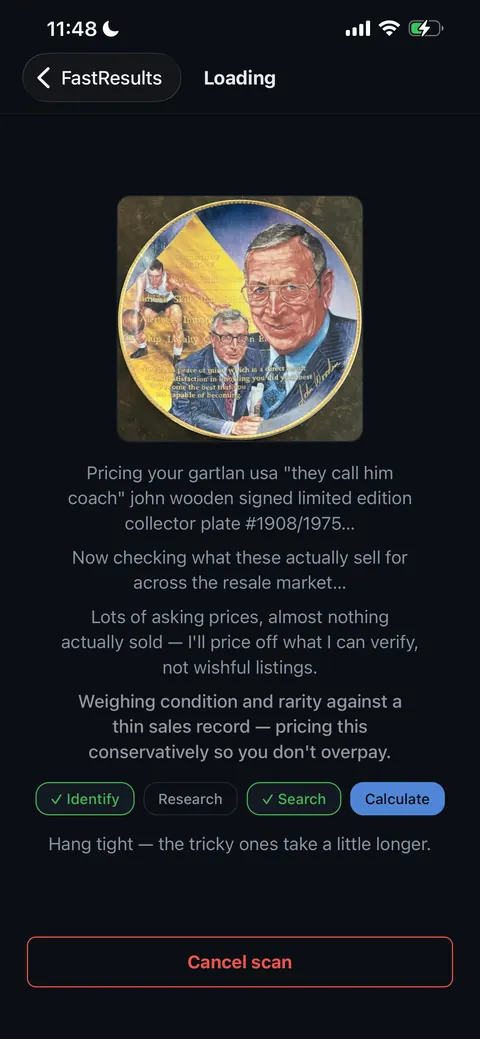
I opened What's It Worth? because this was not a normal decorative plate. It was too busy being official. The app recognized the useful shape of the problem quickly: a 1989 Gartlan USA John Wooden collector plate, titled They Call Him Coach, numbered 1908 out of an edition stated on this plate as 1,975, with a resale range that did not behave like the gold border wanted it to.
The Plate Makes Its Case
On the front, Michael J. Taylor's artwork stacks Wooden into an entire little career shrine. There is the coach in glasses. There is the earlier athlete crouched over a basketball. There is the Pyramid of Success, or enough of it to make the plate feel as if it might correct your posture.
The pyramid is the first door I almost walked through wrong.
Once you see a pyramid on an American object, the mind gets theatrical. Dollar bill. Great Seal. Eye of Providence. Secret meanings. The usual attic-door stuff. I let that thought run for a minute because it was fun, and because WIW had already shown me the plate was not just a portrait. It was a little system of symbols pretending to be a collectible.
Then the object spoiled the conspiracy by being more interesting than one. Wooden's pyramid is not hidden. It is printed right there in plain daylight. The official Pyramid of Success is a moral architecture: Industriousness, Enthusiasm, Friendship, Loyalty, Cooperation, Self-Control, Alertness, Initiative, Intentness, Condition, Skill, Team Spirit, Poise, Confidence, Competitive Greatness. It is not a secret code. It is the opposite. It is a man explaining, almost painfully, that there is no magic door.
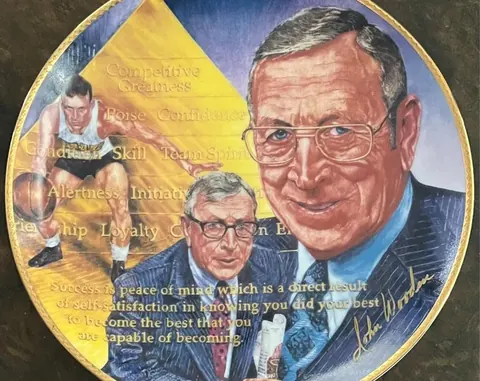
That makes the plate funnier and sadder. It puts a philosophy of earned success on an object whose market pitch depends on manufactured scarcity. Wooden says build the blocks. The plate says worldwide edition, artist proofs, personally signed, please preserve this fragile circle because the future may reward you.
Even the title is doing work. They Call Him Coach sounds like a salute to Wooden's famous autobiography, They Call Me Coach. The pronoun has shifted. The book is Wooden speaking. The plate is everyone else pointing at him and saying, that one.
If you know nothing about John Wooden, the plate gives you the short version loudly. UCLA. Coach. Success. Best effort. Calm authority. If you know a little more, the numbers are the absurd part. UCLA says Wooden's Bruins won 10 NCAA championships, including seven straight, and had an 88-game winning streak. The official UCLA athletics biography adds the career record: 885-203 across 40 years, with a .813 winning percentage.
That is the imbalance here. The man was not a souvenir-level figure. He was an actual monument in American basketball. The souvenir is the thing being cross-examined.
Gartlan, And The Age Of Serious Plates
Gartlan USA was not making dinnerware. The back of this plate says, politely but firmly, "decorative item" and "not to be used for food consumption." That is a useful warning, because a collector plate has always had one job: sit there being meaningful.
Gartlan appears in the secondary market as a maker of sports and pop-culture collectibles: plates, figures, limited editions, the kind of objects that arrive already numbered and biographical. Replacements lists Gartlan USA as a collectibles maker with patterns for Wayne Gretzky, Pete Rose, Kareem Abdul-Jabbar's Sky Hook, and a John Wooden coaching line. CollectorPoint lists a Gartlan basketball plate series that includes They Call Him Coach - John Wooden and a 1989 Kareem Abdul-Jabbar plate, both by Michael J. Taylor.
In other words, this was not a one-off trophy-store accident. It belonged to a late twentieth-century world that believed a collectible could announce itself into importance: limited edition, artist, serial number, official tribute, famous subject, please keep the box.
That world produced a lot of objects that still look valuable because they were designed to look valuable. The market has become less obedient. It no longer treats a serial number as destiny just because the backstamp used a formal voice.
The Back Starts Arguing
The back is where the plate stops being a portrait and starts being evidence.
It says the artwork was by Michael J. Taylor and approved by John Wooden. It says the plate was personally signed by Wooden. It gives a short career summary: from 1964 to 1975, UCLA won 335 games and lost 22, including an 88-game winning streak; across 40 years of coaching, Wooden had a .813 winning percentage; he was a three-time All-American at Purdue. It states a worldwide edition size of 1,975, marking the year he retired after winning his tenth NCAA championship with UCLA. It also says there were 250 artist's proofs. Then, in hand-numbered ink, this example becomes 1908.
That sounds terrific. It also creates the question that matters most.
What does "signed" mean here?
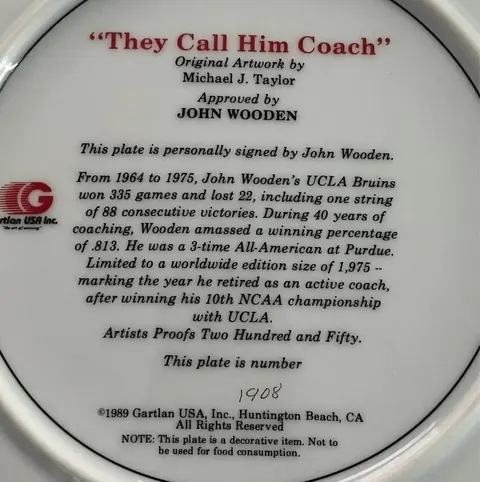
A true hand signature changes the object. A fired or printed facsimile signature mostly changes the decoration. A later marker signature with JSA or PSA authentication is another category again. The front of this example has a gold Wooden signature, and the back claims personal signing, but a photograph cannot authenticate ink, pressure, surface, or provenance. I would want a close raking-light photo, original paperwork, or third-party authentication before pricing it as a hand-autographed Wooden piece.
This is not nitpicking. It is the whole game.
Some market examples call similar plates autographed. One Mears listing describes a 1989 Gartlan Wooden plate, number 824, personally signed in gold marker and accompanied by a JSA auction letter. Aeron House listed another numbered 1989 example with an estimate of $50 to $100, but its own page warns bidders to rely on the photo rather than AI-generated text. Julien's recorded a 1989 They Call Him Coach plate by Gartlan with a $50 sold price against a $100 to $200 estimate. An eBay listing for an autographed Gartlan Wooden plate has also shown a $19.95 asking price with one sold.
The market is telling you something, but quietly: even with Wooden attached, buyers are not lining up in rows like it is Pauley Pavilion in 1972.
Why It Feels Richer Than It Is
The collector-plate market had a long run on the idea that limited meant scarce and scarce meant valuable. Sometimes that works. Often it just means 1,975 people were invited to store the same fragile circle in a closet.
There is another small wrinkle. CollectorPoint lists They Call Him Coach with a limit of 10,000 and "numbered without certificate." This plate's own back says 1,975, and the hand number is visible as 1908. I trust the object in front of me for this specific example, but the conflict is useful. It shows why these objects punish lazy certainty. Databases, listings, seller titles, edition variants, artist's proofs, certificates, and autograph claims all start talking over one another.
WIW was good here because it did not let the plate win by volume. The scan moved from identification to the market problem: high confidence on what the object is, low confidence on price because verified sales are thin. It separated an asking price from a sale. It treated authenticated hand-signed examples as a different lane. That is the difference between enthusiasm and discipline.
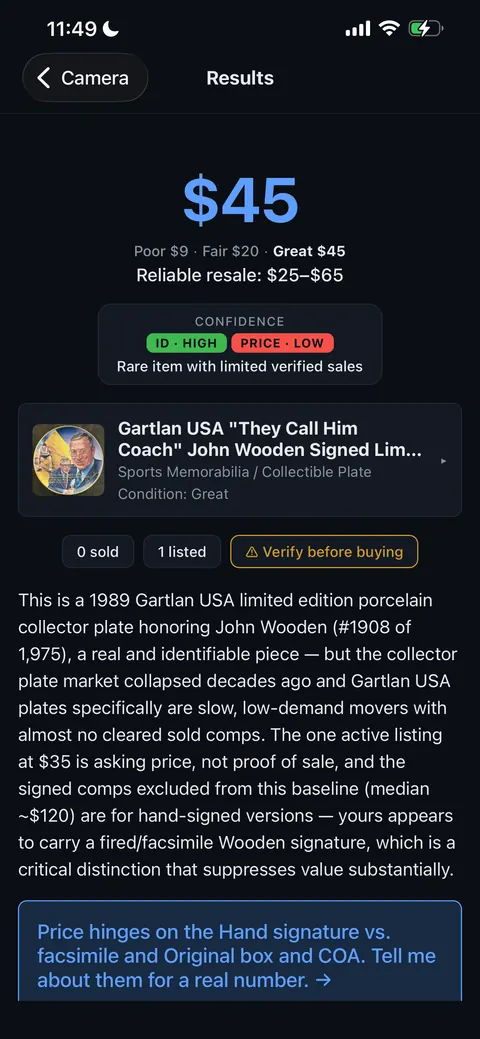
The app's full result put this example around $45, with a reliable resale range of roughly $25 to $65. That is not an insult. It is probably the most honest kind of answer this object can get from the available evidence.
A plate like this is not worthless. It has a real subject, a real maker, a visible edition number, a good presentation front, and a direct connection to one of the most famous coaches in American sports. It is also not a championship ring, not a game-used jersey, not a signed letter, and not automatically a premium autograph just because the front has a shiny Wooden name on it.
The collector-plate collapse was not really a collapse of porcelain. It was a collapse of certainty. People were sold the idea that saved objects would become wanted objects. Thirty-five years later, the wanted part has to be proved again one buyer at a time.
The Best Effort Problem
What I like about this plate is that it is trying so hard to be serious that it becomes a little tender.
It wants to preserve Wooden as Coach, not merely as winner. The words floating behind him are not box scores. Poise. Confidence. Skill. Team spirit. Alertness. Loyalty. The quote at the bottom is not about beating Kentucky. It is about knowing you did your best.
That is a dangerous sentence to put on a collectible, because collectibles are where we often do the opposite. We want the object to do better than it can. We want a number on the back to become a future buyer. We want a printed signature to behave like an autograph. We want a limited edition to mean demand, not just production.
Wooden's actual philosophy keeps ruining that fantasy. His Pyramid does not say, "Purchase scarcity and wait." It says work, self-control, skill, team spirit, poise. The whole thing is an argument against the collector-plate dream of passive appreciation. Nothing becomes valuable just because it was told to.
So the plate becomes a small family argument in porcelain. The sports person wants it respected. The decluttering person wants it gone. The optimistic person sees a signature and a number. The practical person asks for sold comps. Everybody is a little right, which is why nobody enjoys these conversations.
My read is simple. If the signature can be authenticated as hand-applied by Wooden, this becomes a more interesting sports-autograph object, though still one living in a narrow buyer pool. If it cannot, then it is a handsome 1989 Gartlan tribute plate with good Wooden content and modest resale gravity. Price it like the second until the first is proved.
The plate came in acting like a treasure. It leaves as something more useful: a real object with a real subject, a better argument than its market expected, and a number that stopped pretending to be destiny.
Sources And Market Notes
- Object evidence: WIW Drive photographs and screenshots; front artwork; backstamp and edition text; visible hand-numbering 1908; WIW result showing $45 and reliable resale around $25-$65.
- Official Coach Wooden site, Pyramid of Success: block names and Wooden's own explanations of the Pyramid framework.
- U.S. Bureau of Engraving and Printing: $1 note design featuring the Great Seal on the back.
- UCLA Anderson, Coach John Wooden: 10 NCAA championships, seven straight titles, 88-game winning streak, and Pyramid of Success context.
- UCLA Bruins, John R. Wooden: An American Icon: career record, .813 winning percentage, 10 championships, 88-game streak, and Hall of Fame note.
- Official Coach Wooden bookstore: They Call Me Coach, Wooden's classic autobiography with Jack Tobin.
- Replacements, Ltd.: Gartlan USA collectibles listings, including sports and John Wooden patterns.
- CollectorPoint: Gartlan USA basketball plate series, including They Call Him Coach - John Wooden by Michael J. Taylor; note the conflicting 10,000 limit listed there.
- Julien's Auctions: 1989 They Call Him Coach Gartlan plate, sold price shown in search result as $50 against a $100-$200 estimate.
- Aeron House Auctions: comparable 1989 numbered Gartlan Wooden plate listing with $50-$100 estimate and photo-first caution.
- eBay current/sold listing context: autographed Gartlan Wooden plate listed at $19.95 or best offer with one sold; used as market context, not a definitive comp for this exact plate.