The $5 Syriac-script religious book
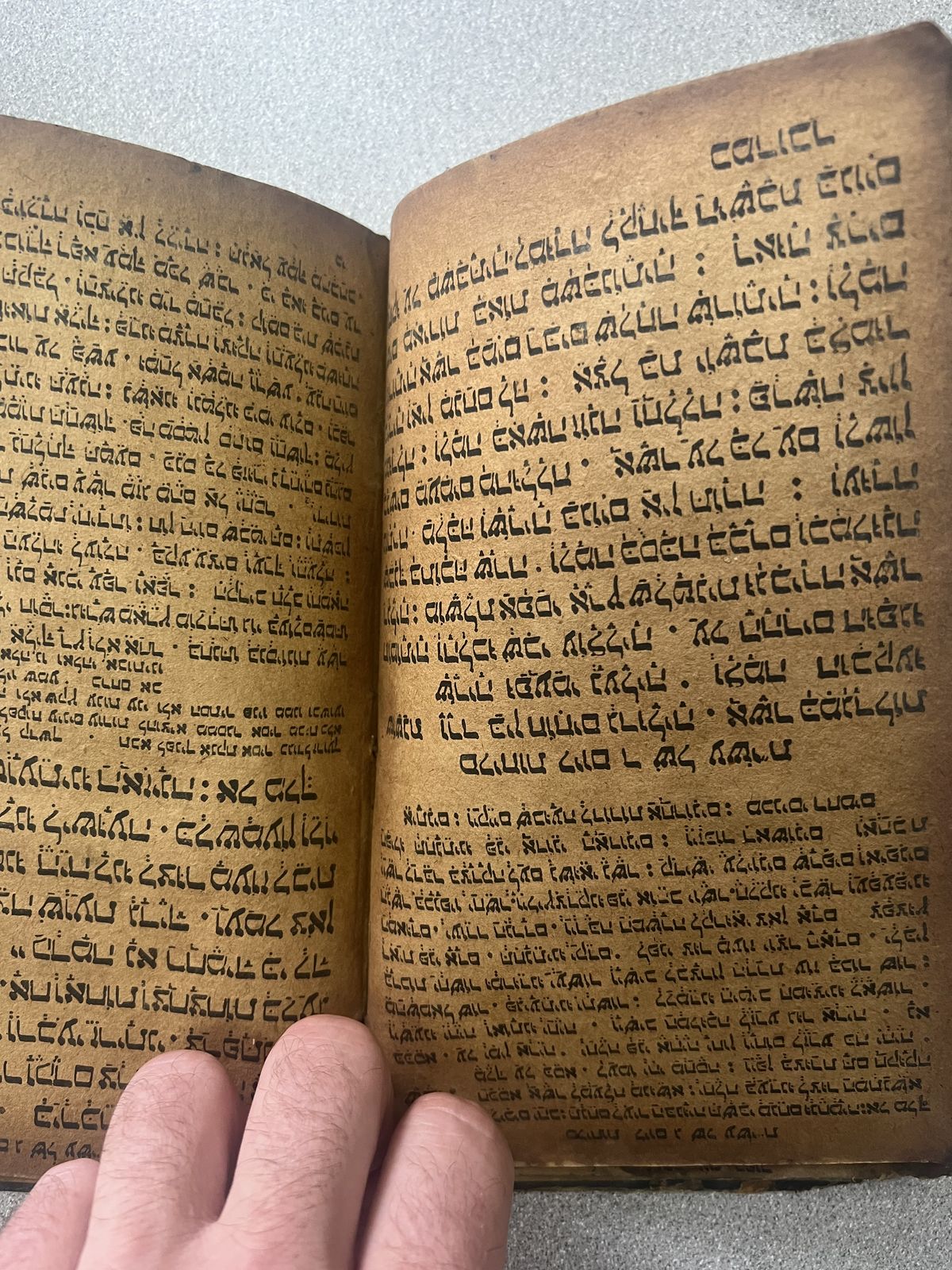
A book nobody at the sale could read, bought for five dollars, with leaves from somebody else's prayer book tucked between its pages. The price was the least interesting thing about it.
Where it came from, which turns out to matter
The sale read like a priest's, or at least like someone who took religion seriously as a subject and not just a practice. Theological books in quantity. Old language-learning books, the kind you buy because you intend to work through them. Several volumes stamped Sacred Heart.
That context does more work than it looks like it should. An unreadable religious book sitting in a random garage is a curiosity, and probably a decorative one. The same book on a shelf beside grammars and church material is a book that plausibly belonged there, owned by somebody who could likely read it, or was trying to learn.
Five dollars.
What is physically there
Before any guess about what it says, here is only what the object shows.
- It is hand-written, right to left, in rounded connected letterforms rather than square blocks.
- Lines are broken by colon-form and single-dot punctuation rather than by spacing alone.
- Some openings carry two text sizes, a formal block above and a smaller, denser one below. In religious books that pattern usually means a primary text with commentary set under it, though which is which is not established here.
- The paper is browned right through, not just at the margins.
- The binding has failed. Pages are loose, the block is separating, and the covers are barely doing their job.
The wrong answers came first
Nobody could name it on sight, so it got asked about, repeatedly, and the answers came back inconsistent. Different tools gave different scripts. One said the Book of Enoch. One said Syriac. An earlier version of this very entry called the main book Hebrew.
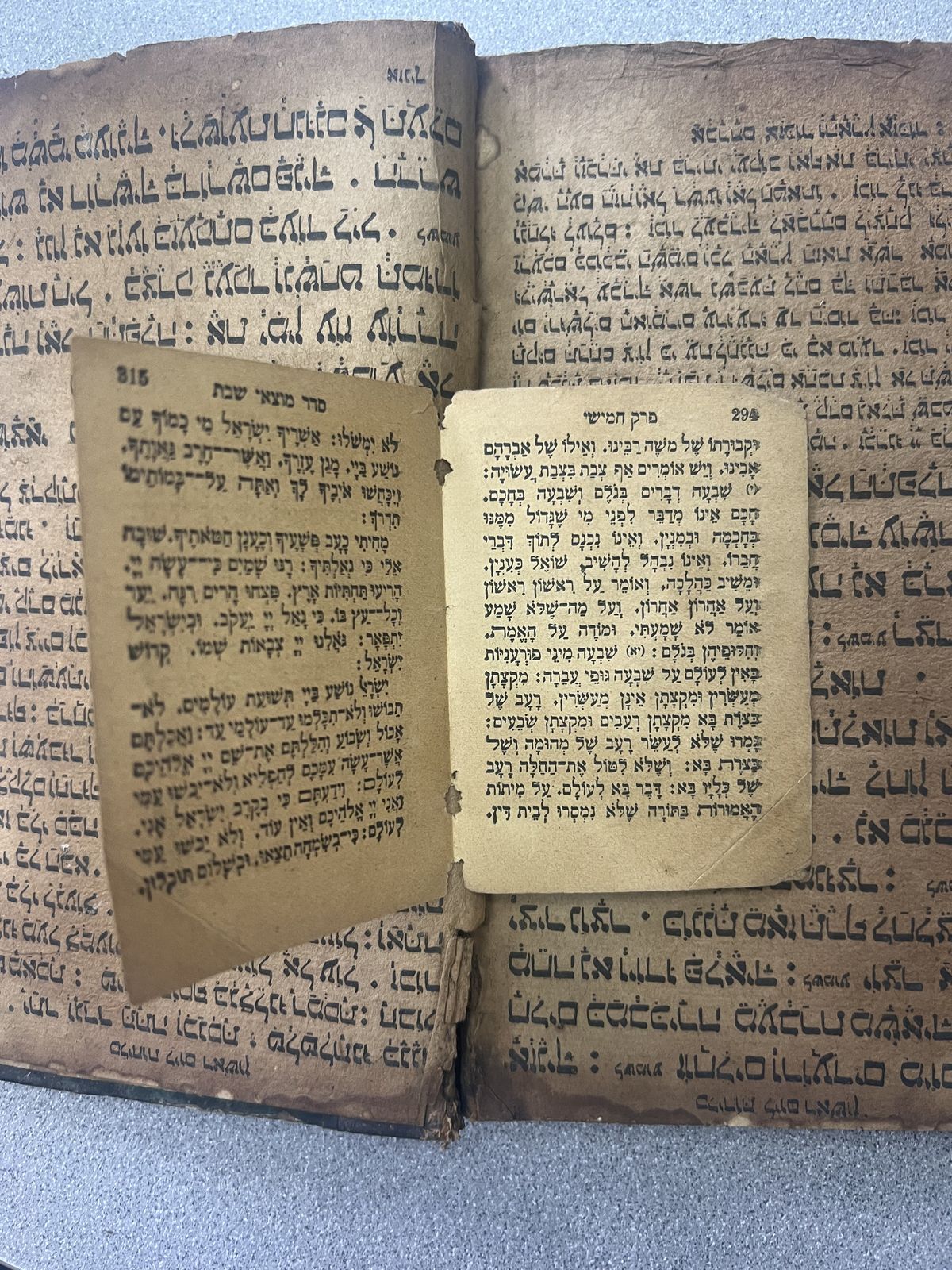
That entry was wrong, and the reason it was wrong is sitting in plain view in the next photograph.
The inserts are a different book entirely
The loose leaves are printed, not written. They are square Hebrew type with full nikkud, the vowel points added to liturgical and study texts where pronunciation has to be right. They carry their own page numbers, in the 290s and the 810s, from a volume nobody has.
Their running heads are legible. One reads סדר מוצאי שבת, Seder Motzei Shabbat, the order of service that closes the Sabbath. Another reads פרק חמישי, chapter five, almost certainly from Pirkei Avot, which is commonly bound into prayer books.
So: leaves from a Hebrew siddur, loose, stored inside a hand-written book in a completely different script.
And then a third layer
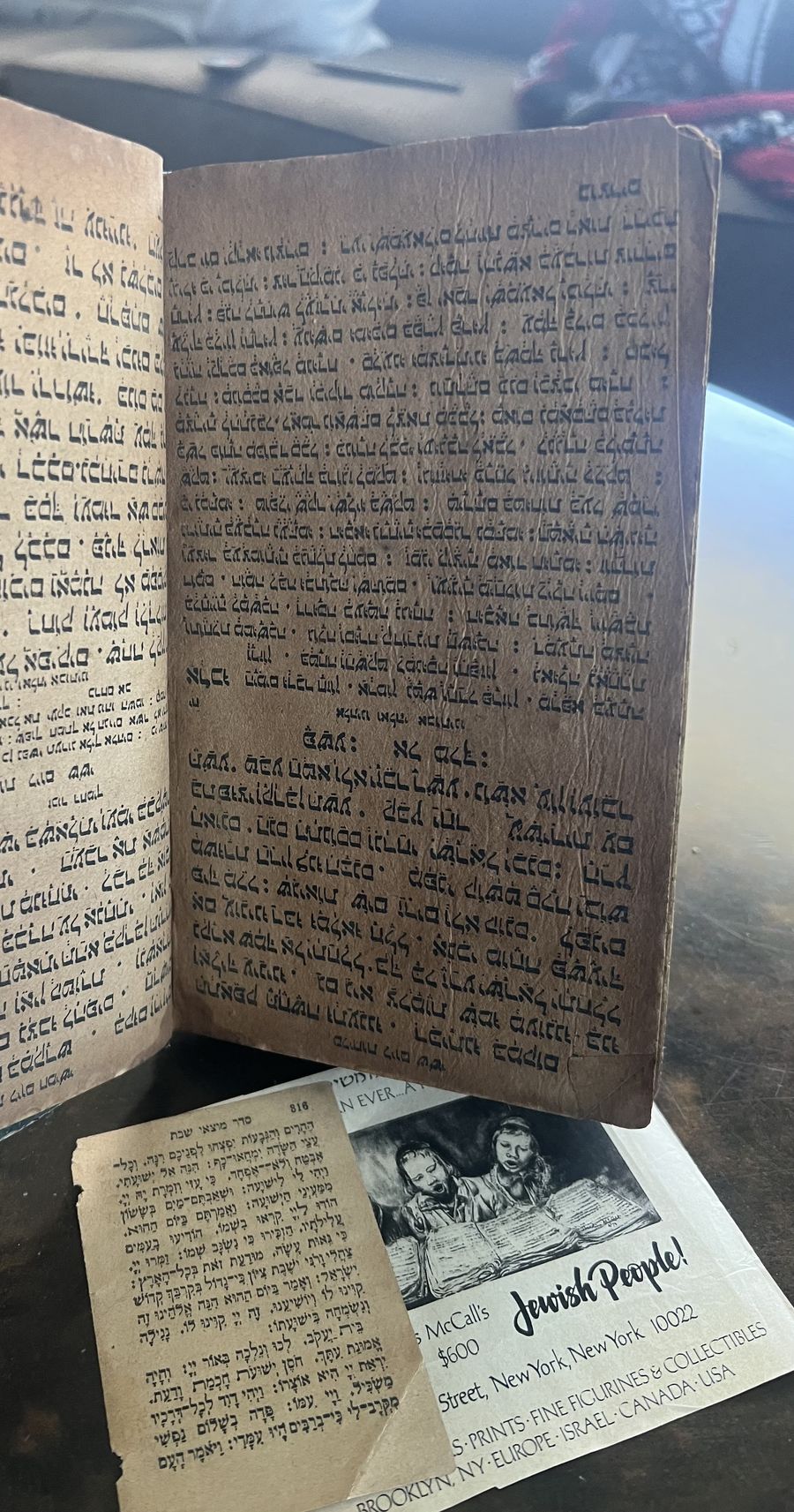
Stored with the rest is a printed advertisement. An engraving of two children reading over an open book, the headline “Jewish People!”, a New York address in the 10022 zip, and a line of trade copy reading PRINTS · FINE FIGURINES & COLLECTIBLES, with BROOKLYN, NY · EUROPE · ISRAEL · CANADA · USA beneath it.
That is a Judaica dealer advertising to collectors. It does not identify the book. It does tell you that whoever kept this material was buying, or thinking about buying, in that category. The loose leaves stop looking like random scrap and start looking like somebody's filing system.
Supported, inferred, unresolved
Keeping these three columns separate is the entire discipline. Most bad pricing comes from an inference quietly getting promoted to a fact.
| Supported | How |
|---|---|
| The book and the loose leaves are in two different scripts | Visible in one photograph. One is written and connected, one is printed and square. |
| The inserts are Hebrew liturgical printing | Running heads read as Seder Motzei Shabbat and chapter five, with nikkud throughout. |
| The advertisement is for a Judaica prints and collectibles dealer | Its own trade copy says so. |
| Bought for $5 from a sale heavy in theological and language books, some stamped Sacred Heart | Buyer was there. |
| Inferred | On what |
|---|---|
| The main book is Syriac-script religious material | The owner's additional context and prior checks, plus a find-site full of church material and language study. Reasonable, not yet proven from the object itself. |
| The two text sizes are a text-and-commentary layout | A common convention in religious books. Not confirmed for this one. |
| Unresolved | What would settle it |
|---|---|
| What work this actually is | A title page or colophon, or a reader who knows the script. |
| Manuscript or lithograph | Magnification. Nineteenth-century lithographic reproduction of handwriting fools people constantly, and a phone photo will not settle it. |
| Age and place of production | Paper, ink and binding examined in person. Browning says bad storage, not a date. |
| Whether the inserts have any relationship to the book | Nothing so far connects them beyond a shelf and an owner. |
Anyone who gives you a firm date and a firm price off these photographs is guessing at you with confidence.
The label problem is the expensive problem
An unfamiliar alphabet reads as “foreign” long before it reads as any particular language. Syriac, Hebrew, Ge’ez, Aramaic and Arabic get bundled together by eye all the time. They are not remotely the same, and the wrong label sends you to the wrong comparables and the wrong buyers.
You cannot search for a thing you cannot name. Name it wrong and everything downstream inherits the error: the price research, the listing title, the specialists you contact, the number you talk yourself into paying. That is why the identification work happens before the pricing work, and never the other way around.
How you would actually work this
- Name the script before anything elsePhotograph a clean, flat, well-lit block of text with nothing lying on top of it. Move the loose material off the page first, which is exactly the step that got skipped here.
- Separate the object from what is stored in itInserts, clippings and bookmarks belong in their own photographs. They are their own small research problem and they contaminate the main one.
- Hunt for a title page or colophonThe front matter or the end of the block is where a work names itself, often with place and year. Its absence is information too.
- Decide manuscript or printLook for plate marks, perfectly repeating letterforms, unnaturally consistent baselines. Handwriting drifts. Printing does not.
- Only then look at compsAnd compare against completed sales for the same kind of book, not asking prices on hopeful listings. The difference between those two numbers is where most of the money gets lost.
What a buyer should take from this
Books in unfamiliar scripts carry one of the widest value ranges you will meet at an estate sale. A common devotional volume in poor condition is worth very little. A dated, located, identified manuscript is a different object with different buyers. They sit in the same box and look identical to somebody in a hurry.
The practical move is not to pretend you can tell them apart on sight. It is to know which questions collapse the range, and to ask them while you are still standing in front of the thing with five dollars in your hand.
At five dollars the buy decision was never really about resale. It was about recognising that the book was asking a question worth the trouble of answering. Sometimes the find is not the price. It is the trail the object opens: a sale full of church books, a script that has to be named before anything else can happen, and somebody's prayer book folded into a stranger's manuscript for reasons nobody has worked out yet.
Still open
This entry gets updated as the object gets worked, and the open column above is real. If you read Syriac and recognise this text, or you know the dealer behind that advertisement, we would genuinely like to hear it. Support reaches us.
Try it on the thing you cannot name
What's It Worth? is free to try on iPhone and Android. Photograph it, get a starting read, and keep adding what the camera could not see until the picture is honest.


More objects in Finds. How-to material in Guides.
Estimates are informational and not a certified appraisal.